




404
+1-313-307-4176

Trenchless Pipe Rehabilitation Market Report

Trenchless Pipe Rehabilitation Market Size, Share, Trend, Forecast, Competitive Landscape & Growth Opportunities: 2026-2032
The annual demand for trenchless pipe rehabilitation was USD 7.5 billion in 2025 and is expected to reach USD 7.8 billion in 2026.
During the forecast period (2026-2034), the market is expected to grow at a CAGR of 3.7%. The annual demand will reach USD 9.7 billion in 2032, which is almost 1.3 times the demand in 2025.
North America generated the greatest demand across regions in the trenchless rehabilitation market.
In terms of application type, wastewater pipes are the most dominant application in the market.
By diameter type, <18-inch pipes are expected to maintain the lead in the market.
In terms of method type, CIPP is expected to remain the dominant method throughout the forecast period.
“According to the Senior Analyst at Stratview Research, the trenchless pipe rehabilitation market will generate a cumulative sales opportunity worth USD 61.2 billion during 2026-2032. During the next six years, Wastewater Pipes, <18-inch Pipes, CIPP, & North America are some of the high-opportunity segments to bank upon.”
Sharpen Your Strategies to Explore this USD 61+ billion Opportunity. Get Free Sample of Our Report: “Here”.
Have a look at the sales opportunities presented by the trenchless pipe rehabilitation market in terms of growth and market forecast.
|
Market Statistics |
Value (in USD Billion) |
Market Growth (%) |
|
Market Size in 2025 |
USD 7.5 billion |
- |
|
Market Size in 2026 |
USD 7.8 billion |
YoY Growth in 2026: 3.7% |
|
Market Size in 2032 |
USD 9.7 billion |
CAGR 2026-2032: 3.7% |
|
Cumulative Sales Opportunity during 2026-2032 |
USD 61.2 billion |
- |
|
Top 10 Countries’ Market Share in 2025 |
USD 6.5 billion + |
85% + |
|
Top 10 Companies’ Market Share in 2025 |
USD 2.3 billion to USD 2.5 billion |
30% to 33% |
Want to Explore the Market Opportunities? Get Free Sample “Here”.
The trenchless pipe rehabilitation market is witnessing a decent growth trajectory as municipalities and industrial operators increasingly prioritize the renewal of aging underground pipeline networks without the extensive excavation associated with traditional pipe replacement methods.
Growing concerns regarding sewer overflows, service disruptions, and infrastructure reliability are encouraging authorities to adopt rehabilitation solutions that can extend pipeline lifespan while minimizing operational interruptions and surface restoration requirements. At the same time, advancements in trenchless technologies, including improved cured-in-place pipe (CIPP) systems, spray-applied rehabilitation solutions, and robotic installation techniques, are enhancing project efficiency, installation quality, and long-term performance.
Growing concerns over aging infrastructure, increasing investments in water and wastewater networks, rapid urbanization, and the need for sustainable asset management practices are driving the adoption of trenchless rehabilitation technologies worldwide. As utilities continue to prioritize cost-effective infrastructure renewal while minimizing environmental and social impacts, the trenchless pipe rehabilitation market is expected to experience steady growth in the years ahead.
Aging Pipeline Infrastructure Across the World
Water distribution networks, wastewater collection systems, stormwater pipelines, and industrial pipelines installed decades ago are approaching or have already exceeded their intended design lives. According to the U.S. Environmental Protection Agency (EPA) estimate, the drinking water systems will require approximately US$ 625 billion in infrastructure investments over the next 20 years, with roughly US$ 422.9 billion dedicated to transmission and distribution pipelines for the United States of America alone. This reflects the enormous backlog of aging pipeline assets requiring renewal or replacement.
Trenchless pipe rehabilitation technologies have emerged as the preferred solution because it offers a cost-effective means of extending asset life while minimizing excavation and public disruption. As governments and their respective authorities worldwide continue to address substantial rehabilitation backlogs, aging infrastructure will remain one of the most influential drivers supporting market growth across North America, Europe, Asia-Pacific, and other regions over the coming decades.
Development of Pipe Infrastructure
Development of pipe infrastructure is a foundational long-term driver of the trenchless pipe rehabilitation market because it continuously expands the global installed base of underground assets that will eventually require renewal. While trenchless rehabilitation is primarily associated with aging infrastructure renewal, the continuous expansion of water, wastewater, and industrial pipeline networks globally will steadily increase the future addressable market for rehabilitation technologies. As governments invest in urban development, smart cities, industrial corridors, water security projects, and wastewater treatment systems, the total installed base of underground pipelines will continue to grow. A larger installed pipeline network inevitably will translate into a larger future rehabilitation market because all underground assets deteriorate over time and eventually require maintenance, rehabilitation, or replacement.
“As per our analyst, the trenchless pipe rehabilitation industry is evolving fast. While conducting the market analysis and speaking with the leading players, it is quite clear that the next decade will be defined by trends like adoption of advanced trenchless technologies & focus on sustainable solutions.”
Align with the Mega Trends Shaping the Industry. Get Free Sample “Here”.
High Upfront Costs and Technical Complexity
One of the most significant barriers to the adoption and expansion of the trenchless pipe rehabilitation industry is the high initial capital investment and technical ability required for project execution, technology deployment, and contractor capability development. Although trenchless rehabilitation often delivers lower lifecycle costs than conventional open-cut replacement, the upfront expenditures associated with specialized equipment, engineering assessments, and skilled labor can be substantial. This challenge is particularly relevant in developing and emerging markets, where budget constraints are often more severe.
Technical Limitations in Complex Conditions
A key challenge for the trenchless pipe rehabilitation market is the technical limitation of rehabilitation technologies when operating under complex pipeline, environmental, and network conditions. Factors such as severe pipe deterioration, irregular geometries, underground congestion, extensive service connections, difficult ground conditions, and unknown asset conditions can reduce the feasibility of trenchless solutions or require highly specialized engineering approaches.
Get Insights on High-Growth Segments. Get Free Sample “Here”.
“Wastewater pipes are expected to remain the largest segment, whereas water main pipes are likely to be the fastest-growing application during the forecast period.”
The market is segmented into water main pipes, wastewater pipes, and other applications, all of which are projected to experience steady growth. Among these, wastewater pipes are anticipated to dominate due to the extensive need for rehabilitation of aging sewer infrastructure and the widespread adoption of CIPP as a preferred solution. Trenchless methods, such as CIPP, offer a significant advantage over traditional excavation techniques, as they reduce project time, lower costs, and minimize surface disruption. In contrast, conventional trenched repairs are more time-consuming and often damage surrounding structures. Meanwhile, water main pipes are expected to witness the fastest growth, driven by increasing investments in potable water infrastructure and the need for efficient, non-invasive rehabilitation methods.
“CIPP is expected to remain the dominant method, while pipe bursting is projected to be the fastest-growing method in the market during the forecast period.”
Based on method type, the market is categorized into CIPP, pipe bursting, sliplining, SIPP, and other techniques. CIPP is projected to maintain its dominant position due to its superior performance, versatility across a wide range of pipe diameters, and significantly faster installation, often up to five times quicker than full pipe replacement. Its ability to provide a seamless, durable lining with minimal disruption further strengthens its adoption.
On the other hand, pipe bursting is expected to grow at the fastest rate, supported by its effectiveness in replacing severely damaged pipelines and its increasing use in infrastructure upgrade projects.
“<18-inch pipes are expected to maintain their dominance and grow at a higher rate compared to larger diameter categories during the forecast period.”
The market is segmented into <18-inch pipes, 18–36-inch pipes, and >36-inch pipes. Among these, pipes with diameters less than 18 inches are expected to remain the leading segment, as trenchless rehabilitation techniques are particularly well-suited for smaller pipe sizes. Technologies such as CIPP, spray-applied liners, and pipe bursting are widely used and highly effective in this category. Additionally, small-diameter pipes are extensively utilized in municipal water distribution and residential sewer systems, representing a significant portion of the existing infrastructure, which continues to drive strong demand for their rehabilitation.
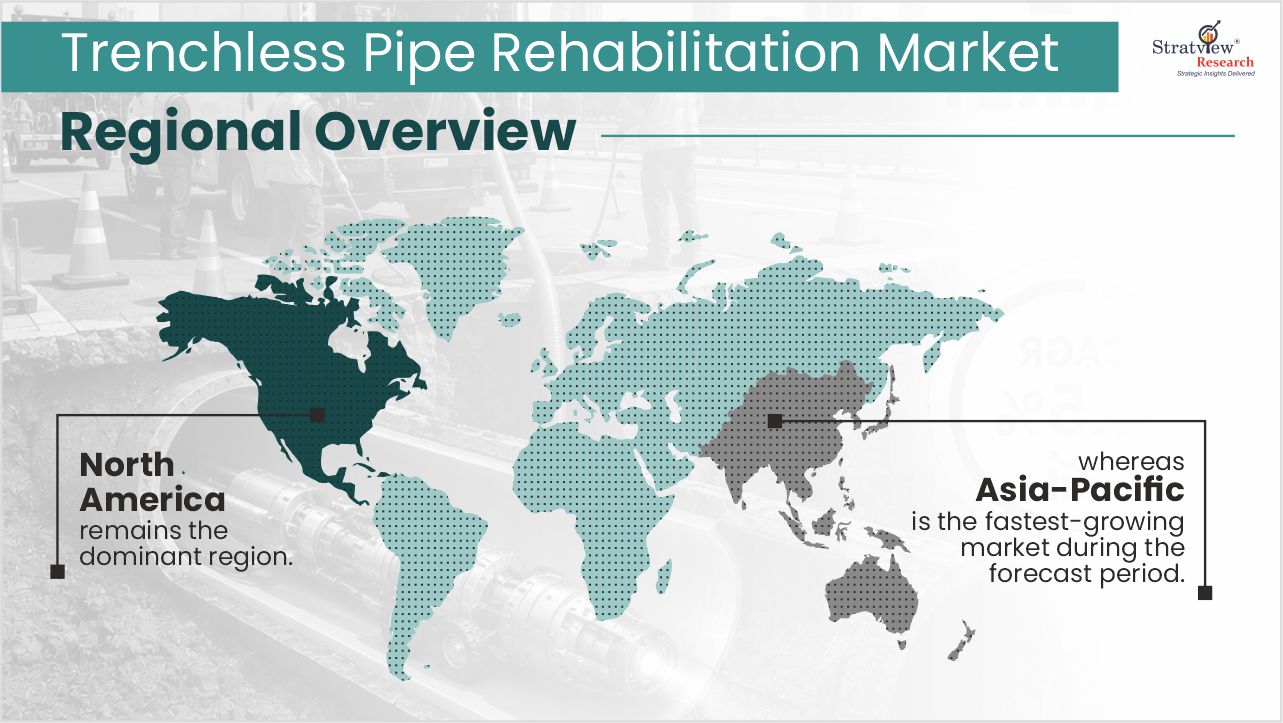
“North America holds the largest market share, while Asia-Pacific is expected to register the fastest growth during the forecast period.”
Regionally, North America dominates the trenchless pipe rehabilitation market due to its well-established infrastructure and significant need for upgrading aging pipeline networks.
Meanwhile, Asia-Pacific is projected to witness the fastest growth, driven by countries such as Japan, China, and Australia. The rapid expansion is supported by increasing infrastructure investments aimed at reducing water loss, improving water quality, and modernizing outdated systems. Additionally, the growing adoption of trenchless technologies across the region, combined with rising urbanization and infrastructure development, is further accelerating market growth.
“Analysis suggests that the Top 10 countries generate 88.6% of the annual sales for trenchless pipe rehabilitation. A few countries are the demand powerhouses and will drive the regional markets in big ways, offering attractive business opportunities.”
Speak to Us for Deep Diving into a Country/Region Specific Opportunity. Contact Us “Here”.
The highly populated market has several local, regional, and global players. A massive change in market dynamics across regions, changes in competitive landscapes from one trenchless pipe rehabilitation technology to another, and dominance of different players in different regions are some factors resulting in high market fragmentation. However, the market has gradually consolidated over the years, with major players acquiring smaller/local players.
The following are the key players in the trenchless pipe rehabilitation market.
Azuria Water Solutions (formerly Aegion Corporation)
PURIS Corporation
Per Aarsleff A/S
SAK Construction, LLC
Reline UV Group
SAERTEX Multicom® GmbH
IMPREG Group
Ashimori Industry Co, Ltd.
Michels Corporation
Spinello Companies
Note: The above list is not an exhaustive list of the key players in the market. If your company is active in this market and would like to be considered for inclusion in future editions of this study, please contact us at [email protected].
Have the Competitive Edge with Our Intelligence. Get Free Sample “Here”.
In February 2026, Per Aarsleff acquired a 49.5% stake in LiquiForce, a PURIS company, through a strategic partnership focused on the Canadian lateral rehabilitation market. The partnership aims to introduce advanced LED-light curing technology for trenchless rehabilitation applications, contributing to trenchless pipe rehabilitation market trends focused on faster and lower-disruption pipeline repair solutions.
In April 2026, United Felts acquired BKP Berolina, a manufacturer of UV-cured composite liners for trenchless rehabilitation applications. The acquisition expands United Felts’ advanced UV liner portfolio, supporting trenchless pipe rehabilitation market growth driven by increasing demand for high-performance cured-in-place pipe solutions.
In April 2026, Aegion Corporation acquired Portland Utilities Construction Company (PUCC), a contractor specializing in underground utilities and pipe rehabilitation services in the southeastern U.S. The acquisition strengthens Aegion’s trenchless rehabilitation capabilities, contributing to trenchless pipe rehabilitation market demand amid rising wastewater infrastructure modernization projects.
In April 2026, The Vortex Companies acquired Mainlining America LLC to strengthen its national watermain rehabilitation and replacement operations. The acquisition expands the company’s trenchless infrastructure service footprint, supporting trenchless pipe rehabilitation market growth in North American utility rehabilitation projects.
In May 2026, The Vortex Companies acquired U.K.-based Lining Division Ltd (LDL) to expand its trenchless rehabilitation operations across Europe. The acquisition strengthens the company’s international rehabilitation network, contributing to trenchless pipe rehabilitation market demand driven by increasing sewer infrastructure renewal activities.
In 2026, RSM Lining Supplies Global Ltd. introduced upgraded SpeedyLight+ UV LED curing systems capable of rehabilitating pipes up to 600 mm in diameter at curing speeds of 1.3 meters per minute. The system improves installation efficiency in complex underground networks by navigating 90-degree bends and reducing cable failure risks, supporting trenchless pipe rehabilitation market growth focused on faster and lower-disruption pipeline repair solutions.
In 2026, United Felts expanded its domestic cured-in-place pipe liner portfolio to strengthen local supply chain reliability amid rising global trade and tariff pressures. The expansion supports trenchless pipe rehabilitation market demand by improving material availability for municipal sewer rehabilitation projects while aligning with regional environmental compliance standards.
The trenchless pipe rehabilitation market encompasses a variety of rehabilitation technologies, including cured-in-place pipe (CIPP), sliplining, sprayed-in-place pipe (SIPP), pipe bursting, and other advanced relining solutions. These systems not only extend the service life of aging pipelines but also improve structural integrity, flow efficiency, and long-term reliability. In potable water applications, liner materials and rehabilitation equipment must comply with strict standards such as NSF/ANSI 61 to ensure the safety and quality of drinking water.
As underground pipeline networks across the world continue to age, utilities and municipalities are increasingly turning to trenchless pipe rehabilitation as a practical and cost-effective alternative to traditional pipe replacement methods. Trenchless technologies enable the repair, renewal, or replacement of underground pipelines with little to no excavation, helping infrastructure owners to restore pipeline performance while minimizing disruption to surrounding communities. Compared to conventional open-cut methods, trenchless solutions offer a faster, cleaner, and less intrusive approach to rehabilitating critical water, wastewater, stormwater, and industrial pipeline systems.
This report provides market intelligence most comprehensively. The report structure has been kept so that it offers maximum business value. It provides critical insights into market dynamics and will enable strategic decision-making for existing market players as well as those willing to enter the market.
The following are the key features of the report:
Market structure: Overview, industry life cycle analysis, supply chain analysis.
Market environment analysis: Growth drivers and constraints, Porter’s five forces analysis, SWOT analysis.
Market trend and forecast analysis.
Market segment trend and forecast.
Competitive landscape and dynamics: Market share, Service portfolio, New Product Launches, etc.
Attractive market segments and associated growth opportunities.
Emerging trends.
Strategic growth opportunities for the existing and new players.
Key success factors.
|
Market Study Period |
2020-2032 |
|
Base Year |
2025 |
|
Forecast Period |
2026-2032 |
|
Trend Period |
2020-2025 |
|
Number of Tables & Figures |
>100 |
|
Number of Segments Analyzed |
4 (Application Type, Method Type, Pipe Diameter Type, and Region) |
|
Number of Regions Analyzed |
4 (North America, Europe, Asia-Pacific, Rest of the World) |
|
Countries Analyzed |
11 (The USA, Canada, Mexico, Germany, France, The UK, Spain, China, Japan, Australia, Singapore) |
|
Free Customization Offered |
10% |
|
After Sales Support |
Unlimited |
|
Report Presentation |
Complimentary |
|
Market Dataset |
Complimentary |
|
Further Deep Dive & Consulting Services |
10% Discount |
Want a Report Tailor-Made to Your Objectives? Speak with Our Analyst
The report provides detailed insights into the market dynamics to enable informed business decision-making and growth strategy formulation based on the opportunities present in the market.
The trenchless pipe rehabilitation market is segmented into the following categories:
Trenchless Pipe Rehabilitation Market, By Application Type
Water Main Pipes
Wastewater Pipes
Others
Trenchless Pipe Rehabilitation Market, By Method Type
CIPP
Pipe Bursting
Sliplining
SIPP
Others
Trenchless Pipe Rehabilitation Market, By Pipe Diameter Type
<18-inch Pipes
18-36-inch Pipes
>36-inch Pipes
Trenchless Pipe Rehabilitation Market, By Region
North America (Country Analysis: The USA, Canada, and Mexico)
Europe (Country Analysis: Germany, France, The UK, Spain, and the Rest of Europe)
Asia-Pacific (Country Analysis: China, Japan, Australia, Singapore, and Rest of Asia-Pacific)
Rest of the World (Sub-Region Analysis: Latin America, Middle East, and Others)
Looking for a Deep Dive? Speak with Our Analyst
This strategic assessment report, from Stratview Research, provides a comprehensive analysis that reflects today’s trenchless pipe rehabilitation market realities and future market possibilities for the forecast period.
The report segments and analyzes the market in the most detailed manner to provide a panoramic view of the market.
The vital data/information provided in the report can play a crucial role for the market participants as well as investors in the identification of the low-hanging fruits available in the market as well as to formulate the growth strategies to expedite their growth process.
This report offers high-quality insights and is the outcome of a detailed research methodology comprising extensive secondary research, rigorous primary interviews with industry stakeholders, and validation and triangulation with Stratview Research’s internal database and statistical tools.
More than 1,000 authenticated secondary sources, such as company annual reports, fact books, press releases, journals, investor presentations, white papers, patents, and articles, have been leveraged to gather the data.
We conducted more than 15 detailed primary interviews with the market players across the value chain in all four regions and industry experts to obtain both qualitative and quantitative insights.
With this detailed report, Stratview Research offers one of the following free customization options to our respectable clients:
Company Profiling
Competitive Benchmarking
Custom Research: Stratview Research offers custom research services across sectors. In case of any custom research requirement related to market assessment, competitive benchmarking, sourcing and procurement, target screening, and others, please send your inquiry to [email protected]
The report is delivered digitally through our online portal. Buyers receive login credentials from our team to access the report and may update their credentials at any time after the initial login.
Delivery timelines depend on the status of the report:
For the most accurate delivery timeline, please contact us to confirm the current status of the report.
Yes. You may request a complimentary preview of the report through a video conference with our team.
Yes. The scope of the report can be fully customized to align with your specific research objectives and information requirements.
Please contact us at [email protected], and our team will be happy to discuss your requirements and propose a tailored solution.
Yes. Selected sections of the report can be purchased separately based on your requirements. Please contact us at [email protected] to discuss your needs.
Yes, AI can help gather publicly available information, but its outputs are only as reliable as the data it accesses. Stratview Research reports are built using validated data, extensive primary interviews with industry stakeholders, and the expertise of our experienced research team.
Additionally, many critical insights, including market dynamics, competitive intelligence, and industry-specific trends, are not publicly available and therefore cannot be captured through AI alone.
Trenchless pipe rehabilitation market size was USD 7.5 billion in 2025. The market is expected to grow from USD 7.8 billion in 2026 to USD 9.7 billion in 2032, witnessing a decent market growth (CAGR) of 3.7% during the forecast period (2026-2032).
Wastewater pipes are expected to remain the most dominant application in the market throughout the forecast period, driven by the growing need to rehabilitate aging sewer infrastructure, increasing investments in wastewater collection and treatment networks, and stringent environmental regulations aimed at reducing leakage, infiltration, and contamination risks.
The top players in the trenchless pipe rehabilitation market include Azuria Water Solutions (formerly Aegion Corporation), PURIS Corporation, Per Aarsleff A/S, SAK Construction, LLC, Reline UV Group, SEARTEX Multicom® GmbH, IMPREG Group, Ashimori Industry Co, Ltd., Michels Corporation, and Spinello Companies


WE ACCEPT