



404
+1-313-307-4176

Road Marking Material Market Analysis | 2026-2031

Road Marking Material Market Size, Share, Trend, Forecast, Competitive Landscape & Growth Opportunities: 2026-2031
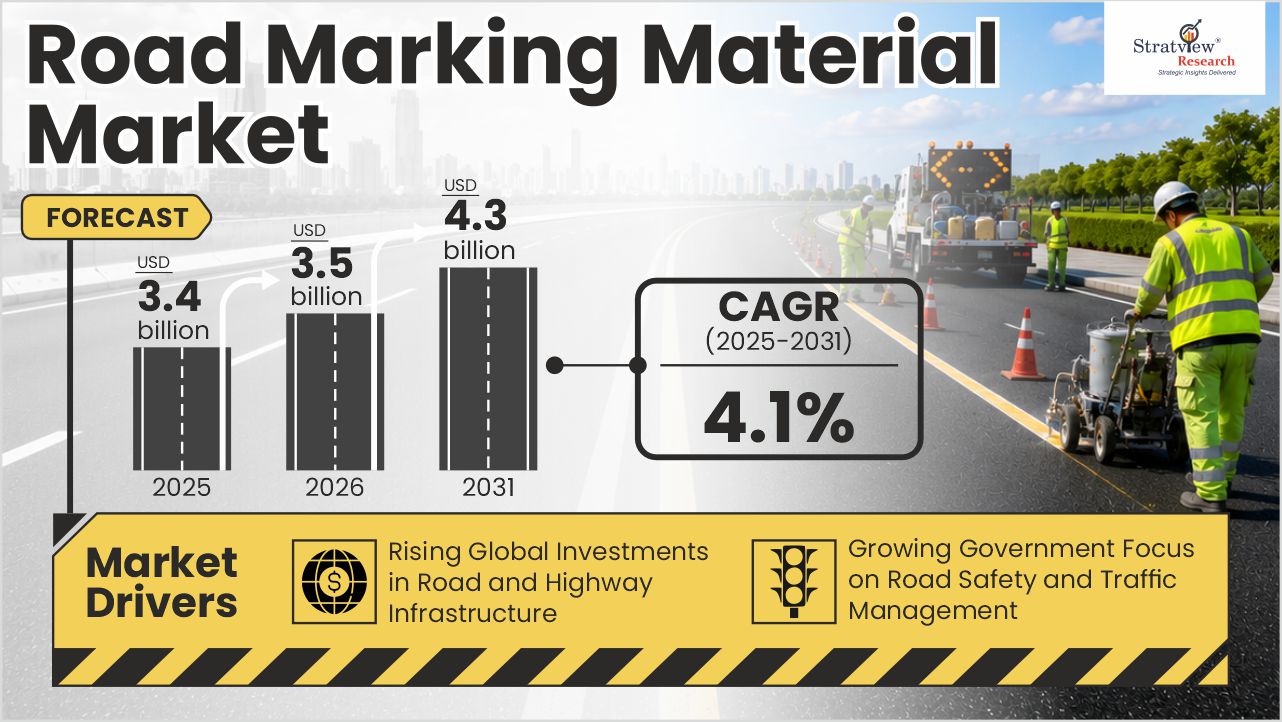
" Road Marking Material market size was USD 3.4 billion in 2025.”
The market size in 2024 was USD 3.2 billion. In 2025, the market experienced a YoY growth of 4.5% to reach a value of USD 3.5 billion.
The market is expected to reach USD 3.5 billion in 2026, witnessing an annual growth of 3.7%.
The market size will reach USD 4.3 billion in 2031, witnessing a market growth (CAGR) of 4.1% during the forecast period of 2026-2031.
The annual demand for road marking materials market was USD 3.4 billion in 2025 and is expected to reach USD 3.5 billion in 2026, up 3.7% than the value in 2025.
During the forecast period (2026-2031), the Road Marking Materials market size is expected to grow at a CAGR of 4.1%. The annual demand will reach USD 4.3 billion in 2031, which is almost 1.2 times the demand in 2026.
As per the market analysis, during 2026-2031, the Road Marking Materials industry is expected to generate a cumulative sales opportunity of USD 23.8 billion
Want to get a free sample? Register Here
A comprehensive Road Marking Materials market analysis indicates that segment-level performance varies significantly based on evolving market trends.
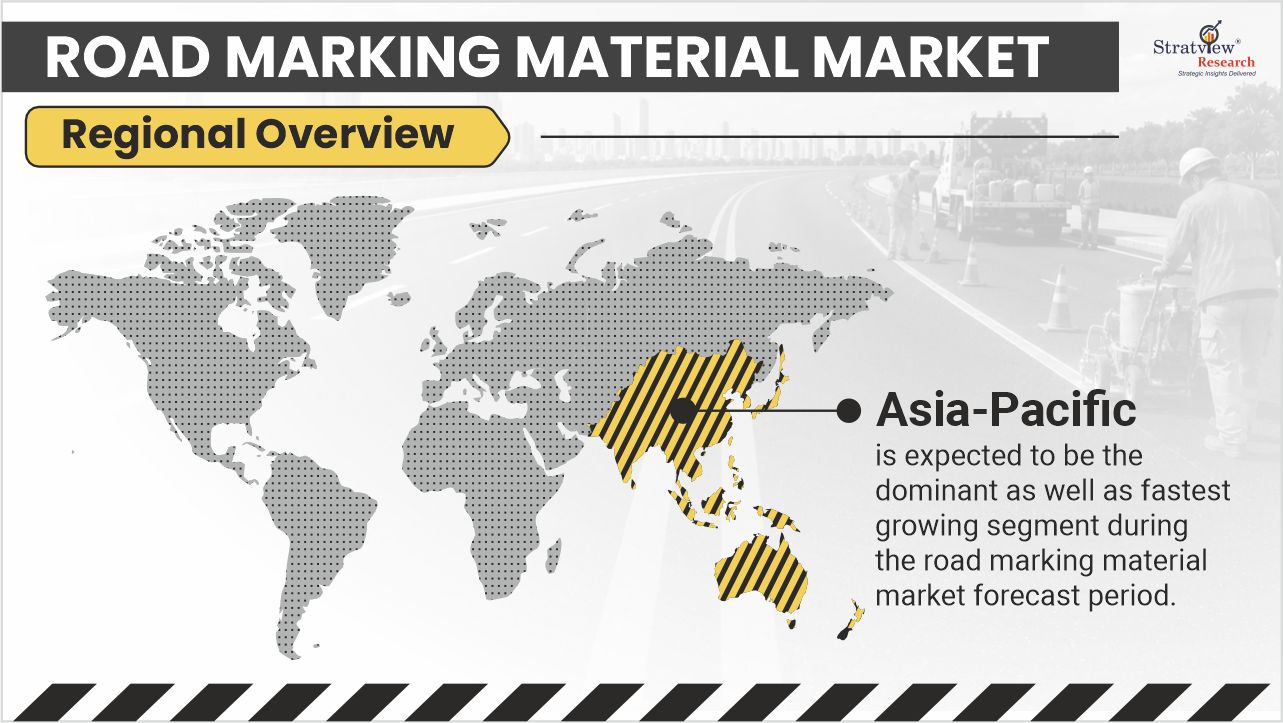
Asia-Pacific generated the highest demand with the largest market share of XX% in 2024, with China & India as the key growth drivers in the region.
By product type, thermoplastics segment is expected to be the dominant and fastest growing segment during the forecast period.
By application type, roads & highways are expected to be the dominant while airport markings are expected to be the fastest growing during the forecast period.
Have a look at the sales opportunities presented by the Road Marking Materials market in terms of growth and market forecast.
|
Road Marking Materials Market Data & Statistics |
|
||
|
Market Statistics |
Value (in USD Billion) |
Market Growth (%) |
|
|
Annual Market Size in 2024 |
USD 3.2 billion |
- |
|
|
Annual Market Size in 2025 |
USD 3.4 billion |
YoY Growth in 2025: 4.5% |
|
|
Annual Market Size in 2026 |
USD 3.5 billion |
YoY Growth in 2026: 3.7% |
|
|
Annual Market Size in 2031 |
USD 4.3 billion |
CAGR 2026-2031: 4.1% |
|
|
Cumulative Sales Opportunity during 2026-2031 |
USD 23.8 billion |
|
|
|
Top 10 Countries’ Market Share in 2025 |
USD 2.6 billion + |
> 80% |
|
|
Top 10 Company’s Market Share in 2025 |
USD 1.7 billion to USD 2.4 billion |
50% - 70% |
|
What is Road Marking Materials?
Road marking materials are specialized coatings and compounds used to create visible and durable traffic markings on roads, highways, airports, and industrial surfaces. They include paint-based systems, thermoplastics, cold plastics (MMA), and preformed tapes, selected based on traffic load and durability requirements. These materials provide essential functions such as visibility, skid resistance, and weather durability, and are increasingly used in color-coded and functional applications like pedestrian crossings, bus lanes, and EV charging zones.
Rising Global Investments in Road and Highway Infrastructure
Increasing investment in road and highway infrastructure is driving demand for road marking materials, as large-scale construction, expansion, and maintenance activities require continuous application and renewal of high-visibility traffic markings.
Growing Government Focus on Road Safety and Traffic Management
Stringent government regulations and standardized guidelines for traffic management, lane delineation, and safety markings are driving demand for road marking materials. Authorities across the world are mandating higher levels of visibility, retro-reflectivity, and skid resistance, requiring consistent application of high-performance marking materials across highways, urban roads, and critical zones.
Rising Volatility in Raw Material Prices
Volatility in raw material prices is creating significant cost pressure in the road marking materials market, as key inputs such as resins, pigments, and petroleum-derived chemicals experience frequent price fluctuations, impacting production economics and pricing stability across manufacturers.
Expanding Global Environmental Norms on Hazardous Emissions
Conventional formulations, including solvent-based paints, thermoplastics, and MMA (cold plastics), rely on petrochemical resins and can generate VOC emissions and particulate release during application and wear, necessitating reformulation and increasing production costs.
Growing Development of Smart Road Infrastructure and Intelligent Transport Systems
The development of smart road infrastructure and connected mobility systems is creating new demand for advanced road marking materials, as ADAS and autonomous vehicle technologies rely on highly visible, durable, and machine-readable markings for accurate lane detection and navigation.
Rapid Urbanization in Emerging Economies
Rapid urbanization across emerging economies is leading to significant expansion of urban road networks, metro corridors, and peri-urban infrastructure, all of which require new road marking installations and ongoing maintenance. As cities grow, traffic density increases, making lane discipline, pedestrian safety markings, and traffic management systems more critical, thereby boosting demand for road marking materials.
|
Segmentations |
List of Sub-Segments |
Segments with High-Growth Opportunity |
|
Product-Type Analysis |
Paints, Thermoplastics, 2-Components, and Tapes |
Thermoplastics dominated the product type segment in the year 2025 and are expected to remain the dominant product type during the forecast period. |
|
Application-Type Analysis |
Roads & Highways, Airport Marking, Parking Lot, and Others. |
Roads & Highways are expected to remain the biggest demand generators for the road marking materials during the forecast period. Airport marking is anticipated to remain the fastest-growing application type during the same period. |
|
Regional Analysis |
North America, Europe, Asia-Pacific, and |
Asia-Pacific is likely to remain the dominant and fastest-growing region during the forecast period. |
“Thermoplastic is expected to remain dominant as well as the fastest-growing product type in the market during the forecast period.”
The market is segmented into paints, thermoplastics, 2-components, and tapes. Globally, thermoplastics are the most popular road marking material in the market, closely followed by paints.
Thermoplastics are a more durable, cost-effective, and environmentally friendly alternative to VOC-emitting paints.
Furthermore, they have high reflectivity and are less expensive than tapes and two-component marking materials. Owing to these benefits, Thermoplastics are gradually replacing these paints and are among the fastest-growing segments during the forecast period. Thermoplastics are applied using numerous methods, including screeding, spraying, and extrusion.
“Roads & Highways is expected to remain the dominant, and airport marking is projected to be the fastest-growing application in the market during the forecast period.”
The market is segmented into roads & highways, airport marking, parking lots, and others. The roads & highways application is expected to remain the biggest demand generator for the road marking materials during the forecast period.
Road marking materials are used on streets and highways to display various types of markings, such as longitudinal markings, transverse marking, hazard marking, block marking, an arrow marking, and directional marking.
The expansion of the road network, combined with a growing concern for road safety to reduce fatal accidents, would accelerate the segment’s growth in the coming years.
Different materials are used for different types of applications. For instance, water-borne paint is preferred. For airport marking, two-component materials are preferred for anti-skid markings, etc
“Asia-Pacific is anticipated to sustain its dominance and is poised to experience the most rapid growth throughout the forecast period.”
Want to get a free sample? Register Here
Most of the major players compete in some of the factors, including price, service offerings, regional presence, etc. The following are the key players holding majority of the road marking materials market share -
The market is highly populated with the presence of several local, regional, and global players. Major players in the market are strengthening their presence in key markets around the world by building new partnerships, opening new manufacturing and distribution sites, and acquiring several local players in the market. Most of the major players are offering a variety of roads.
marking materials for different applications.
Here is the list of the Top Players (Based on Dominance)
Note: The above list does not necessarily include all the top players in the market.
Are you the leading player in this market? We would love to include your name. Please write to us at [email protected]
In October 2025, the Sherwin-Williams Company acquired Suvinil, BASF’s Brazilian architectural paint business, expanding its footprint in the industry.
In August 2025, SWARCO AG acquired Heusch/Boesefeldt GmbH, a leading provider of software solutions for highway and traffic management systems.
In February 2025, Geveko Markings acquired Farby Maestria Polska Sp. z o.o., a leading Polish manufacturer of road marking materials, to strengthen their presence in Eastern Europe.
In October 2023, Geveko Markings acquired PPG’s Traffic Solutions business in Australia and New Zealand, expanding its footprint in the Oceania road marking market.
Recent Product Development:
Leading manufacturers are focusing on sustainable, durable, and high-performance marking solutions to meet evolving infrastructure and regulatory requirements. Key recent product developments include:
In July, 2025, WJ Group Launches RapidLine, a cutting-edge cold-applied, UV-cured road marking material that delivers instant curing, high levels of visibility, and long-term durability.
In 2024–2025, Geveko Markings introduced several low-VOC and environmentally friendly road marking formulations, aligned with tightening environmental regulations and sustainability goals
This report provides market intelligence most comprehensively. The report structure has been kept so that it offers maximum business value. It provides critical insights into market dynamics and will enable strategic decision-making for existing market players as well as those willing to enter the market.
The following are the key features of the report:
|
Market Study Period |
2019-2031 |
|
Base Year |
2025 |
|
Forecast Period |
2026-2031 |
|
Trend Period |
2019-2024 |
|
Number of Tables & Figures |
>100 |
|
Number of Segments Analysed |
5 (Product Type, Application-Type Type, and Region) |
|
Number of Regions Analysed |
4 (North America, Europe, Asia-Pacific, Rest of the World) |
|
Countries Analysed |
15 (The USA, Canada, Mexico, Germany, France, Italy, The UK, China, Japan, India, Brazil, Saudi Arabia, Rest of Europe, Rest of APAC, and Rest of the World) |
|
Free Customization Offered |
10% |
|
After Sales Support |
Unlimited |
|
Report Presentation |
Complimentary |
|
Market Dataset |
Complimentary |
|
Further Deep Dive & Consulting Services |
10% Discount |
Market Segmentation
The report provides detailed insights into the market dynamics to enable informed business decision-making and growth strategy formulation based on the opportunities present in the market.
By Product Type
By Application Type
By Region Type
With this detailed report, Stratview Research offers one of the following free customization options to our respected clients:
Company Profiling
Competitive Benchmarking
Custom Research: Stratview Research offers custom research services across industries. In case of any custom research requirement related to market assessment, competitive benchmarking, sourcing and procurement, target screening, and others, please send your inquiry to [email protected]
The report is delivered digitally through our online portal. Buyers receive login credentials from our team to access the report and may update their credentials at any time after the initial login.
Delivery timelines depend on the status of the report:
For the most accurate delivery timeline, please contact us to confirm the current status of the report.
Yes. You may request a complimentary preview of the report through a video conference with our team.
Yes. The scope of the report can be fully customized to align with your specific research objectives and information requirements.
Please contact us at [email protected], and our team will be happy to discuss your requirements and propose a tailored solution.
Yes. Selected sections of the report can be purchased separately based on your requirements. Please contact us at [email protected] to discuss your needs.
Yes, AI can help gather publicly available information, but its outputs are only as reliable as the data it accesses. Stratview Research reports are built using validated data, extensive primary interviews with industry stakeholders, and the expertise of our experienced research team.
Additionally, many critical insights, including market dynamics, competitive intelligence, and industry-specific trends, are not publicly available and therefore cannot be captured through AI alone.
The road marking materials market is estimated to grow at a CAGR of 4.1% by 2031, driven by an increase in the width of longitudinal traffic lines and length of skip lines, the development of advanced driver assistance technologies, development of safe paths for non-vehicular road users, rising concern toward road safety to decrease tragic road accidents, increasing road maintenance spending, etc.
The forecasted value for the road marking materials market is US$ 4.4 billion in 2031.
Thermoplastics are expected to remain the dominant product type in the market for the coming years, owing to the substitution of paints by thermoplastics; the latter is an economical and environmentally friendly alternative to VOC-emitting paints.
Asia-Pacific is estimated to remain the fastest-growing market for road marking materials during the forecast period. Increasing road networks, improving road connectivity, growing focus of regional governments on maintenance and repair of roads, and implementation of new types of road markings to enhance road safety would drive the growth of the market in the region over the forecast period.
PPG Industries, Inc. (Ennis Flint, Inc.), Geveko Markings, SWARCO AG, KANSAI HELIOS Group, 3M Company, Aximum S.A. (Colas Group), The Sherwin-Williams Company, and Nippon Paint Holdings Co., Ltd. are the leading players in the road marking materials market.


WE ACCEPT