




404
+1-313-307-4176

IO-Link Market Analysis | 2025-2032

IO-Link Market Size, Share, Trends, Dynamics, Forecast, & Growth Analysis: 2025-2032
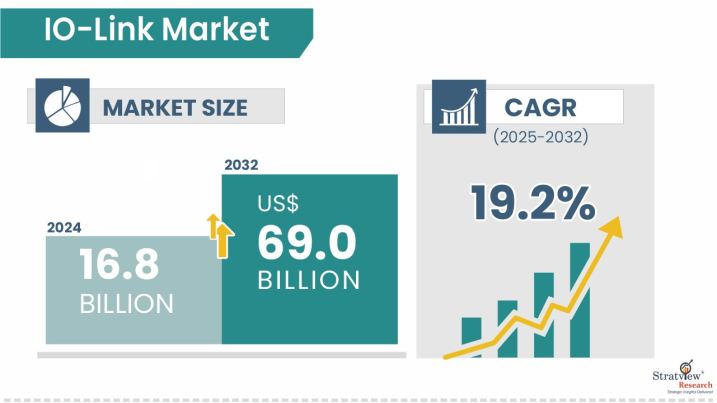
"IO-link market size was USD 16.8 billion in 2024.”
Want to know more about the market scope? Register Here
Have a look at the sales opportunities presented by the IO-link market in terms of growth and market forecast.
|
IO-Link Market Data & Statistics |
||
|
Market Statistics |
Value (in USD Billion) |
Market Growth (%) |
|
Annual Market Size in 2023 |
USD 14.1 billion |
- |
|
Annual Market Size in 2024 |
USD 16.8 billion |
YoY Growth in 2024: 19.7% |
|
Annual Market Size in 2025 |
USD 20.19 billion |
YoY Growth in 2025: 19.6% |
|
Annual Market Size in 2032 |
USD 69.02 billion |
CAGR 2025-2032: 19.2% |
|
Cumulative Sales Opportunity during 2025-2032 |
USD 324.28 billion |
- |
|
Top 10 Countries’ Market Share in 2024 |
USD 16 billion + |
> 80% |
|
Top 10 Company’s Market Share in 2024 |
USD 10 billion to USD 14 billion |
50% - 70% |
What is IO-link?
IO-Link is a standardized communication protocol for connecting actuators and sensors with automation systems. It facilitates bidirectional data transfer, device diagnosis, and remote configuration through simple 3-wire cabling. IO-Link increases efficiency, minimizes downtime, and enables smart manufacturing in Industry 4.0 systems.
Rapid Adoption of Industry 4.0 and Smart Manufacturing
The IO-Link ecosystem has expanded significantly, now encompassing over 500 member companies and more than 30,000 products worldwide, driven by the rising demand for intelligent automation and Industry 4.0 solutions. This growth solidifies IO-Link (IEC 61131-9) as a foundational, globally standardized interface for sensors and actuators, strengthening its role in enabling seamless and efficient device communication across industrial environments.
The IO-Link ecosystem has expanded significantly, with over 500 member companies and 30,000+ products worldwide, driven by rising demand for intelligent automation and Industry 4.0 solutions. This growth solidifies IO-Link (IEC 61131-9) as a foundational, globally standardized interface for sensor and actuator communication.
Governments across major manufacturing economies are actively promoting industrial digitalization and smart manufacturing. Germany’s Industry 4.0 initiatives support connected factory investments. China’s Made in China 2025 drives automation and intelligent manufacturing. India’s Digital India and Make in India programs are accelerating industrial automation and communication adoption.
Overall, such factors are collectively accelerating the adoption of IO-Link across smart manufacturing environments, reinforcing its role in next-generation industrial automation.
Rising Demand for Predictive Maintenance and Industrial IoT (IIoT)
IO-Link enables continuous monitoring and real-time diagnostics, supporting predictive maintenance strategies that help manufacturers reduce downtime and maintenance costs.
Industries such as automotive, food & beverage, packaging, and oil & gas are rapidly deploying IO-Link-enabled devices to enhance machine visibility, efficiency, and productivity.
Growth in Industrial Automation Across Emerging Economies
Increasing automation investments across Asia-Pacific, particularly in China and India, are driving IO-Link market growth in manufacturing facilities, as expanding smart factory deployments and industrial digitization initiatives continue to support demand for IO-Link-enabled devices and systems.
According to the International Federation of Robotics (IFR),global industrial robot installations have surpassed 540,000 units annually, with Asia accounting for nearly 73% of total deployments, reflecting strong automation momentum supporting IO-Link growth.
Automotive manufacturers are increasingly integrating advanced automation systems to support electric vehicle production and enhance quality monitoring processes.
High Initial Integration and Retrofit Costs
Latency and Performance Limitations in Certain Applications
Interoperability and Skilled Workforce Constraints
Expansion of IO-Link Wireless Technology
The expansion of IO-Link Wireless technology is contributing to the broader IO-Link market forecast, share, and growth outlook, driven by rising demand for flexible, scalable, and cable-free industrial communication solutions in advanced manufacturing environments. As factories increasingly adopt smart, reconfigurable production systems under Industry 4.0 frameworks, wireless connectivity is emerging as a key enabler of efficient data exchange in dynamic and space-constrained industrial setups.
Increasing Smart Factory Investment
Governments and industrial organizations are significantly increasing investments in smart manufacturing infrastructure, with the European Union supporting industrial digitalization through programs such as Horizon Europe and the Digital Europe Programme, while the U.S. is accelerating automation spending to address labor shortages and improve productivity, further driving IO-Link market trend for real-time sensor communication and factory automation.
Smart factory technologies are expected to attract substantial industrial investment over the next decade, reaching hundreds of billions of dollars globally as manufacturers transition toward connected and data-driven production systems.
The growing adoption of digital twin technologies and connected factory ecosystems is further strengthening demand for intelligent sensor communication platforms such as IO-Link, enabling real-time data exchange and improved operational visibility.
Growth in Packaging, Intralogistics, and Robotics Applications
IO-Link adoption is expanding across packaging automation, conveyor systems, warehouse robotics, and material handling applications, supported by the rapid rise in global warehouse automation driven by e-commerce growth and labor shortages.
|
Segmentations |
List of Sub-Segments |
Segments with High-Growth Opportunity |
|
Type Analysis |
IO-Link Wired and IO-Link Wireless |
IO-Link Wireless segment is expected to grow with the highest CAGR during the forecast period. |
|
Component Analysis |
IO-Link Masters and IO-Link Devices |
IO-Link Devices segment is expected to be the fastest-growing segment of the IO-link market during the forecast period. |
|
Application Analysis |
Machine Tools, Handling and Assembly Automation, Packaging Automation Solutions, and Intralogistics Solutions |
Intralogistics Solutions segment by application type is projected to witness steady growth in the coming years. |
|
Industry Analysis |
Discrete Industries (Automotive, Aerospace & Defense, Semiconductor & Electronics, Machine Manufacturing, and Packaging) and Hybrid Industries (Pharmaceuticals, Metals & Mining, Food & Beverages, and Cement & Glass) |
Hybrid Industries segment is projected to be the fastest-growing segment of the IO-link market during the forecast period. |
|
Regional Analysis |
North America, Europe, Asia-Pacific, and The Rest of the World |
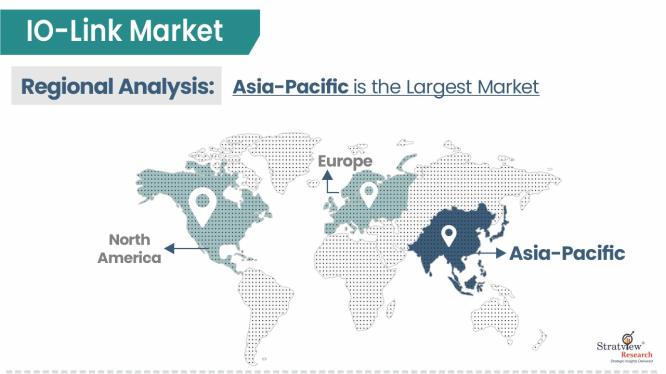
Asia-Pacific is expected to be the dominant and fastest-growing region over the forecasted period. |
“IO-Link Wireless segment is expected to grow with the highest CAGR during the forecast period.”
“Hybrid Industries segment is projected to be the fastest-growing segment of the IO-link market during the forecast period.”
“Asia-Pacific is expected to be the dominant and the fastest-growing region in the IO-link market over the forecasted period.”
Know the high-growth countries in this report. Register Here
Most of the major players compete in some of the factors, including price, service offerings, regional presence, etc. The following are the key players in the IO-link market:
Note: The above list does not necessarily include all the top players in the market.
Are you a leading player in this market? We would love to include your name. Please write to us at [email protected]
This report provides market intelligence most comprehensively. The report structure has been kept so that it offers maximum business value. It provides critical insights into market dynamics and will enable strategic decision-making for existing market players as well as those willing to enter the market.
The following are the key features of the report:
|
Market Study Period |
2019-2032 |
|
Base Year |
2024 |
|
Forecast Period |
2025-2032 |
|
Trend Period |
2019-2023 |
|
Number of Tables & Figures |
>100 |
|
Number of Segments Analysed |
5 (Type, Component Type, Application Type, Industry Type, and Region) |
|
Number of Regions Analysed |
4 (North America, Europe, Asia-Pacific, Rest of the World) |
|
Countries Analysed |
15 (The USA, Canada, Mexico, Germany, France, Italy, The UK, China, Japan, India, Brazil, Saudi Arabia, Rest of Europe, Rest of APAC, and Rest of the World) |
|
Free Customization Offered |
10% |
|
After Sales Support |
Unlimited |
|
Report Presentation |
Complimentary |
|
Market Dataset |
Complimentary |
|
Further Deep Dive & Consulting Services |
10% Discount |
This report studies the market, covering a period of 15 years of trend and forecast. The report provides detailed insights into the market dynamics to enable informed business decision-making and growth strategy formulation based on the opportunities present in the market.
The IO-Link market is segmented into the following categories.
By Type
By Component Type
By Application Type
By Industry Type
By Region
With this detailed report, Stratview Research offers one of the following free customization options to our respected clients:
Company Profiling
Competitive Benchmarking
Custom Research: Stratview Research offers custom research services across industries. In case of any custom research requirement related to market assessment, competitive benchmarking, sourcing and procurement, target screening, and others, please send your inquiry to [email protected].
The report is delivered digitally through our online portal. Buyers receive login credentials from our team to access the report and may update their credentials at any time after the initial login.
Delivery timelines depend on the status of the report:
For the most accurate delivery timeline, please contact us to confirm the current status of the report.
Yes. You may request a complimentary preview of the report through a video conference with our team.
Yes. The scope of the report can be fully customized to align with your specific research objectives and information requirements.
Please contact us at [email protected], and our team will be happy to discuss your requirements and propose a tailored solution.
Yes. Selected sections of the report can be purchased separately based on your requirements. Please contact us at [email protected] to discuss your needs.
Yes, AI can help gather publicly available information, but its outputs are only as reliable as the data it accesses. Stratview Research reports are built using validated data, extensive primary interviews with industry stakeholders, and the expertise of our experienced research team.
Additionally, many critical insights, including market dynamics, competitive intelligence, and industry-specific trends, are not publicly available and therefore cannot be captured through AI alone.
The IO-Link market refers to the industry centered around IO-Link technology, a standardized, point-to-point communication protocol used to connect sensors and actuators to automation systems in industrial settings. It enables real-time data exchange, remote configuration, and advanced diagnostics, supporting Industry 4.0 initiatives by enhancing efficiency, flexibility, and predictive maintenance capabilities across manufacturing and process industries.
The forecasted value for the market is US$69.02 billion in 2032.
IO-link market size was USD 16.8 billion in 2024 and is expected to grow from USD 20.19 billion in 2025 to USD 69.02 billion in 2032, witnessing an impressive market growth (CAGR) of 19.2% during the forecast period (2025-2032).
The key drivers of the IO-link market include rising adoption of Industry 4.0 and growing demand for remote configuration, monitoring, and maintenance.
The top players in the IO-link market include • Bosch Rexroth Corporation • Datalogic S.p.A. • Emerson Electric Co. • OMRON Corporation • Rockwell Automation Inc.
Asia-Pacific is expected to be the dominant and fastest-growing region over the forecasted period, due to rapid industrialization, strong growth in manufacturing sectors, and increasing adoption of Industry 4.0 technologies.


WE ACCEPT