




404
+1-313-307-4176

Data Center Power Distribution Units Market | 2025-2032

Data Center Power Distribution Units Market Size, Share, Trend, Forecast, Competitive Landscape & Growth Opportunities: 2025-2032
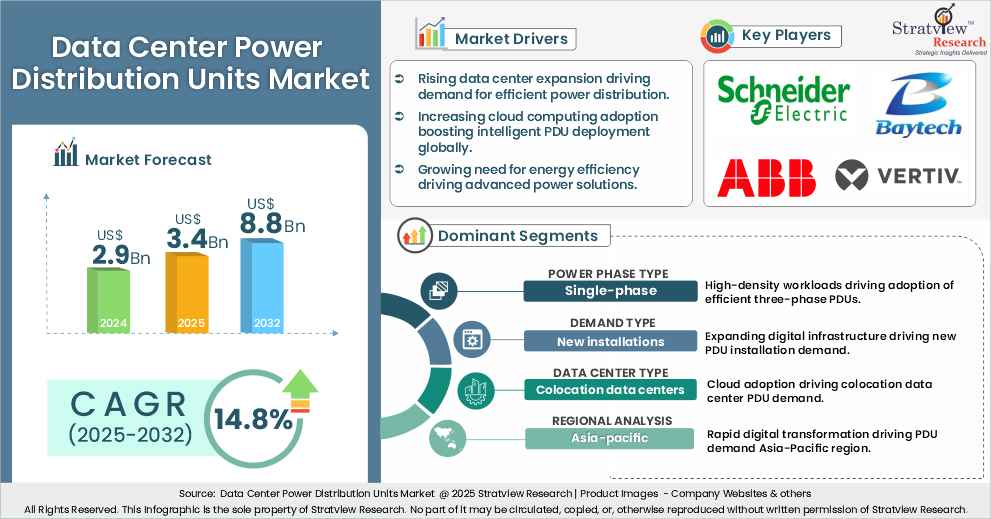
"Data center power distribution units market size was USD 2.9 billion in 2024.”
The market size in 2023 was USD 2.6 billion. In 2024, the market experienced a YoY growth of 11.9% to reach a value of USD 2.9 billion.
The market is expected to reach USD 3.4 billion in 2025, witnessing an annual growth of 14.7%.
The market size will reach USD 8.8 billion in 2032, witnessing a market growth (CAGR) of 14.8% during the forecast period of 2025-2032.
The annual demand for data center power distribution units was USD 2.9 billion in 2024 and is expected to reach USD 3.4 billion in 2025, up 14.7% than the value in 2024.
During the forecast period (2025-2032), the data center power distribution units market is expected to grow at a CAGR of 14.8%. The annual demand will reach USD 8.8 billion in 2032, which is more than 2 times the demand in 2025.
During 2025-2032, the data center power distribution units industry is expected to generate a cumulative sales opportunity of USD 46.1 billion, which is almost 3.5 times the opportunities during 2019-2024.
Want to get a free sample? Register Here
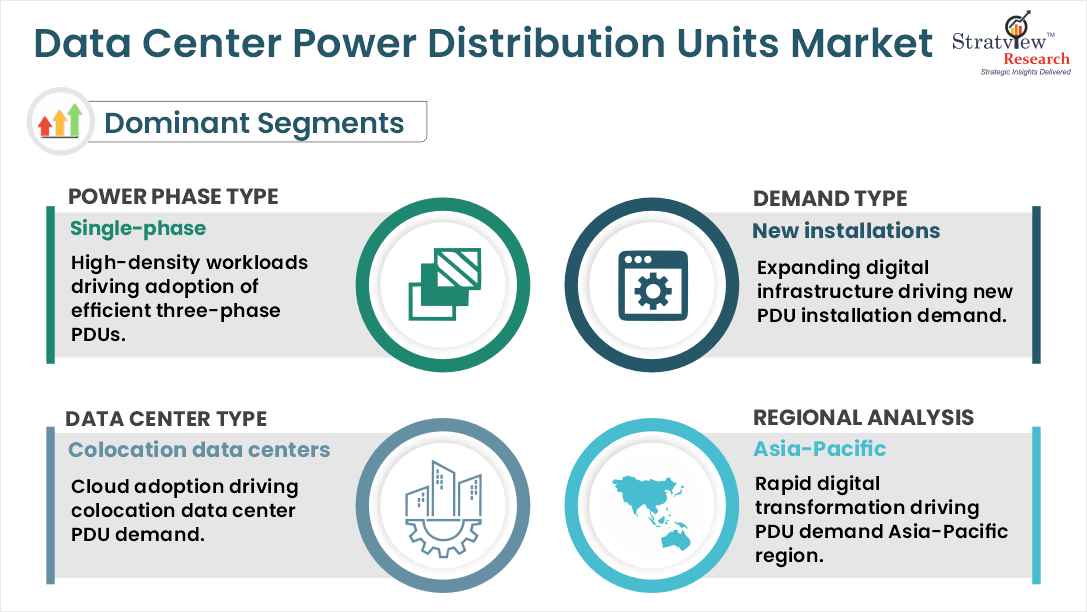
Asia-Pacific is expected to experience the fastest growth over the forecast period.
By PDU type, Basic PDUs currently dominate due to low cost and legacy usage, while switched PDUs will grow fastest with rising colocation data centers.
By power-rating type, PDUs rated above 240V dominate the data center market as they efficiently support higher power density, lower energy loss, and meet the increasing load demands of modern and hyperscale data centers.
By capacity type, PDUs with up to 10 kW capacity dominate the market as data centers were previously smaller and mid-sized, with 10 to 20 KW PDUs expected to grow fastest.
By power phase type, Single-phase is dominant for simplicity and cost, while three-phase grows faster due to higher efficiency, scalability, and industrial demand.
By demand type, New installations dominate due to expanding infrastructure, rising energy demand, and industries needing modern, scalable power systems.
By data center type, Colocation data centers are expected to hold the largest share of the Data Center Power Distribution Units Market in the coming years.
Have a look at the sales opportunities presented by the data center power distribution units market in terms of growth and market forecast.
|
Data Center Power Distribution Units Market Data & Statistics |
|
||
|
Market Statistics |
Value (in USD Billion) |
Market Growth (%) |
|
|
Annual Market Size in 2023 |
USD 2.6 billion |
- |
|
|
Annual Market Size in 2024 |
USD 2.9 billion |
YoY Growth in 2024: 11.9% |
|
|
Annual Market Size in 2025 |
USD 3.4 billion |
YoY Growth in 2025: 14.7% |
|
|
Annual Market Size in 2032 |
USD 8.8 billion |
CAGR 2025-2032: 14.8% |
|
|
Cumulative Sales Opportunity during 2025-2032 |
USD 46.1 billion |
- |
|
|
Top 10 Countries’ Market Share in 2024 |
USD 2.3 billion + |
> 80% |
|
|
Top 10 Company’s Market Share in 2024 |
USD 1.4 billion to USD 2.0 billion |
50% - 70% |
|
The data center power distribution units (PDU) market plays a crucial role in supporting the surging global demand for data storage, processing, and cloud-based services. PDUs are essential components that ensure clean and efficient power delivery to servers, networking equipment, and other IT infrastructure within data centers. As organizations accelerate their digital transformation efforts, there is a rising need for high-density, energy-efficient, and intelligent PDUs. These advanced units enhance power utilization efficiency, enable detailed energy monitoring, and support sustainability goals. Innovations such as real-time monitoring, remote access capabilities, and modular designs have transformed PDUs into vital assets for modern data centers. Additionally, the rapid growth of hyperscale facilities and edge computing is driving demand for scalable and adaptable power distribution solutions. As a result, the global data center PDU market is poised for steady growth, driven by technological advancements, increasing data traffic, and a heightened focus on operational efficiency.
Rapid Expansion of AI, Hyperscale Cloud, and High-Density Computing
The rapid expansion of AI, hyperscale cloud, and high-density computing is significantly increasing data center power distribution units market growth. Modern rack architectures require reliable, scalable power distribution to support AI servers while improving energy efficiency, making intelligent rack PDUs a critical component of next-generation data center infrastructure.
The International Energy Agency (IEA) projects global data center electricity consumption to increase from approximately 415 TWh in 2024 to around 945 TWh by 2030, driven primarily by AI workloads.
According to the IEA Electricity 2025 report, electricity demand from data centers is expected to grow by about 15% annually through 2030, reinforcing the need for scalable and intelligent power distribution infrastructure.
Increasing Rack Power Density and Intelligent Power Management
Increasing rack power densities are driving widespread adoption of intelligent PDUs with remote monitoring, branch-level metering, and load-balancing capabilities, supporting data center power distribution units market demand. As operators deploy GPU-intensive AI infrastructure, higher-density racks require advanced power distribution systems that improve reliability, optimize capacity utilization, and reduce overload risks across mission-critical facilities.
According to the Uptime Institute Global Data Center Survey 2025, the average modal rack power density increased to nearly 9 kW, with growing adoption of 10–30 kW racks.
The same survey found that 43% of operators expect average rack densities to increase further over the next three years, accelerating demand for intelligent rack PDUs.
Power Infrastructure Supply Constraints
Power infrastructure supply constraints are delaying deployment of new data centers and associated PDU installations. Long lead times for transformers, switchgear, and electrical equipment are slowing project execution while increasing procurement costs, forcing operators to secure electrical infrastructure years in advance.
Maintaining Power Reliability in AI Data Centers
Maintaining power reliability in increasingly complex AI facilities presents major operational challenges. Higher electrical loads increase risks associated with outages, overload protection, and capacity management, compelling operators to invest in intelligent PDUs that provide real-time monitoring, redundancy, predictive maintenance, and improved power quality management.
Growth of AI-Ready Hyperscale Facilities
The rapid deployment of AI-ready hyperscale facilities creates strong opportunities for intelligent rack PDUs featuring remote monitoring, outlet-level metering, predictive analytics, and integration with Data Center Infrastructure Management (DCIM) platforms, supporting the data center power distribution units market forecast. Operators increasingly prioritize smart power management solutions that maximize uptime while improving energy efficiency and operational visibility.
The IEA estimates that global investment in data center infrastructure reached approximately USD 500 billion in 2024, with AI-driven facilities accounting for a growing share of new capacity, creating strong demand for advanced power distribution systems.
Growing Focus on Energy Optimization and Sustainability
Growing emphasis on sustainability, energy optimization, and regulatory compliance is accelerating adoption of metered and switched intelligent PDUs, supporting the data center power distribution units market size. Advanced monitoring enables operators to improve Power Usage Effectiveness (PUE), optimize energy consumption, support carbon reduction initiatives, and enhance reporting capabilities required by evolving environmental regulations.
According to the Uptime Institute Global Data Center Survey 2025, 45% of enterprise IT workloads continue to reside in corporate data centers, sustaining long-term investment in on-premises power infrastructure modernization.
The same survey found that more than 70% of data center operators identified improving energy efficiency as a strategic priority, increasing adoption of intelligent power monitoring and distribution technologies.
|
Segmentations |
List of Sub-Segments |
Segments with High-Growth Opportunity |
|
PDU-Type Analysis |
Basic PDUs, Metered PDUs, Switched PDUs, and Hybrid PDUs (MBOS & Other PDUs) |
Basic PDUs currently dominate due to low cost and legacy usage, while switched PDUs will grow fastest with rising colocation data centers. |
|
Power Rating-Type Analysis |
Up to 240V and Above 240V |
PDUs rated above 240V dominate the data center market as they efficiently support higher power density, lower energy loss, and meet the increasing load demands of modern and hyperscale data centers. |
|
Capacity-Type Analysis |
Up to 10 KW, 10 to 20 KW, and Above 20 KW |
PDUs with up to 10 kW capacity dominate the market as data centers were previously smaller and mid-sized, with 10 to 20 KW PDUs expected to grow fastest. |
|
Power Phase-Type Analysis |
Single-Phase PDUs and Triple-Phase PDUs |
Single-phase is dominant for simplicity and cost, while three-phase grows faster due to higher efficiency, scalability, and industrial demand. |
|
Demand-Type |
New Installation and Replacement |
New installations dominate due to expanding infrastructure, rising energy demand, and industries needing modern, scalable power systems. |
|
Data Center-Type Analysis |
Enterprise, Colocation, Hyperscale, and Edge |
Colocation data centers are expected to hold the largest share of the Data Center Power Distribution Units Market in the coming years. |
|
Region Analysis |
North America, Europe, Asia-Pacific, and The Rest of the World |
Asia-Pacific is expected to experience the fastest growth over the forecast period. |
“Basic PDUs currently dominate due to low cost and legacy usage, while switched PDUs will grow fastest with rising colocation data centers.”
Based on PDU type, the data center power distribution units market is segmented into basic PDUs, metered PDUs, switched PDUs, and hybrid PDUs (MBOS & Others).
Basic PDUs are the most prevalent because of their cost, simplicity, and extensive presence within legacy infrastructures, making them suitable for smaller environments and applications. They are affordable and easy to install, which makes them the favorite among most companies. Switched PDUs are projected to increase at a faster rate, influenced by the proliferation of colocation data centers.
Switched PDUs provide remote monitoring, power management, and improved energy management, which are needed to operate contemporary data centers. As enterprises keep expanding, the requirement for energy efficiency, uptime reliability, and remote management will drive the incorporation of switched PDUs in large-scale environments.
“PDUs rated above 240V dominate the data center market as they efficiently support higher power density, lower energy loss, and meet the increasing load demands of modern and hyperscale data centers.”
Based on power rating type, the data center power distribution units’ market is segmented into Up to 240V and Above 240V.
PDUs rated above 240V are the majority in the data center market because they can carry higher power densities needed by newer IT equipment. They accommodate more servers per rack, lowering the number of PDUs required and enhancing space optimization. Increased voltage distribution lowers current, thereby decreasing I²R losses (heat produced), and results in lower energy waste and cooling costs.
Hyperscale and enterprise data centers fueled by AI, cloud computing, and big data require resilient, scalable power infrastructure. Above-240V PDUs facilitate improved load balancing, greater efficiency, and meeting global standards, making them critical to future data center operations.
“PDUs with up to 10 kW capacity dominate the market as data centers were previously smaller and mid-sized, with 10 to 20 KW PDUs expected to grow fastest.”
Based on capacity type, the data center power distribution units’ market is segmented into Up to 10 KW, 10 to 20 KW, and Above 20 KW.
PDUs with capacities up to 10 kW are the market leaders at present since most of the current data centers were initially designed as smaller or mid-sized facilities with lower power density needs. These PDUs are economical and adequate for typical IT loads. But with the fast development of cloud computing, AI, and edge computing, newer data centers are being constructed with higher-density racks and higher energy needs. This transition is causing the quicker use of 10 to 20 kW PDUs, which will be able to handle current high-performance servers and equipment. They provide improved scalability, energy efficiency, and are suitable for next-generation data center environments.
“Single-phase is dominant for simplicity and cost, while three-phase grows faster due to higher efficiency, scalability, and industrial demand.”
Based on power phase type, the data center power distribution units’ market is segmented into single-phase and three-phase PDUs.
Single-phase PDUs are prevalent in most data centers because of their affordability, ease of deployment, and applicability in small to medium-sized data centers with limited power needs. They are common in edge data centers as well as old systems where there is no need for high power density.
Three-phase PDUs are, however, increasing at a fast pace with recent data centers, particularly hyperscale and colocation data centers, requiring more power per rack. Three-phase systems provide greater power more effectively, decrease cable clutter, and enhance load balancing.
With the increased application of AI, big data, and high-density servers, the demand for scalable and power-efficient power solutions is driving three-phase PDU adoption.
Want to get more details about the segmentations? Register Here
“New installations dominate due to expanding infrastructure, rising energy demand, and industries needing modern, scalable power systems.”
Based on demand type, the data center power distribution units’ market is segmented into new installation and replacement.
New deployments control the PDU market as world infrastructure growth gathers momentum due to increased urbanization, digitalization, and data center proliferation. Emerging markets are investing heavily in new facilities compared to refurbishing old ones, and this raises the demand for efficient, energy-saving power systems.
The development of cloud computing, IoT, and AI also necessitates expandable and reliable power distribution, which tips in favor of new deployments over legacy upgrades.
Besides, greenfield deployments also enable seamless integration of advanced technologies, like intelligent and three-phase PDUs, right at the beginning. As efficiency, uptime, and future-proofing become top of mind for industries, new deployments keep leading the market over replacement deployments.
“Colocation data centers are poised to dominate the data center power distribution units market in the coming years, fueled by soaring data demand and cloud-driven expansion.”
Based on data center type, the data center power distribution units’ market is segmented into Enterprise, Colocation, Hyperscale, and Edge.
Colocation data centers are likely to dominate the Data Center Power Distribution Units market owing to several key reasons. With companies shifting away from having and maintaining their facilities, colocation presents a cost-effective and flexible solution.
Colocation data centers provide sophisticated infrastructure, high uptime, and scalability, which makes them suitable for managing increasing data loads. Cloud adoption growth, AI applications, and digital transformation are encouraging businesses to turn to cost-effective, outsourced solutions.
Colocation data centers are also incorporating smart PDUs that include features such as real-time monitoring, energy efficiency, and remote manageability—functionality necessary in today's high-performance computing ecosystems and green objectives.
“Asia-Pacific is poised to be the fastest-growing region in the data center power distribution units market, fueled by rapid digital transformation and surging demand for advanced IT infrastructure.”
Based on region, the data center power distribution units’ market is segmented into North America, Europe, Asia Pacific, and the Rest of the World.
India, China, and Malaysia are all seeing high investment in data centers to meet increasing internet usage, cloud computing, and AI-related applications. India, for example, has emerged as a dominant data center location in the country, outshining old incumbents such as Singapore and Japan in terms of installed capacity.
Likewise, the data center industry in Malaysia is growing exponentially, with estimates showing fourfold growth in electricity demand within the next ten years, driven by rising investments by technology giants. This upswing in infrastructural growth creates the need for reliable and efficient, scalable power distribution products, fueling the Asia-Pacific region's market for PDU growth.
The market is consolidated, with around 50 players. Most of the major players compete in some of the governing factors, including price, product offerings, regional presence, etc. The following are the key players in the data center power distribution units market. Some of the major players provide a complete range of products.
Here is the list of the Top Players (Based on Dominance)
Schneider Electric SE
Vertiv Holdings Co
Eaton Corporation plc
Siemens AG
ABB Ltd.
Legrand SA
Cyber Power Systems (USA), Inc.
Enlogic Systems, LLC
Panduit Corp.
BayTech
Note: The above list does not necessarily include all the top players in the market.
Are you the leading player in this market? We would love to include your name. Please write to us at [email protected]
In 2021, Vertiv bought E&I Engineering to enhance its portfolio in data center power distribution systems in global markets.
In 2020, Schneider Electric acquired L&T's E&A business in India to enhance its market presence in power distribution and automation.
In2024, ABB acquired Siemens's Chinese wiring accessories business to expand its portfolio of low-voltage distribution and smart building products.
In 2021, Siemens acquired India's C&S Electric to grow its market share in the low-voltage power distribution and installation market.
In 2024, Legrand acquired VASS Electrical Industries in Australia to strengthen its market position in modular busway power distribution for data centers.
In 2024, Legrand acquired Australian Plastic Profiles to extend its manufacturing footprint to satisfy expanding regional demand for power distribution products.
This report provides market intelligence most comprehensively. The report structure has been kept so that it offers maximum business value. It provides critical insights into market dynamics and will enable strategic decision-making for existing market players as well as those willing to enter the market.
The following are the key features of the report:
Market structure: Overview, industry life cycle analysis, supply chain analysis.
Market environment analysis: Growth drivers and constraints, Porter’s five forces analysis, SWOT analysis.
Market trend and forecast analysis.
Market segment trend and forecast.
Competitive landscape and dynamics: Market share, Service portfolio, New Product Launches, etc.
COVID-19 impact and its recovery curve.
Attractive market segments and associated growth opportunities.
Emerging trends.
Strategic growth opportunities for the existing and new players.
Key success factors.
|
Market Study Period |
2019-2032 |
|
Base Year |
2024 |
|
Forecast Period |
2025-2032 |
|
Trend Period |
2019-2023 |
|
Number of Tables & Figures |
>100 |
|
Number of Segments Analysed |
7 (PDU Type, Power Rating Type, Capacity Type, Power Phase Type, Demand Type, Data Center Type, and Region) |
|
Number of Regions Analysed |
4 (North America, Europe, Asia-Pacific, Rest of the World) |
|
Countries Analysed |
15 (The USA, Canada, Mexico, Germany, France, Italy, The UK, China, Japan, India, Brazil, Saudi Arabia, Rest of Europe, Rest of APAC, and Rest of the World) |
|
Free Customization Offered |
10% |
|
After Sales Support |
Unlimited |
|
Report Presentation |
Complimentary |
|
Market Dataset |
Complimentary |
|
Further Deep Dive & Consulting Services |
10% Discount |
The report provides detailed insights into the market dynamics to enable informed business decision-making and growth strategy formulation based on the opportunities present in the market.
The global data center power distribution units market is segmented into the following categories.
Data Center Power Distribution Units Market, by PDU Type
Basic PDUs (Regional Analysis: North America, Europe, Asia-Pacific, and The Rest of the World)
Metered PDUs (Regional Analysis: North America, Europe, Asia-Pacific, and The Rest of the World)
Switched PDUs (Regional Analysis: North America, Europe, Asia-Pacific, and The Rest of the World)
Hybrid PDUs (Regional Analysis: North America, Europe, Asia-Pacific, and The Rest of the World)
Data Center Power Distribution Units Market, by Power Rating Type
Up to 240V (Regional Analysis: North America, Europe, Asia-Pacific, and The Rest of the World)
Above 240V (Regional Analysis: North America, Europe, Asia-Pacific, and The Rest of the World)
Data Center Power Distribution Units Market, by Capacity Type
Up to 10 KW (Regional Analysis: North America, Europe, Asia-Pacific, and The Rest of the World)
10 to 20 KW (Regional Analysis: North America, Europe, Asia-Pacific, and The Rest of the World)
Above 20 KW (Regional Analysis: North America, Europe, Asia-Pacific, and The Rest of the World)
Data Center Power Distribution Units Market, by Power Phase Type
Single-Phase PDUs (Regional Analysis: North America, Europe, Asia-Pacific, and The Rest of the World)
Triple-Phase PDUs (Regional Analysis: North America, Europe, Asia-Pacific, and The Rest of the World)
Data Center Power Distribution Units Market, by Demand Type
New Installation (Regional Analysis: North America, Europe, Asia-Pacific, and The Rest of the World)
Replacement (Regional Analysis: North America, Europe, Asia-Pacific, and The Rest of the World)
Data Center Power Distribution Units Market, by Data Center Type
Enterprise (Regional Analysis: North America, Europe, Asia-Pacific, and the Rest of the World)
Colocation (Regional Analysis: North America, Europe, Asia-Pacific, and The Rest of the World)
Hyperscale (Regional Analysis: North America, Europe, Asia-Pacific, and The Rest of the World)
Edge (Regional Analysis: North America, Europe, Asia-Pacific, and The Rest of the World)
Data Center Power Distribution Units Market by Region
North America (Country Analysis: The USA, Canada, and Mexico)
Europe (Country Analysis: Germany, France, The UK, and the Rest of Europe)
Asia-Pacific (Country Analysis: China, Japan, India, and the Rest of Asia-Pacific)
Rest of the World (Country Analysis: Brazil, Africa, and Others)
This strategic assessment report from Stratview Research provides a comprehensive analysis that reflects today’s data center power distribution units market realities and future market possibilities for the forecast period.
The report segments and analyzes the market in the most detailed manner in order to provide a panoramic view of the market.
The vital data/information provided in the report can play a crucial role for market participants and investors in identifying the low-hanging fruit available in the market and formulating growth strategies to expedite their growth process.
This report offers high-quality insights and is the outcome of a detailed research methodology comprising extensive secondary research, rigorous primary interviews with industry stakeholders, and validation and triangulation with Stratview Research’s internal database and statistical tools.
More than 1,000 authenticated secondary sources, such as company annual reports, fact books, press releases, journals, investor presentations, white papers, patents, and articles, have been leveraged to gather the data.
We conducted more than 15 detailed primary interviews with market players across the value chain in all four regions and industry experts to obtain both qualitative and quantitative insights.
With this detailed report, Stratview Research offers one of the following free customization options to our respected clients:
Company Profiling
Detailed profiling of additional market players (up to three players)
SWOT analysis of key players (up to three players)
Competitive Benchmarking
Benchmarking of key players on the following parameters: Product portfolio, geographical reach, regional presence, and strategic alliances
Custom Research: Stratview Research offers custom research services across industries. In case of any custom research requirement related to market assessment, competitive benchmarking, sourcing and procurement, target screening, and others, please send your inquiry to [email protected]
The report is delivered digitally through our online portal. Buyers receive login credentials from our team to access the report and may update their credentials at any time after the initial login.
Delivery timelines depend on the status of the report:
For the most accurate delivery timeline, please contact us to confirm the current status of the report.
Yes. You may request a complimentary preview of the report through a video conference with our team.
Yes. The scope of the report can be fully customized to align with your specific research objectives and information requirements.
Please contact us at [email protected], and our team will be happy to discuss your requirements and propose a tailored solution.
Yes. Selected sections of the report can be purchased separately based on your requirements. Please contact us at [email protected] to discuss your needs.
Yes, AI can help gather publicly available information, but its outputs are only as reliable as the data it accesses. Stratview Research reports are built using validated data, extensive primary interviews with industry stakeholders, and the expertise of our experienced research team.
Additionally, many critical insights, including market dynamics, competitive intelligence, and industry-specific trends, are not publicly available and therefore cannot be captured through AI alone.
Data center power distribution units (PDUs) are devices that distribute electrical power to servers, network equipment, and other devices in a data center, providing reliable, efficient, and structured power delivery and management.
The forecasted value of the data center power distribution units market is US$ 8.8 billion in 2032.
The data center power distribution units market is projected to grow at a CAGR of 14.8% by 2032.
The Asia-Pacific region is witnessing the fastest growth in data center networking gear due to fast-paced digitalization, heightened internet penetration, and huge investment in IT infrastructure in China, India, and Japan.
Schneider Electric SE, Vertiv Holdings Co, Eaton Corporation plc, Siemens AG, ABB Ltd., Legrand SA, Cyber Power Systems (USA), Inc., Enlogic Systems, LLC, Panduit Corp., and BayTech
Basic PDUs currently dominate due to low cost and legacy usage, while switched PDUs will grow fastest with rising colocation data centers.


WE ACCEPT