




404
+1-313-307-4176

Solar Photovoltaic Glass Market Analysis | 2025-2032

Solar Photovoltaic Glass Market Size, Share, Trends, Dynamics, Forecast, & Growth Analysis: 2025-2032
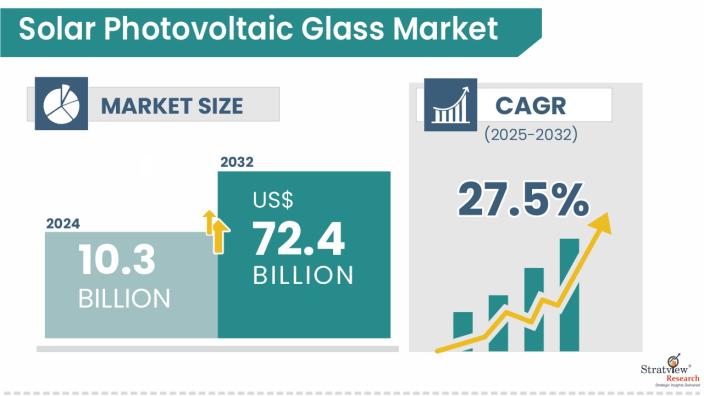
"Solar photovoltaic glass market size was USD 10.3 billion in 2024.”
Want to know more about the market scope? Register Here
Have a look at the sales opportunities presented by the solar photovoltaic glass market in terms of growth and market forecast.
|
Solar Photovoltaic Glass Market Data & Statistics |
||
|
Market Statistics |
Value (in USD Billion) |
Market Growth (%) |
|
Annual Market Size in 2023 |
USD 8.0 billion |
- |
|
Annual Market Size in 2024 |
USD 10.3 billion |
YoY Growth in 2024: 28.0% |
|
Annual Market Size in 2025 |
USD 13.2 billion |
YoY Growth in 2025: 28.3% |
|
Annual Market Size in 2032 |
USD 72.4 billion |
CAGR 2025-2032: 27.5% |
|
Cumulative Sales Opportunity during 2025-2032 |
USD 289.0 billion |
|
|
Top 10 Countries’ Market Share in 2024 |
USD 8.2 billion + |
> 80% |
|
Top 10 Company’s Market Share in 2024 |
USD 5.1 billion to USD 7.2 billion |
50% - 70% |
Solar Photovoltaic (PV) glass is an advanced glazing material embedded with solar cells, designed to convert sunlight into electrical energy. It seamlessly combines structural functionality with energy generation, making it ideal for applications such as façades, skylights, and windows. PV glass plays a vital role in promoting sustainable and energy-efficient building design.
The global solar PV market is expanding rapidly due to accelerating renewable energy adoption, increasing solar installations, supportive government policies, and technological advancements in high-efficiency solar modules. Rising investments in utility-scale solar projects and building-integrated photovoltaics (BIPV) are also driving demand for specialized PV glass solutions. According to the International Energy Agency (IEA), global solar PV capacity additions reached approximately 605 GW in 2025, marking a record year for installations. Solar PV accounted for nearly three-quarters of total renewable capacity additions, while cumulative global solar capacity surpassed 2.8 TW, reflecting the technology’s growing dominance in the global power mix.
Rapid Growth in Global Solar Installations
The solar glass PV market growth is being driven by rapid expansion in global solar capacity as countries accelerate the shift toward clean energy systems. Utility-scale solar projects and high-efficiency module adoption are significantly increasing the demand for tempered, low-iron, and anti-reflective photovoltaic glass used in modern solar panels.
According to IEA, Solar PV capacity additions in 2025 rose by around 12%, surpassing 600 GW for the first time. This expansion brought cumulative solar PV capacity to around 2.8 TW globally, strengthening long-term demand for advanced solar glass solutions across utility, commercial, and residential applications.
Governments worldwide are aggressively increasing renewable energy capacity to meet net-zero and climate goals, supported by large-scale policy frameworks such as China’s carbon neutrality target for 2060, the European Union’s Green Deal aiming for climate neutrality by 2050, and the United States’ Inflation Reduction Act, which provides major tax incentives for clean energy deployment.
Declining Solar Module Costs
Continuous reductions in solar module prices have improved solar economics and accelerated deployments across utility-scale and distributed projects. Driven by manufacturing scale-up and supply chain expansion, these cost declines are directly increasing solar PV glass market demand through higher solar module installation volumes and greater consumption of tempered and anti-reflective glass.
Solar PV continues to be the largest contributor to renewable electricity growth globally, according to the International Energy Agency (IEA) 2025 report. In 2023, solar PV generation increased by a record 320 TWh (up 25%), reaching over 1,600 TWh, marking the highest absolute growth among all renewable energy technologies.
The IEA further notes that sustaining a growth pathway aligned with its Net Zero Emissions by 2050 (NZE) Scenario will require a near doubling of annual solar capacity additions by 2030, highlighting the scale of continued investment and infrastructure development needed to support the global energy transition.
Overall, these combined factors are expected to sustain strong and steady growth in the solar PV glass market over the forecast period. As solar deployment continues to scale globally, demand for high-performance photovoltaic glass is expected to rise in parallel across key end-use segments.
Government Policies and Renewable Energy Incentives
Strong government policy support remains a key driver of solar PV expansion, with major economies scaling up renewable deployment through long-term climate commitments and financial incentives. Global renewable energy investment exceeded USD 1 trillion in 2024, with solar accounting for the largest share of new capacity additions across key markets.
In addition, building-integrated photovoltaics (BIPV) and green building regulations are expanding the use of solar PV glass beyond traditional utility applications, further supporting long-term demand growth.
Supply Chain Concentration and Dependency
The global solar PV supply chain remains highly concentrated, with China continuing to dominate key manufacturing stages such as polysilicon, wafers, cells, and module production. According to recent International Energy Agency (IEA) assessments (2025), China accounts for around 80–90% of global production capacity across critical solar PV supply chain segments, reinforcing its central role in the industry.
This high level of concentration creates structural risks for the market, including exposure to trade policy shifts, geopolitical tensions, logistics disruptions, and price volatility. In response, several regions including the United States, the European Union, and India are actively investing in domestic solar manufacturing capacity to diversify supply chains and reduce dependency on a single geography.
High Raw Material and Manufacturing Costs
Technological and Efficiency Constraints
Market Opportunities
Building-Integrated Photovoltaics (BIPV)
Building-integrated photovoltaics (BIPV) is emerging as a high-growth application area for solar PV glass, covering façades, windows, skylights, and curtain walls. The shift toward net-zero energy buildings and sustainable construction practices is accelerating adoption of transparent and semi-transparent photovoltaic glass, making BIPV one of the most important solar pv glass market trend drivers over the long term.
The U.S. Department of Energy highlights that silicon-based solar modules offer a strong combination of high efficiency, low cost, and long operational lifetime, with modules typically lasting 25 years or more while retaining over 80% of their original power output.
Growing adoption of net-zero energy buildings, green building certifications, and sustainable construction practices is further expected to drive demand for transparent and semi-transparent photovoltaic glass in BIPV applications over the forecast period.
Domestic Manufacturing Expansion
Governments across major economies are actively promoting domestic solar manufacturing to reduce supply chain dependency, strengthen energy security, and build resilient clean energy ecosystems. This shift is also supporting localized value creation by lowering logistics costs, reducing emissions from transportation, and enhancing supply chain efficiency.
The IEA estimates that the solar PV industry could support approximately 1 million direct manufacturing jobs globally by 2030, reflecting the scale of industrial expansion driven by rising solar deployment and localization policies.
Growth in Utility-Scale Solar Projects
Utility-scale solar projects continue to dominate global solar deployment and remain the largest driver of PV glass demand. Large-scale solar farms require substantial volumes of tempered and high-transmittance glass to support durable, high-efficiency module production, making them a key consumption hub for solar PV glass manufacturers.
Emerging economies across Asia-Pacific, the Middle East, and Latin America are expected to witness strong solar deployment growth, supported by rising energy demand, favorable solar irradiance conditions, and increasing policy support for renewable energy expansion.
|
Segmentations |
List of Sub-Segments |
Segments with High-Growth Opportunity |
|
Type Analysis |
AR-Coated Solar PV Glass, Tempered Solar PV Glass, TCO-Coated Solar PV Glass |
Tempered Solar PV Glass segment is anticipated to experience the fastest growth in the future. |
|
Application Analysis |
Residential, Non-Residential, Utility |
Residential segment is expected to be the largest solar photovoltaic glass market segment during the forecast period. |
|
Installation Analysis |
Float Glass Technology, Pattern Glass Technology |
Patterned Glass is expected to be the largest segment of the solar photovoltaic market during the forecast period. |
|
End Use Analysis |
Crystalline Silicon PV Module, Thin Film PV Module, Perovskite Module |
Perovskite Module segment holds the largest market share during the forecast period. |
|
Regional Analysis |
North America, Europe, Asia-Pacific, and The Rest of the World |
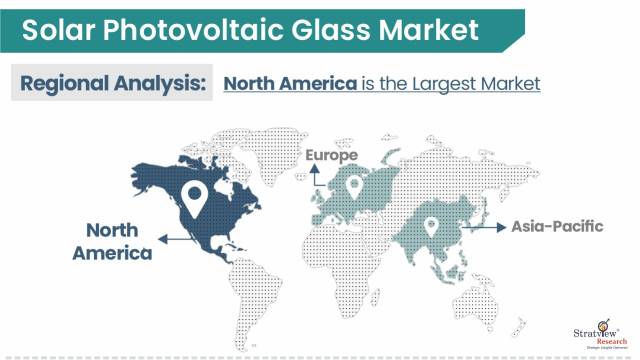
North America region holds the largest share of the Solar Photovoltaic Glass Market. |
“Tempered Solar PV Glass segment is anticipated to experience the fastest growth in the future.”
“Perovskite Module segment holds the largest market share during the forecast period.”
“North America is estimated to be the largest market during the forecast period.”
Know the high-growth countries in this report. Register Here
Most of the major players compete in some of the factors, including price, service offerings, regional presence, etc. The following are the key players in the solar photovoltaic glass market:
Note: The above list does not necessarily include all the top players in the market.
Are you a leading player in this market? We would love to include your name. Please write to us at [email protected]
In August 2025, g-neration.energy AG acquired Kromatix Glass Tech SA to obtain its colored solar glass technology, patents, and trademark rights. The acquisition strengthens the company’s position in building-integrated photovoltaic glass solutions and advanced solar glass manufacturing technologies.
In October 2025, AGC Glass Europe partnered with SOLAR MATERIALS to utilize recycled glass from end-of-life solar panels in float glass production. The partnership aims to advance circularity initiatives, reduce carbon emissions, and strengthen sustainable raw material sourcing in photovoltaic glass manufacturing.
In September 2025, CSG Holding announced plans to establish a 1,400-ton-per-day solar photovoltaic glass manufacturing facility in Egypt. The investment is expected to strengthen regional solar supply chain capabilities and support the company’s international expansion strategy.
In April 2025, Changzhou Almaden announced plans to build a solar photovoltaic glass manufacturing plant in the UAE with an annual production capacity of 500,000 tons. The project is intended to expand the company’s presence across Middle Eastern, European, and South Asian markets.
In January 2025, Borosil Renewables announced a 50% expansion of its solar glass production capacity, increasing daily output from 1,000 tons to 1,500 tons. The expansion supports India’s domestic solar manufacturing initiatives and enhances local photovoltaic glass supply capabilities.
In January 2025, NSG Group initiated operations at its converted TCO glass facility at Pilkington North America’s Rossford, Ohio site. The facility is expected to support thin-film solar module manufacturing and strengthen the U.S. solar glass supply chain.
This report provides market intelligence most comprehensively. The report structure has been kept so that it offers maximum business value. It provides critical insights into market dynamics and will enable strategic decision-making for existing market players as well as those willing to enter the market.
The following are the key features of the report:
|
Market Study Period |
2019-2032 |
|
Base Year |
2024 |
|
Forecast Period |
2025-2032 |
|
Trend Period |
2019-2023 |
|
Number of Tables & Figures |
>100 |
|
Number of Segments Analysed |
5 (Type, Application Type, Installation Type, End-Use Type, and Region) |
|
Number of Regions Analysed |
4 (North America, Europe, Asia-Pacific, Rest of the World) |
|
Countries Analysed |
15 (The USA, Canada, Mexico, Germany, France, Italy, The UK, China, Japan, India, Brazil, Saudi Arabia, Rest of Europe, Rest of APAC, and Rest of the World) |
|
Free Customization Offered |
10% |
|
After Sales Support |
Unlimited |
|
Report Presentation |
Complimentary |
|
Market Dataset |
Complimentary |
|
Further Deep Dive & Consulting Services |
10% Discount |
This report studies the market, covering a period of 15 years of trend and forecast. The report provides detailed insights into the market dynamics to enable informed business decision-making and growth strategy formulation based on the opportunities present in the market.
The solar photovoltaic glass market is segmented into the following categories.
By Type
By Application Type
By Installation Type
By End Use Type
By Region
With this detailed report, Stratview Research offers one of the following free customization options to our respected clients:
Company Profiling
Competitive Benchmarking
Custom Research: Stratview Research offers custom research services across industries. In case of any custom research requirement related to market assessment, competitive benchmarking, sourcing and procurement, target screening, and others, please send your inquiry to [email protected].
The report is delivered digitally through our online portal. Buyers receive login credentials from our team to access the report and may update their credentials at any time after the initial login.
Delivery timelines depend on the status of the report:
For the most accurate delivery timeline, please contact us to confirm the current status of the report.
Yes. You may request a complimentary preview of the report through a video conference with our team.
Yes. The scope of the report can be fully customized to align with your specific research objectives and information requirements.
Please contact us at [email protected], and our team will be happy to discuss your requirements and propose a tailored solution.
Yes. Selected sections of the report can be purchased separately based on your requirements. Please contact us at [email protected] to discuss your needs.
Yes, AI can help gather publicly available information, but its outputs are only as reliable as the data it accesses. Stratview Research reports are built using validated data, extensive primary interviews with industry stakeholders, and the expertise of our experienced research team.
Additionally, many critical insights, including market dynamics, competitive intelligence, and industry-specific trends, are not publicly available and therefore cannot be captured through AI alone.
The solar photovoltaic (PV) glass market involves the production and use of specially coated glass designed to protect and enhance solar panels. It enables efficient light transmission, durability, and energy conversion in residential, commercial, and utility-scale solar applications.
The forecasted value for the market is US$ 72.4 billion in 2032.
Solar photovoltaic glass market size was USD 10.3 billion in 2024 and is expected to grow from USD 13.2 billion in 2025 to USD 72.4 billion in 2032, witnessing an impressive market growth (CAGR) of 27.5% during the forecast period (2025-2032).
The key drivers of the global solar photovoltaic glass market are the supportive policies and initiatives of various governments for solar PV plant installations to promote renewable energy generation, and the decreasing costs of solar systems and energy storage devices.
The top players in the global solar photovoltaic glass market include Xinyi Solar Holdings Ltd. (China), IRICO Group New Energy Co. Ltd. (China), Flat Glass Group Co. Ltd (China), etc.
The North America region is the fastest-growing market for global solar photovoltaic glass.


WE ACCEPT