




404
+1-313-307-4176

Water and Wastewater Treatment Equipment Market Analysis | 2025-2032

Water and Wastewater Treatment Equipment Market Size, Share, Trends, Dynamics, Forecast, & Growth Analysis: 2025-2032
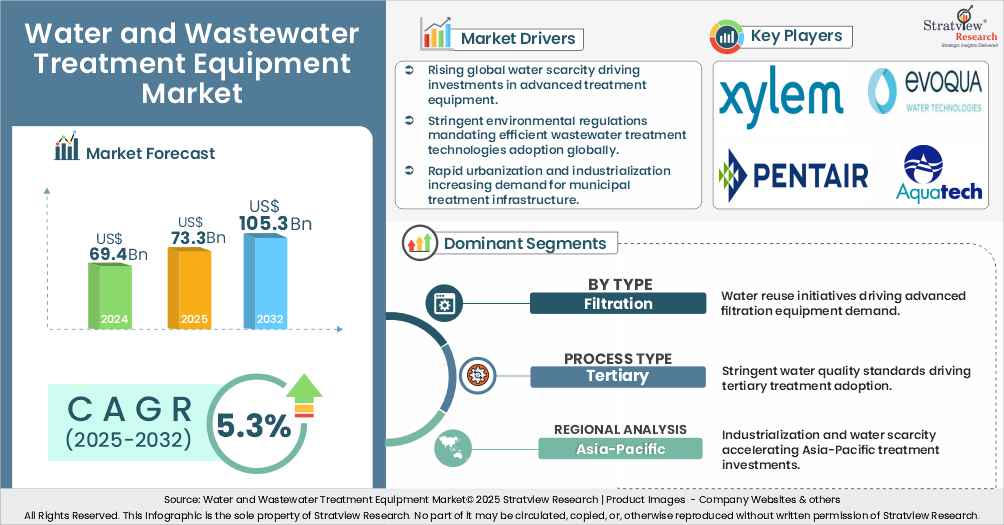
"Water & wastewater treatment equipment market size was USD 69.4 billion in 2024.”
Want to get a free sample? Register Here
Have a look at the sales opportunities presented by the water & wastewater treatment equipment market in terms of growth and market forecast.
|
Water & Wastewater Treatment Equipment Market Data & Statistics |
||
|
Market Statistics |
Value (in USD Billion) |
Market Growth (%) |
|
Annual Market Size in 2023 |
USD 65.8 billion |
- |
|
Annual Market Size in 2024 |
USD 69.4 billion |
YoY Growth in 2024: 5.4% |
|
Annual Market Size in 2025 |
USD 73.3 billion |
YoY Growth in 2025: 5.7% |
|
Annual Market Size in 2032 |
USD 105.3 billion |
CAGR 2025-2032: 5.3% |
|
Cumulative Sales Opportunity during 2025-2032 |
USD 710.4 billion |
|
|
Top 10 Countries’ Market Share in 2024 |
USD 56 billion + |
> 80% |
|
Top 10 Company’s Market Share in 2024 |
USD 35 billion to USD 49 billion |
50% - 70% |
Water and wastewater treatment equipment is the technology and machinery employed to treat, purify, and manage water and wastewater to make it safe for human consumption, industrial use, or environmental discharge. This equipment includes filters, clarifiers, disinfection units, sludge treatment systems, and membrane technologies that remove contaminants, solids, and harmful microorganisms from water, ensuring compliance with regulatory and safety standards.
The water and wastewater treatment equipment market is witnessing steady growth, driven by rising investments in water infrastructure, increasing freshwater scarcity, and stricter environmental regulations. Growing demand for safe drinking water, wastewater reuse, and sustainable water management is accelerating the adoption of advanced filtration, membrane, disinfection, and monitoring technologies. A key trend shaping the market is the increasing deployment of smart and decentralized water treatment solutions to improve operational efficiency and water security.
Rising Investments in Water Infrastructure are Driving Market Growth
Increasing investments to modernize aging drinking water and wastewater infrastructure are driving the market growth of the water and wastewater treatment equipment market. Governments and utilities are upgrading pipelines, treatment plants, and distribution networks, creating strong demand for advanced filtration, membrane, disinfection, and monitoring equipment.
Growing Water Scarcity and Urbanization are Expanding Market Share
Growing freshwater scarcity and rapid urbanization are expanding the market share of the water and wastewater treatment equipment market. Increasing pressure on freshwater resources is encouraging municipalities and industries to invest in water reuse, desalination, and advanced treatment technologies to ensure reliable water supplies.
Stricter Wastewater Regulations are Driving Market Demand
Stricter wastewater discharge regulations are driving the market demand for water and wastewater treatment equipment. Governments are strengthening pollution control standards, encouraging utilities and industries to upgrade biological, sludge, and tertiary treatment systems.
High Capital and Operating Costs Restrain Market Growth
High capital and operating costs continue to restrain the market growth of the water and wastewater treatment equipment market. Advanced technologies such as membrane filtration, desalination, UV disinfection, and PFAS treatment require substantial investments in equipment, energy, and maintenance, limiting adoption among smaller municipalities and utilities.
Energy-Intensive Treatment Processes Challenge Market Demand
Energy-intensive treatment processes are challenging the market demand for water and wastewater treatment equipment. Desalination and advanced wastewater treatment technologies require significant electricity, increasing operating costs and sustainability concerns for water utilities.
Emerging Contaminants Increase Compliance Complexity
The growing presence of emerging contaminants is increasing compliance complexity in the water and wastewater treatment equipment market. Pollutants such as PFAS, microplastics, pharmaceuticals, and other trace contaminants require advanced treatment processes and continuous monitoring, increasing compliance costs for utilities.
Expansion of Water Reuse Projects Strengthens Market Forecast
The expansion of water reuse and recycling projects is strengthening the market forecast for the water and wastewater treatment equipment market. Governments and industries are increasingly investing in wastewater recycling to improve water security, creating demand for membrane bioreactors, tertiary treatment systems, and advanced filtration technologies.
Growing Demand for Decentralized Treatment Creates New Market Opportunities
Growing demand for decentralized treatment systems is creating new opportunities in the water and wastewater treatment equipment market. Remote communities, industrial facilities, and developing regions are increasingly adopting localized treatment solutions that require lower infrastructure investments while improving water accessibility.
Smart Water Technologies are Emerging as a Key Market Trend
The adoption of smart water technologies is emerging as a key market trend in the water and wastewater treatment equipment market. Utilities are increasingly deploying sensors, automation, AI-based monitoring, and predictive maintenance solutions to improve operational efficiency and strengthen infrastructure resilience.
|
Segmentations |
List of Sub-Segments |
Segments with High-Growth Opportunity |
|
Type Analysis |
Filtration, Disinfection, Desalination, Sludge Treatment, Biological, and Testing |
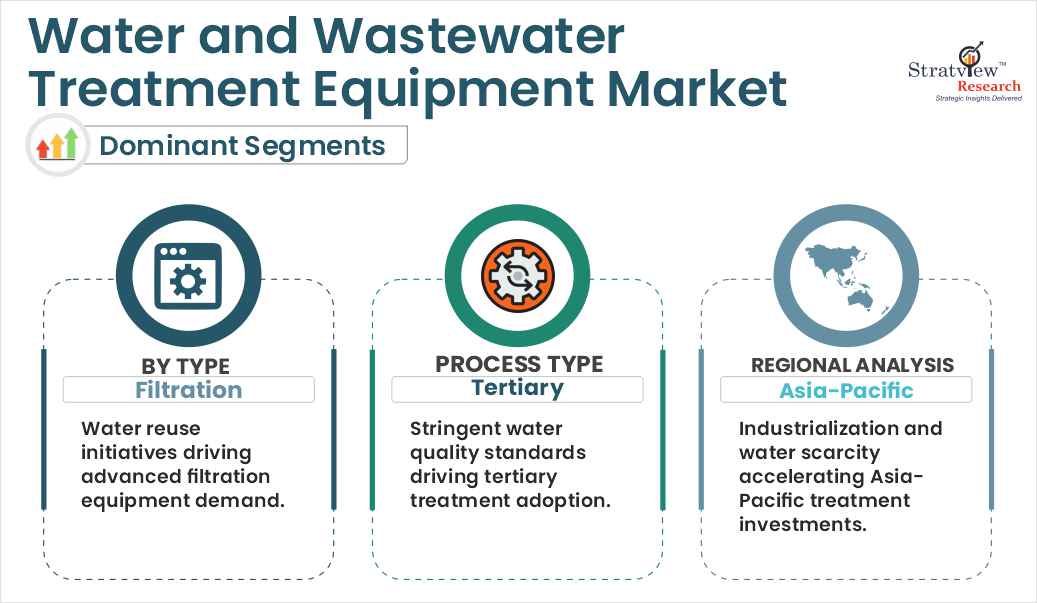
Filtration segment accounted for the largest share of the water and wastewater treatment equipment market. |
|
Process Analysis |
Primary, Secondary, and Tertiary |
Tertiary segment accounted for the largest share of the water and wastewater treatment equipment market. |
|
End-User Analysis |
Municipal and Industrial |
Municipal segment is the largest and fastest-growing segment of the water and wastewater treatment equipment market. |
|
Regional Analysis |
North America, Europe, Asia-Pacific, and The Rest of the World |
Asia-Pacific region accounted for the largest market share in 2024 and is expected to be the fastest-growing region over the forecasted period. |
“Filtration segment accounted for the largest share of the water and wastewater treatment equipment market.”
“Tertiary segment accounted for the largest share of the water and wastewater treatment equipment market.”
Want to get more details about the segmentations? Register Here
"The Asia-Pacific region accounted for the largest market share in 2024 and is expected to be the fastest-growing region over the forecasted period.”
Most of the major players compete in some of the factors, including price, service offerings, regional presence, etc. The following are the key players in the water and wastewater treatment equipment market:
Note: The above list does not necessarily include all the top players in the market.
Are you a leading player in this market? We would love to include your name. Please write to us at [email protected]
In May 2026, De Nora acquired BW Water, completing the transaction in July 2026 for US$60.8 million at closing, with the enterprise value capped at US$66.5 million. BW Water generated US$91.5 million in revenue in 2025 and had an order backlog of approximately US$190 million, strengthening De Nora's turnkey engineering, fabrication, and industrial water treatment project execution capabilities.
In September 2025, Kemira announced an agreement to acquire Water Engineering, Inc. for approximately US$150 million in cash. The acquisition expands Kemira's portfolio beyond water treatment chemicals into engineered water services, including equipment management, monitoring, maintenance, and technical support for industrial and commercial customers across North America.
In June 2025, Grundfos announced an agreement to acquire Newterra from Frontenac, completing the transaction in August 2025. The acquisition expanded Grundfos' North American water treatment business to more than 1,500 employees and over US$350 million in annual revenue, strengthening its portfolio of modular water and wastewater treatment systems.
In May 2025, Veolia acquired CDPQ's remaining 30% stake in Water Technologies & Solutions for US$1.75 billion, securing full ownership of the business. The transaction is expected to generate approximately €90 million in annual cost synergies by 2027, while strengthening Veolia's industrial water treatment equipment, chemicals, mobile water, and service operations.
In February 2026, EKKI HOMA launched its Linus clog-resistant sewage pump platform in India after successful field testing at approximately 100 sites. Supported by a brownfield expansion targeting an initial production capacity of 30,000 pumps annually and a planned network of 75 dealers, the launch expands pumping solutions for industrial, municipal, commercial, and residential wastewater applications.
In September 2025, JSP Enviro successfully deployed its Bio-Electrochemical Anaerobic Digestor System at two industrial facilities in Tamil Nadu. A 100 m³/day installation can reportedly reduce nearly 80 tonnes of CO₂ emissions annually while lowering aeration requirements, chemical consumption, sludge generation, and maintenance costs.
In May 2025, Veolia secured approximately US$750 million in new water technology contracts, including a US$550 million project for a major U.S. Midwest microelectronics facility, along with additional projects in San Francisco, Brazil, and the UAE. The contracts support growing demand for ultrapure water production, wastewater recycling, and advanced treatment systems in water-intensive industries.
This report provides market intelligence most comprehensively. The report structure has been kept so that it offers maximum business value. It provides critical insights into market dynamics and will enable strategic decision-making for existing market players as well as those willing to enter the market.
The following are the key features of the report:
|
Market Study Period |
2019-2032 |
|
Base Year |
2024 |
|
Forecast Period |
2025-2032 |
|
Trend Period |
2019-2023 |
|
Number of Tables & Figures |
>100 |
|
Number of Segments Analysed |
4 (Type, Process Type, End-User Type, and Region) |
|
Number of Regions Analysed |
4 (North America, Europe, Asia-Pacific, Rest of the World) |
|
Countries Analysed |
15 (The USA, Canada, Mexico, Germany, France, Italy, The UK, China, Japan, India, Brazil, Saudi Arabia, Rest of Europe, Rest of APAC, and Rest of the World) |
|
Free Customization Offered |
10% |
|
After Sales Support |
Unlimited |
|
Report Presentation |
Complimentary |
|
Market Dataset |
Complimentary |
|
Further Deep Dive & Consulting Services |
10% Discount |
This report studies the market, covering a period of 15 years of trend and forecast. The report provides detailed insights into the market dynamics to enable informed business decision-making and growth strategy formulation based on the opportunities present in the market.
The water and wastewater treatment equipment market is segmented into the following categories.
By Type
By Process Type
By End-User Type
By Region
With this detailed report, Stratview Research offers one of the following free customization options to our respected clients:
Company Profiling
Competitive Benchmarking
Custom Research: Stratview Research offers custom research services across industries. In case of any custom research requirement related to market assessment, competitive benchmarking, sourcing and procurement, target screening, and others, please send your inquiry to [email protected]
The report is delivered digitally through our online portal. Buyers receive login credentials from our team to access the report and may update their credentials at any time after the initial login.
Delivery timelines depend on the status of the report:
For the most accurate delivery timeline, please contact us to confirm the current status of the report.
Yes. You may request a complimentary preview of the report through a video conference with our team.
Yes. The scope of the report can be fully customized to align with your specific research objectives and information requirements.
Please contact us at [email protected], and our team will be happy to discuss your requirements and propose a tailored solution.
Yes. Selected sections of the report can be purchased separately based on your requirements. Please contact us at [email protected] to discuss your needs.
Yes, AI can help gather publicly available information, but its outputs are only as reliable as the data it accesses. Stratview Research reports are built using validated data, extensive primary interviews with industry stakeholders, and the expertise of our experienced research team.
Additionally, many critical insights, including market dynamics, competitive intelligence, and industry-specific trends, are not publicly available and therefore cannot be captured through AI alone.
The water and wastewater treatment equipment market refers to the industry focused on the design, manufacture, and supply of systems and devices used to treat water and wastewater for safe consumption, reuse, or environmental discharge. This includes equipment such as filtration systems, membrane technologies, disinfection units, and sludge treatment tools used across municipal, industrial, and commercial applications to meet regulatory and sustainability standards.
The forecasted value for the market is US$ 105.3 billion in 2032.
Water and wastewater treatment equipment market size was USD 69.4 billion in 2024 and is expected to grow from USD 73.3 billion in 2025 to USD 105.3 billion in 2032, witnessing an impressive market growth (CAGR) of 5.3% during the forecast period (2025-2032).
The key drivers of the water and wastewater treatment equipment market include rising water scarcity and growing global population.
The top players in the water and wastewater treatment equipment market include • Xylem, Inc. • Pentair plc. • Evoqua Water Technologies LLC • Aquatech International LLC • Ecolab Inc.
Asia-Pacific region accounted for the largest market share in 2024 and is expected to be the fastest-growing region over the forecasted period, driven by rapid industrialization, urbanization, and population growth in countries such as China, India, and Southeast Asian nations. These factors have led to increased water pollution and scarcity, necessitating substantial investments in advanced treatment infrastructure.


WE ACCEPT