




404
+1-313-307-4176

Pultrusion Market | 2024-2035

Pultrusion Market Size, Share, Trend, Forecast, Competitive Analysis, and Growth Opportunity: 2024-2035
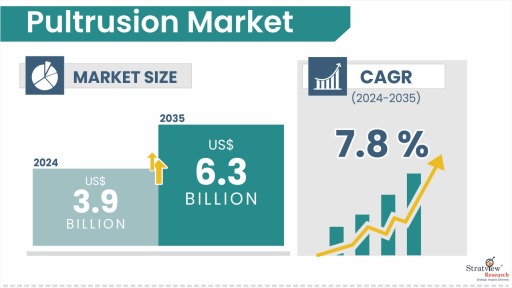
Pultrusion market size was US$ 3.9 billion in 2024 and is likely to grow at a strong CAGR of 7.8% in the long run to reach US$ 6.3 billion in 2035.
This market report presents data and insights segmented by End-Use Industry Type (Building & Infrastructure, Transportation, Oil & Gas, Electrical, Defense, Wind, and Other End-Uses), Application Type (Structural Shapes, Tubes, Tool Handles, Grating, Decking/Flooring, Rebar, Utility Poles, Door/Window Profiles, Sound Barriers, Road Markers, Cable Trays, Electric Insulators, Ladder Rail, Custom Shapes, Wind Spars, and Other Applications), Fiber Type (Glass Composites, Carbon Composites, and Hybrid Composites), Resin Type (Polyester Composites, Vinyl Ester Composites, Epoxy Composites, Phenolic Composites, and Other Resins), and Region (North America [The USA, Canada, and Mexico], Europe [Germany, France, The UK, and Rest of Europe], Asia-Pacific [China, Japan, India, and Rest of Asia-Pacific], and Rest of the World [Brazil, Saudi Arabia, and Others]).
“The global pultrusion market size was US$ 3.9 billion in 2024 and is likely to grow at a strong CAGR of 7.8% in the long run to reach US$ 6.3 billion in 2035.”
Want to get a free sample? Register Here
The pultrusion market refers to the industry focused on the production and sale of fiber-reinforced polymer (FRP) composites manufactured through the pultrusion process. Pultrusion is a continuous, automated process used to produce high-strength, lightweight composite profiles with constant cross-sections. These materials are widely utilized across industries such as construction, automotive, aerospace, and electrical due to their corrosion resistance, durability, and low maintenance. The market's growth is driven by the rising demand for sustainable materials and the ongoing shift from traditional materials like steel and aluminum to advanced composites.
In recent years, the global pultrusion market has witnessed significant expansion, fueled by advancements in resin technology and increasing applications in infrastructure and renewable energy industries. The demand for cost-effective and long-lasting composite solutions has encouraged manufacturers to innovate and diversify product offerings. Geographically, North America and Europe lead the market due to strong industrial bases and early adoption of composite technologies, while Asia-Pacific is emerging as a lucrative region owing to rapid urbanization and industrial growth. Market trends indicate a continued focus on lightweight, eco-friendly materials for both structural and non-structural applications.
The pultrusion market is primarily driven by the increasing demand for lightweight, corrosion-resistant, and high-strength materials across various industries. The construction and infrastructure industries are adopting pultruded composites for applications like bridges, structural frameworks, and utility poles due to their long lifespan and minimal maintenance needs. Additionally, the growing emphasis on energy efficiency and sustainability is pushing industries to replace traditional materials like steel and wood with fiber-reinforced composites. The transportation and aerospace industries also contribute to market growth by leveraging pultruded products for improved fuel efficiency and design flexibility.
Infrastructure Modernization and Corrosion-Resistant Construction Materials
Infrastructure modernization is driving the pultrusion market demand, as governments and private developers increasingly replace corrosion-prone steel and concrete with durable composite materials. Pultruded composites offer high strength-to-weight ratios, excellent corrosion resistance, and lower lifecycle costs, making them suitable for bridges, utility structures, walkways, and industrial facilities.Infrastructure modernization projects worldwide are creating new opportunities for pultrusion suppliers specializing in structural composites, particularly in applications such as bridges, walkways, utility poles, and structural reinforcement systems requiring minimal maintenance.
Growing Demand for Lightweight Materials Across End-Use Industries
The increasing adoption of lightweight materials is supporting the pultrusion market growth across transportation, renewable energy, and electrical infrastructure. Pultruded composite profiles improve durability, reduce maintenance requirements, and lower structural weight compared with conventional materials, driving their use in rail, utility poles, cable management systems, and wind energy applications.
Volatility in Raw Material Prices
High raw material costs remain a key challenge for the pultrusion market growth. Price fluctuations for fiberglass, carbon fiber, and specialty resins increase production costs and pressure manufacturers' margins, particularly in price-sensitive construction and industrial applications.
Limited Recycling Infrastructure for Thermoset Composites
Limited recycling infrastructure continues to challenge the pultrusion market. Increasing environmental regulations and sustainability expectations are encouraging manufacturers to develop recyclable composite materials, reduce production waste, and improve circularity while maintaining the structural performance of pultruded products.
Expansion of Renewable Energy Infrastructure
The rapid expansion of renewable energy projects is creating significant pultrusion market opportunities. Wind farms, solar installations, cable trays, structural supports, and utility infrastructure increasingly require lightweight, corrosion-resistant composite materials, supporting long-term demand for pultruded products.
Grid Modernization and Expansion of Electricity Networks
Grid modernization is creating new pultrusion market opportunities as utilities increasingly invest in resilient and low-maintenance transmission and distribution infrastructure. Pultruded composite cross-arms, poles, cable management systems, and insulators offer excellent corrosion resistance, electrical insulation, and long service life, making them well suited for modern power networks.
|
Segmentations |
List of Sub-Segments |
Segments with High-Growth Opportunity |
|
End-Use Industry-Type Analysis |
Building & Infrastructure, Transportation, Oil & Gas, Electrical, Defense, Wind, and Others |
Building & infrastructure dominate the pultrusion market, fueled by demand for durable, low-maintenance, and sustainable materials in modern construction. |
|
Application-Type Analysis |
Structural Shapes, Tubes, Tool Handles, Grating, Decking/Flooring, Rebar, Utility Poles, Door/Window Profiles, Sound Barriers, Road Markers, Cable Trays, Electric Insulators, Ladder Rail, Custom Shapes, Wind Spars, and Others |
Structural shapes dominate the pultrusion market due to their widespread use in construction, while wind spars are the fastest-growing segment, driven by rising demand for wind energy. |
|
Fiber-Type Analysis |
Glass Composites, Carbon Composites, and Hybrid Composites |
Glass fiber composites dominate the pultrusion market for their versatility and cost-effectiveness, while carbon fiber composites are the fastest-growing segment due to rising demand for lightweight, high-strength materials. |
|
Resin-Type Analysis |
Polyester Composites, Vinyl Ester Composites, Epoxy Composites, Phenolic Composites, and Others |
Polyester resin composites lead the pultrusion market and will continue to reign in the forecast period. |
|
Region Analysis |
North America, Europe, Asia-Pacific, and The Rest of the World |
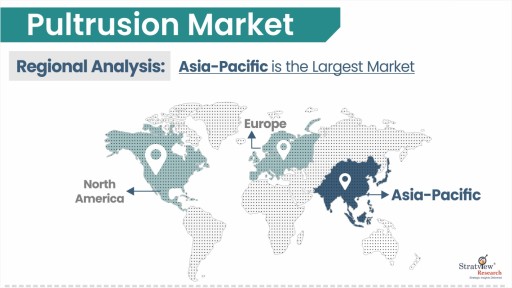
The Asia-Pacific region is expected to maintain its reign over the forecast period. |
“The pultrusion market is largely driven by the growing demand for durable, low-maintenance, and sustainable materials in modern construction, with the building and infrastructure industries leading the way.”
By end-use industry type, the pultrusion market is segmented into building & infrastructure, transportation, oil & gas, electrical, defense, wind, and other end-uses. The building and infrastructure segment is expected to dominate the global pultrusion market in terms of market share due to the growing demand for durable, lightweight, and corrosion-resistant materials in construction. Pultruded composites are increasingly being used in bridges, walkways, utility poles, grating systems, and structural reinforcements, replacing traditional materials like steel, wood, and aluminum. These composites offer advantages such as long service life, minimal maintenance, and resistance to harsh environmental conditions, making them ideal for modern infrastructure projects. Additionally, the global push for sustainable construction and green building initiatives is further encouraging the adoption of pultruded materials. The rapid pace of urbanization and infrastructure development, especially in emerging economies, continues to drive demand, solidifying the segment’s leading position in the pultrusion market.
“Structural shapes dominate the pultrusion market with robust demand from the construction industry, while wind spars are becoming the fastest-growing segment driven by the worldwide initiative for wind power and cutting-edge composite technologies.”
By application, the pultrusion market is segmented into structural shapes, tubes, tool handles, grating, decking/flooring, rebar, utility poles, door/window profiles, sound barriers, road markers, cable trays, electric insulators, ladder rail, custom shapes, wind spars, and other applications. Structural shapes are poised to dominate the pultrusion market by both value and volume, driven by their extensive use in the construction industry. These profiles, such as beams, channels, and angles, offer superior strength-to-weight ratios, corrosion resistance, and durability, making them ideal for infrastructure applications like bridges, industrial supports, and architectural frameworks. As global demand for sustainable and low-maintenance materials rises, pultruded structural shapes are increasingly replacing traditional materials like steel and wood in both new construction and retrofitting projects. Their adaptability and cost-effectiveness further enhance their appeal in diverse structural applications.
In contrast, wind spars represent the fastest-growing application within the pultrusion market, propelled by the global expansion of wind energy initiatives. Pultruded composites are essential in manufacturing wind turbine blades due to their high strength, lightweight nature, and resistance to environmental degradation. The increasing shift towards renewable energy sources has led to a surge in wind turbine installations, thereby elevating the demand for pultruded wind spars. Technological advancements in composite materials and manufacturing processes are further enhancing the performance and efficiency of wind turbines, solidifying the role of pultruded components in the renewable energy industry.
“Glass fiber composites dominate the pultrusion market with their unsurpassed versatility and affordability, followed by carbon fiber composites as industries pursue lightweight, high-performance, and efficient solutions at a fast rate.”
By fiber, the pultrusion market is segmented into glass composites, carbon composites, and hybrid composites. Glass fiber composites dominate the pultrusion market due to their affordability, durability, and versatility. Glass fibers are favored across industries such as construction, automotive, and infrastructure. Their high strength-to-weight ratio, corrosion resistance, and thermal stability make them ideal for applications like bridges, railings, and structural reinforcements. Additionally, advancements in glass fiber formulations and compatibility with various resin systems have expanded their application scope, reinforcing their leading position in the pultrusion market.
On the contrary, carbon fiber composites are experiencing the fastest growth in the pultrusion market, driven by increasing demand for lightweight and high-strength materials. Carbon fibers are increasingly utilized in industries like aerospace, automotive, and renewable energy. Their superior strength-to-weight ratio and rigidity make them ideal for applications such as wind turbine blades, automotive components, and structural profiles. The growing emphasis on fuel efficiency and emission reductions further propels the adoption of carbon fiber composites in various industries.
“Polyester resin composites are the market leaders in the pultrusion market due to their cost-effectiveness, flexibility, and excellent performance in high-volume applications, which make them the first choice for robust, cost-efficient structural solutions in various industries.”
By resin, the pultrusion market is segmented into polyester composites, vinyl ester composites, epoxy composites, phenolic composites, and other resins. Polyester resin composites dominate the pultrusion market due to their cost-effectiveness, good mechanical properties, and ease of processing. Widely used in construction, electrical, and industrial applications, polyester resins offer adequate strength, corrosion resistance, and thermal stability. Their compatibility with various fiber reinforcements and resins enhances their versatility, making them the preferred choice for mass production in structural shapes, grating, and other profiles.
The affordability and availability of polyester resins significantly contribute to their market dominance. These resins cure quickly, are easy to handle, and exhibit strong bonding with glass fibers, further boosting their demand in high-volume applications. The growing need for durable yet economical composite materials in infrastructure and utility industries ensures polyester resins continue to lead in market share within the pultrusion industry.
“Asia-Pacific dominates and drives the fastest growth in the pultrusion market, fueled by infrastructure expansion, sectoral demand, and favorable economic and policy conditions.”
The Asia-Pacific region dominates the global pultrusion market due to rapid industrialization, urbanization, and infrastructure development in countries like China, India, and Southeast Asia. High demand from construction, transportation, and electrical industries drives the widespread adoption of pultruded composites. Government investments in smart cities and sustainable infrastructure further strengthen the region’s leading position in market share and consumption.
Asia-Pacific is also the fastest-growing region in the pultrusion market, fueled by expanding renewable energy projects and increasing awareness of advanced composite materials. The region’s growing automotive and wind energy industries demand lightweight, durable solutions, boosting pultrusion applications. Additionally, lower production costs, supportive policies, and rising foreign investments are accelerating market expansion, making Asia-Pacific the key growth engine for the global pultrusion industry.
Want to get a free sample? Register Here
The market is consolidated, with major players holding a significant portion of the market. Most of the major players compete in some of the governing factors, including price, product offerings, regional presence, etc. The following are the key players in the pultrusion market.
Here is the list of the Top Players
Note: The above list does not necessarily include all the top players in the market.
Are you the leading player in this market? We would love to include your name. Please write to us at [email protected]
This report provides market intelligence most comprehensively. The report structure has been kept so that it offers maximum business value. It provides critical insights into market dynamics and will enable strategic decision-making for existing market players as well as those willing to enter the market. The following are the key features of the report:
Market structure: Overview, industry life cycle analysis, supply chain analysis.
Market environment analysis: Growth drivers and constraints, Porter’s five forces analysis, SWOT analysis.
Market trend and forecast analysis.
Market segment trend and forecast.
Competitive landscape and dynamics: Market share, Service portfolio, New Product Launches, etc.
COVID-19 impact and its recovery curve.
Attractive market segments and associated growth opportunities.
Emerging trends.
Strategic growth opportunities for the existing and new players.
Key success factors.
Market Segmentation
The global pultrusion market is segmented into the following categories:
By End-Use Industry Type
Building & Infrastructure
Transportation
Oil & Gas
Electrical
Defense
Wind
Other End-Uses
Pultrusion Market by Application Type
Structural Shapes
Tubes
Tool Handles
Grating
Decking/Flooring
Rebar
Utility Poles
Door/Window Profiles
Sound Barriers
Road Markers
Cable Trays
Electric Insulators
Ladder Rail
Custom Shapes
Wind Spars
Other Applications
By Fiber Type
Glass Composites
Carbon Composites
Hybrid Composites
By Resin Type
Polyester Composites
Vinyl Ester Composites
Epoxy Composites
Phenolic Composites
Other Resins
By Region
North America (Country Analysis: The USA, Canada, and Mexico)
Europe (Country Analysis: Germany, France, The UK, and the Rest of Europe)
Asia-Pacific (Country Analysis: China, Japan, India, and the Rest of Asia-Pacific)
Rest of the World (Country Analysis: Brazil, Saudi Arabia, and Others)
This strategic assessment report from Stratview Research provides a comprehensive analysis that reflects today’s pultrusion market realities and future market possibilities for the forecast period. The report segments and analyzes the market in the most detailed manner in order to provide a panoramic view of the market. The vital data/information provided in the report can play a crucial role for market participants and investors in identifying the low-hanging fruit available in the market and formulating strategies to expedite their growth process.
This report offers high-quality insights and is the outcome of a detailed research methodology comprising extensive secondary research, rigorous primary interviews with industry stakeholders, and validation and triangulation with Stratview Research’s internal database and statistical tools. More than 1,000 authenticated secondary sources, such as company annual reports, fact books, press releases, journals, investor presentations, white papers, patents, and articles, have been leveraged to gather the data. We conducted more than 15 detailed primary interviews with market players across the value chain in all four regions and industry experts to obtain both qualitative and quantitative insights.
With this detailed report, Stratview Research offers one of the following free customization options to our respectable clients:
Company Profiling
Detailed profiling of additional market players (up to three players)
SWOT analysis of key players (up to three players)
Competitive Benchmarking
Benchmarking of key players on the following parameters: Product portfolio, geographical reach, regional presence, and strategic alliances
Custom Research: Stratview Research offers custom research services across industries. In case of any custom research requirement related to market assessment, competitive benchmarking, sourcing and procurement, target screening, and others, please send your inquiry to [email protected]
The recent mergers & acquisitions in the market are driven by the need for advanced materials, the supply chain strengthening, and reducing production costs.
In October 2021, Kineco Group (India) and Exel Composites (Finland)-the world’s largest pultruded composites manufacturer- formed a joint venture to advance the pultrusion market in India. The newly established entity, Kineco Exel Composites India Pvt. Ltd., is headquartered in Goa and specializes in delivering pultruded composite solutions for transportation, wind energy, and telecommunications industries.
In 2022, Strongwell Corporation and Bedford Reinforced Plastics, both prominent North American pultrusion companies-entered into a strategic partnership to co-develop and market advanced pultruded profiles for infrastructure and industrial industries. This collaboration combines their manufacturing strengths and technical know-how to enhance their presence across the North American market.
In 2023, Shape Technologies Group (USA) acquired the pultrusion business of Fiberline Composites (Denmark). This acquisition strengthened Shape Technologies Group’s position in the global composites market, enabling it to offer a broader range of pultruded solutions for construction, wind energy, and industrial applications.
Exel Composites launched a new line of pultruded carbon fiber profiles in 2024, targeting lightweight structural applications in transportation and industrial automation. These profiles offer enhanced strength-to-weight ratios and are designed for use in electric vehicles and automated machinery.
Strongwell introduced the SAFRAIL™ HD Pultruded Handrail System in 2023. This heavy-duty, corrosion-resistant handrail system is designed for industrial and infrastructure markets, offering improved durability and easier installation compared to previous models.
Bedford Reinforced Plastics released EcoPultrusion™ in 2024, a sustainable pultrusion technology that incorporates recycled glass fibers and bio-based resins, addressing growing demand for eco-friendly construction and infrastructure materials.
The report is delivered digitally through our online portal. Buyers receive login credentials from our team to access the report and may update their credentials at any time after the initial login.
Delivery timelines depend on the status of the report:
For the most accurate delivery timeline, please contact us to confirm the current status of the report.
Yes. You may request a complimentary preview of the report through a video conference with our team.
Yes. The scope of the report can be fully customized to align with your specific research objectives and information requirements.
Please contact us at [email protected], and our team will be happy to discuss your requirements and propose a tailored solution.
Yes. Selected sections of the report can be purchased separately based on your requirements. Please contact us at [email protected] to discuss your needs.
Yes, AI can help gather publicly available information, but its outputs are only as reliable as the data it accesses. Stratview Research reports are built using validated data, extensive primary interviews with industry stakeholders, and the expertise of our experienced research team.
Additionally, many critical insights, including market dynamics, competitive intelligence, and industry-specific trends, are not publicly available and therefore cannot be captured through AI alone.
Pultrusion is a production process that entails the pulling of reinforced fibers into a resin bath followed by curing to produce durable, light composite materials that are utilized in construction, infrastructure, and other industries.
The pultrusion market size was US$ 3.9 billion in 2024 and is likely to grow strongly in the long run to reach US$ 6.3 billion in 2035.
The pultrusion market is estimated to grow at a CAGR of 7.8% by 2035, driven by demand for lightweight solutions, durable materials, growth in infrastructure and construction, and advancements in material technology.
Major drivers of the pultrusion market are the growing demand for strong, light, and corrosion-resistant materials, expansion in construction and infrastructure industries, advances in composite materials technology, environmental sustainability, cost savings, and durability of pultruded products.
Wind among end-use type, wind spars among application type, glass composite in fiber type, polyester resin among resin type, and the Asia-Pacific among the region type are offering high-growth opportunities in the forecast period.
The Asia-Pacific region holds the largest market share of the market owing to the expansion in economies like China, Japan, South Korea, and India.
The Asia-Pacific region is expected to offer the highest market growth, driven by a large consumer base, government spending on sustainable energy alternatives, global restrictions on carbon emissions, and a huge market to be catered.


WE ACCEPT