



404
+1-313-307-4176

Automotive Films Market Analysis | 2025-2032

Automotive Films Market Size, Share, Trends, Dynamics, Forecast, & Growth Analysis: 2025-2032
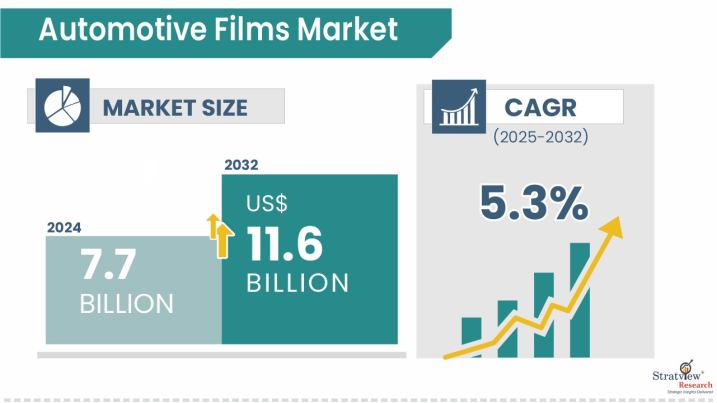
"The automotive films market size was USD 7.7 billion in 2024.”
Want to know more about the market scope? Register Here
Have a look at the sales opportunities presented by the automotive films market in terms of growth and market forecast.
Automotive Films Market Data & Statistics
|
Market Statistics |
Value (in USD Billion) |
Market Growth (%) |
|
Annual Market Size in 2023 |
USD 7.26 billion |
|
|
Annual Market Size in 2024 |
USD 7.7 billion |
YoY Growth in 2024: 6% |
|
Annual Market Size in 2025 |
USD 8.14 billion |
YoY Growth in 2025: 5.7% |
|
Annual Market Size in 2032 |
USD 11.68 billion |
CAGR 2025-2032: 5.3% |
|
Cumulative Sales Opportunity during 2025-2032 |
USD 78.82 billion |
|
|
Top 10 Countries’ Market Share in 2024 |
USD 6.16 billion + |
> 80% |
|
Top 10 Company’s Market Share in 2024 |
USD 3.85 billion to USD 5.39 billion |
50% - 70% |
Automotive films are thin, multi-layered films typically made of polyester or polymer materials. They are applied in vehicles for various purposes, such as aesthetic enhancement, performance improvement, surface protection, and others. Additionally, these films also offer customization options and functional benefits like heat reduction, UV protection, and enhanced privacy to users.
The automotive films market is witnessing steady growth, driven by increasing electric vehicle adoption, rising demand for thermal management solutions, and growing consumer preference for enhanced vehicle comfort and protection. Automotive films are increasingly used for solar control, UV protection, privacy, paint protection, and vehicle customization applications due to their ability to improve efficiency, durability, and aesthetics. A key trend shaping the industry is the development of advanced films with improved heat rejection, energy efficiency, and protective properties for next-generation vehicles.
Rising EV Adoption and Thermal Management Needs are Driving Market Growth
Rising electric vehicle adoption and increasing thermal management requirements are driving the growth of the automotive films market. Automotive films help reduce cabin heat buildup, improve passenger comfort, and enhance EV efficiency by lowering dependence on air-conditioning systems. The increasing use of larger glass surfaces and panoramic roofs in EVs is further increasing demand for solar-control and UV-blocking films.
According to the International Energy Agency (IEA), global electric car sales exceeded 17 million units in 2024, representing more than 20% of total car sales worldwide. The rapid expansion of EVs is supporting demand for advanced automotive films used in thermal management and glazing applications.
Growing Demand for UV Protection and Cabin Comfort is Expanding Market Share
Growing consumer focus on UV protection and cabin comfort is expanding the market share of the automotive films market. Automotive films provide UV rejection, glare reduction, and interior protection, improving passenger comfort while preventing fading and deterioration of vehicle interiors.
According to the World Health Organization (WHO), more than 1.5 million skin cancer cases were diagnosed globally in 2020, with ultraviolet radiation identified as the primary cause. Increasing awareness of UV exposure risks is supporting demand for UV-blocking automotive films.
Stringent Tinting Regulations Restrain Market Growth
Stringent regulations related to tint darkness and visible light transmission (VLT) are restraining the growth of the automotive films market. Regional variations in tinting standards create compliance challenges for manufacturers and installers while limiting the adoption of darker automotive films.
Many jurisdictions require front-side vehicle windows to maintain visible light transmission levels of approximately 70% or higher. These restrictions limit the use of darker films and increase certification requirements across different markets.
Competition from Smart Glazing Technologies Challenges Market Demand
Competition from factory-installed smart glazing and solar-control glass technologies is challenging demand in the automotive films market. Automakers are increasingly integrating advanced glazing solutions directly into vehicles, particularly in premium and EV segments, reducing reliance on aftermarket film installations.
According to the International Energy Agency (IEA), global electric vehicle sales increased by more than 25% in 2024. Rising EV adoption is encouraging OEM investments in integrated thermal management and glazing technologies, increasing competition for traditional automotive films.
Expansion of Paint Protection Films Strengthens Market Forecast
The expansion of paint protection films (PPF) and vehicle personalization solutions is strengthening the market forecast for the automotive films market. Growing consumer interest in vehicle customization, appearance preservation, and resale value improvement is increasing adoption of protective films, wraps, and self-healing coatings.
Increasing demand for premium vehicle protection solutions is creating opportunities for manufacturers and installers of advanced paint protection films across aftermarket automotive applications.
Growth in Emerging Automotive Markets Creates New Market Opportunities
Growth in emerging automotive markets is creating new opportunities in the automotive films market. Rising vehicle ownership, urbanization, and increasing disposable incomes across Asia-Pacific, Latin America, and Southeast Asia are expanding demand for automotive tinting, protective, and decorative films.
According to the International Energy Agency (IEA), electric vehicle sales across emerging markets in Asia and Latin America grew by more than 60% in 2024. Increasing EV adoption in developing regions is creating new demand for thermal management and protective automotive film solutions.
|
Segmentations |
List of Sub-Segments |
Segments with High-Growth Opportunity |
|
Film Type Analysis |
Wrap Films, Automotive Window Films, and Paint Protection Films |
Automotive window films segment is expected to acquire the largest market share during the forecast period. |
|
Application Type Analysis |
Exterior Application and Interior Application |
Exterior application segment is expected to hold the largest market share during the forecast period. |
|
Vehicle Type Analysis |
Passenger Vehicles and Commercial Vehicles |
Passenger vehicle segment is expected to dominate the market with the largest share during the forecast period. |
|
Regional Analysis |
North America, Europe, Asia-Pacific, and The Rest of the World |
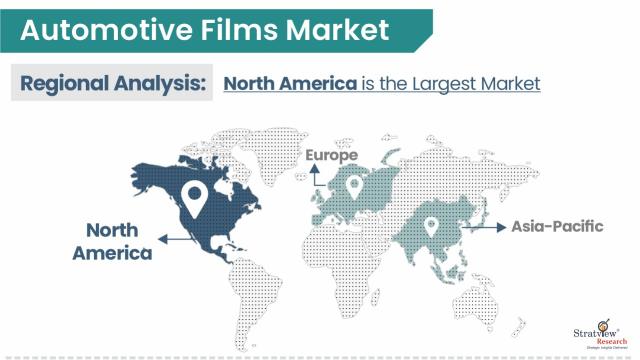
North America is expected to be the dominant and fastest-growing region over the forecasted period. |
“Automotive window films segment is projected to have the largest share of the market during the forecast period.”
“Exterior application segment is expected to account for the largest share of the market during the forecast period.”
“North America is expected to be the dominant and fastest-growing region over the forecasted period.”
Based on region, the automotive films market has been segmented into North America, Europe, Asia Pacific, and the Rest of the world. North America is expected to be the dominant and fastest-growing region over the forecasted period due to its well-established automotive industry. The automotive sector in North America is expected to expand with rising domestic demand, ongoing technological advancements, and expansion of production plants by large automotive manufacturers.
Know the high-growth countries in this report. Register Here
Most of the major players compete in some of the factors, including price, service offerings, regional presence, etc. The following are the key players in the automotive films market:
Note: The above list does not necessarily include all the top players in the market.
Are you a leading player in this market? We would love to include your name. Please write to us at [email protected]
Recent mergers & acquisitions and other developments in the 3D printing powder market reflect evolving market trends, and impact the market. Below given are a few recent developments in the market –
In November 2025, ADNOC's XRG received final regulatory approval for its €14.7 billion acquisition of Covestro, strengthening access to high-performance polyurethane and polycarbonate materials used in automotive paint protection films, interior surface films, and glazing applications.
In November 2025, AkzoNobel and Axalta announced an all-stock merger creating a coatings company with an enterprise value of approximately US$25 billion. The combined company is expected to generate around US$17 billion in annual revenue and achieve approximately US$600 million in cost synergies within three years.
In March 2025, ADNOC and OMV announced the combination of Borouge and Borealis, along with the proposed US$13.4 billion acquisition of Nova Chemicals, creating Borouge Group International with an estimated enterprise value exceeding US$60 billion and strengthening polyolefin material production for automotive protective films.
In July 2026, Garware Hi-Tech Films introduced four new automotive care products at ACMA Automechanika New Delhi, including Window Film Kits, WindShield Pro, Ceramic & Graphene Coating, and a Car Care Kit, expanding its vehicle protection portfolio.
In June 2026, XPEL announced a US$110 million investment in manufacturing and supply chain expansion across San Antonio, Texas, and China. The company acquired a 435,000-square-foot facility in San Antonio to support phased in-house production and improve regional supply capabilities.
In September 2025, XPEL launched COLOR Paint Protection Film in 16 colors, expanding its vehicle customization portfolio. The self-healing polyurethane film is two to three times thicker than conventional vinyl wrap and is backed by a 10-year warranty.
This report provides market intelligence most comprehensively. The report structure has been kept so that it offers maximum business value. It provides critical insights into market dynamics and will enable strategic decision-making for existing market players as well as those willing to enter the market.
The following are the key features of the report:
|
Market Study Period |
2019-2032 |
|
Base Year |
2024 |
|
Forecast Period |
2025-2032 |
|
Trend Period |
2019-2023 |
|
Number of Tables & Figures |
>100 |
|
Number of Segments Analysed |
4 (Film Type, Application Type, Vehicle Type, and Region) |
|
Number of Regions Analysed |
4 (North America, Europe, Asia-Pacific, Rest of the World) |
|
Countries Analysed |
15 (The USA, Canada, Mexico, Germany, France, Italy, The UK, China, Japan, India, Brazil, Saudi Arabia, Rest of Europe, Rest of APAC, and Rest of the World) |
|
Free Customization Offered |
10% |
|
After Sales Support |
Unlimited |
|
Report Presentation |
Complimentary |
|
Market Dataset |
Complimentary |
|
Further Deep Dive & Consulting Services |
10% Discount |
This report studies the market, covering a period of 15 years of trend and forecast. The report provides detailed insights into the market dynamics to enable informed business decision-making and growth strategy formulation based on the opportunities present in the market.
The automotive films market is segmented into the following categories:
By Film Type
By Vehicle Type
By Application Type
By Region
With this detailed report, Stratview Research offers one of the following free customization options to our respectable clients:
Company Profiling
Competitive Benchmarking
Custom Research: Stratview Research offers custom research services across industries. In case of any custom research requirement related to market assessment, competitive benchmarking, sourcing and procurement, target screening, and others, please send your inquiry to [email protected].
The report is delivered digitally through our online portal. Buyers receive login credentials from our team to access the report and may update their credentials at any time after the initial login.
Delivery timelines depend on the status of the report:
For the most accurate delivery timeline, please contact us to confirm the current status of the report.
Yes. You may request a complimentary preview of the report through a video conference with our team.
Yes. The scope of the report can be fully customized to align with your specific research objectives and information requirements.
Please contact us at [email protected], and our team will be happy to discuss your requirements and propose a tailored solution.
Yes. Selected sections of the report can be purchased separately based on your requirements. Please contact us at [email protected] to discuss your needs.
Yes, AI can help gather publicly available information, but its outputs are only as reliable as the data it accesses. Stratview Research reports are built using validated data, extensive primary interviews with industry stakeholders, and the expertise of our experienced research team.
Additionally, many critical insights, including market dynamics, competitive intelligence, and industry-specific trends, are not publicly available and therefore cannot be captured through AI alone.
The automotive films market encompasses the global industry focused on the design, manufacturing, distribution, and application of specialized film materials that are applied to various parts of a vehicle, primarily the windows, body panels, and lights. These films serve both functional and aesthetic purposes, and are used in original equipment manufacturing (OEM) as well as the automotive aftermarket.
The forecasted value for the market is US$ 11.68 billion in 2032.
The automotive films market size was USD 7.70 billion in 2024 and is expected to grow from USD 8.14 billion in 2025 to USD 11.68 billion in 2032, witnessing an impressive market growth (CAGR) of 5.3% during the forecast period (2025-2032).
The key drivers of the market include growing demand for vehicle customization and rising consumer awareness about the advantages of automotive films.
The top players in the market include 3M, Saint-Gobain, Eastman Chemical Company, Avery Dennison, and Lintec Corporation.
North America is expected to be the dominant and the fastest-growing region of the automotive films market over the forecasted period due to its well-established automotive industry.


WE ACCEPT