

Advanced Ceramics Market Analysis | 2026-2031

Advanced Ceramics Market Analysis | 2026-2031

Advanced Ceramics Market Analysis | 2026-2031
Report code - SR2942
Analyst: Purva Jain Published On : Jan,2026 No. of Pages: 120
Advanced Ceramics Market Size, Share, Trend, Forecast, Competitive Landscape & Growth See more...

Attractive Opportunities

Global Demand Analysis & Sales Opportunities in the Advanced Ceramics Market:

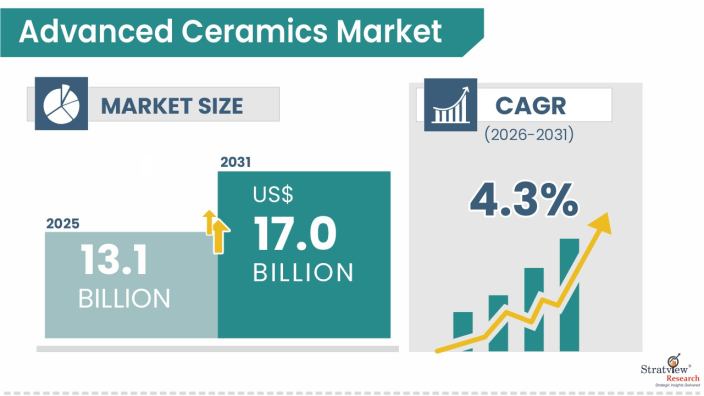
  • The annual demand for insulation was USD 13.1 billion in 2025 and is expected to reach USD 13.8 billion in 2026, reflecting a year-over-year (YoY) growth of 5.3% compared with 2025.

  • During the forecast period (2026-2031), the advanced ceramics market is expected to grow at a CAGR of 4.3%. The annual demand will reach USD 17.0 billion in 2031.

  • During 2026-2031, the insulation industry is expected to generate a cumulative sales opportunity of USD 93.1 billion.
Advanced-Ceramics-Market-Attractive-Opportunities

Want to know more about the market scope? Register Here

High-Growth Market Segments:

  • Asia-Pacific is expected to dominate the market during the forecast period.

  • By type, functional ceramics are expected to maintain a lead throughout the forecast period.

  • By end-use type, electrical & electronics is expected to remain the dominant as well as the fastest-growing end-use type in the market during the forecast period.

  • By electrical & electronics type, electrical & electronic components dominated the electrical & electronics advanced ceramic market and are expected to remain dominant in the coming years.

  • By medical application type, dental is the dominant application, followed by orthopedic, in the advanced medical ceramics market.

  • By automotive application type, powertrain components are anticipated to contribute the largest share of the automotive advanced ceramics market.

  • By aerospace, defense, & security application type, propulsion & controls applications dominated the aerospace, defense, and security advanced ceramics market and are also expected to experience healthy growth in the coming years.

  • By industrial application type, bearings, bushings, & seals are expected to remain the dominant application type in the industrial advanced ceramics market during the forecast period.

  • By material type, alumina is likely to remain dominant in the market in the coming years.

Market Statistics:

Have a look at the sales opportunities presented by the advanced ceramics market in terms of growth and market forecast.

Advanced Ceramics Market Data & Statistics

Market Statistics

Value (in USD Billion)

Market Growth (%)

Annual Market Size in 2024

USD 12.5 billion

-

Annual Market Size in 2025

USD 13.1 billion

YoY Growth in 2025: 4.5%

Annual Market Size in 2026

USD 13.8 billion

YoY Growth in 2026: 5.3%

Annual Market Size in 2031

USD 17.0 billion

CAGR 2026-2031: 4.31%

Cumulative Sales Opportunity during 2026-2031

USD 93.1 billion

-

Top 10 Countries’ Market Share in 2025

USD 10.4 billion+

> 80%

Top 10 Companies’ Market Share in 2025

USD 6.5 billion - USD 9.2 billion

50% - 70%

Market Dynamics

What are Advanced Ceramics?

Advanced ceramics, also known as technical or engineering ceramics, are high-performance ceramics that are specifically engineered to meet demanding functional or structural requirements in modern industrial and high-technology applications. Unlike traditional ceramics, which are mainly used for basic structural or household purposes, advanced ceramics are produced using high-purity raw materials, tightly controlled compositions, and advanced manufacturing processes.

Advantages of advanced ceramics over metals and polymers include extreme hardness and wear resistance, high compressive strength, excellent dimensional stability, high chemical resistance, and high electrical resistivity, making them a preferred material for high-performance environments.

Market Drivers

Rapid Expansion of Semiconductor Industry with Increasing Reliance on Advanced Ceramics

  • Advanced ceramics have become indispensable in semiconductor manufacturing due to their unique combination of mechanical strength, electrical insulation, thermal stability, and chemical inertness. Materials such as alumina, aluminum nitride, silicon nitride, zirconia, beryllium oxide, and boron nitride are widely used in wafer processing equipment, microelectronic packaging, and high-performance devices, where they consistently outperform plastics in heat-intensive, high-precision environments.
  • This material dependence is intensifying as the global semiconductor industry scales rapidly, with the Semiconductor Industry Association (SIA) reporting sales of USD 791.7 billion in 2025, up 25.6% from USD 630.5 billion in 2024. The market is further projected to reach approximately USD 975 billion in 2026, driven largely by AI infrastructure demand.
  • As semiconductor fabrication becomes more complex and thermally demanding, advanced ceramics are increasingly positioned as a foundational material enabling performance, precision, and reliability at scale.

Increasing Use of Advanced Ceramics in Aerospace Electronics and High-Temperature Systems

  • Advanced ceramics are gaining traction in aerospace as aircraft systems become more electronics-intensive and thermally demanding. Modern aircraft integrate a growing number of miniaturized electronic components such as sensors, antennas, capacitors, and resistors, all of which require materials with high electrical insulation and thermal stability.
  • At the same time, ceramics offer a weight advantage over metals while enabling operation under extreme temperature and electrical conditions, making them suitable for critical applications like engine control systems and high-performance avionics.
  • This combination of electronics proliferation + harsh operating environments is directly driving the adoption of advanced ceramics in next-generation aerospace platforms.

Market Opportunities

Advancements in Ceramic Materials and Processing Technologies Creating New Application Opportunities

  • Continuous advancements in material engineering are expanding the functional capabilities of advanced ceramics, enabling their use in applications where conventional materials face performance limitations. Enhanced compositions and microstructural control are supporting improved reliability in compact electronic components, sensors, and high-efficiency power systems.
  • In addition, the increasing adoption of ceramic-based semiconductor materials such as silicon carbide and gallium nitride is opening new opportunities in electric mobility and power electronics, particularly in applications requiring high thermal conductivity and energy efficiency.
  • Simultaneously, progress in manufacturing technologies, including additive manufacturing and ceramic matrix composite development, is improving design flexibility and production consistency. As these processes mature, they are expected to support wider adoption of advanced ceramics across aerospace, energy, and industrial sectors.

Segment Analysis

Segmentations

List of Sub-Segments

Segments with High-Growth Opportunity

Type Analysis

Structural Ceramics and Functional Ceramics

Functional ceramics are expected to maintain a lead throughout the forecast period.

End-Use Industry-Type Analysis

Electrical & Electronics, Medical, Automotive, Aerospace, Defense, and Security, Industrial, and Other End-Use Industries.

Electrical & Electronics is expected to remain the dominant and fastest-growing end-use industry type over the forecast period.

Electrical & Electronics Application-Type Analysis

Electrical & Electronic Components, Deposition, Etch, and Other Applications

Electrical & Electronic components dominated the electrical & electronics advanced ceramic market and are expected to remain dominant in the coming years.

Medical Application-Type Analysis

Dental, Orthopedic & Other Implants, and Medical and Pharmaceutical Equipment

Dental is the dominant application, followed by orthopedic, in the advanced medical ceramics market.

Automotive Application-Type Analysis

Powertrain Components, Electronic Components, Sensor Components, and Other Applications

Powertrain components are anticipated to contribute the largest share of the automotive advanced ceramics market.

Aerospace, Defense, and Security Application-Type Analysis

Propulsion and Controls, Armor and Security Protection, Antenna and Navigation Components, Electronic Systems and Lighting, and Other Applications

Propulsion and controls applications dominated the aerospace, defense, and security advanced ceramics market and are also expected to experience a healthy growth in the coming years.

Industrial Application-Type Analysis

Bearings, Bushings, and Seals, Tooling & Machinery, Sensor Components, and Other Applications

Bearings, bushings, and seals are expected to remain the dominant application type in the industrial advanced ceramics market during the forecast period.

Material-Type Analysis

Alumina, Silicon Carbide, Zirconia, and Other Materials

Alumina is likely to remain dominant in the market in the coming years.

Region Analysis

North America, Europe, Asia-Pacific, and The Rest of the World

The Asia-Pacific is expected to maintain its reign over the forecast period.

By Type

Functional ceramics accounted for a larger share of the advanced ceramics market and are also expected to experience growth during the forecast period.

  • The advanced ceramics market is segmented into structural ceramics and functional ceramics. Structural ceramic offers several advantages, which include high mechanical strength, hardness, and wear resistance; stability under extreme temperatures; good electrical insulation; low solubility; good biocompatibility; and radiofrequency (RF) transparency. The common applications of structural ceramics are bearings, seals, armors, liners, nozzles, and cutting tools.
  • Functional ceramics offer diverse electrical and functional properties, including dielectric, ferroelectric, sensing, and superconducting behaviour, enabling their use across a broad and diverse range of applications. Key applications of functional ceramics are heating elements, temperature sensors, substrates and chip packaging, capacitors, transducers, actuators, memory cells, etc.

By End-Use Industry Type

Electrical & Electronics (including semiconductor) represent the largest demand-generating and fastest-growing end-use industry type in the market during the forecast period.

  • The advanced ceramics market is segmented into electrical & electronics, medical, automotive, aerospace, defense, security, industrial, and other end-use industries. Electrical & Electronics dominate the advanced ceramics market due to advanced ceramics' indispensable role in semiconductor manufacturing, high-volume component consumption, rising electrification in vehicles, and the inability of alternative materials to meet modern performance requirements.
  • Medical remains the second-largest end-use industry, driven by the rising adoption of advanced materials in surgical robotics and AI-based medical devices, along with increasing demand for biocompatible, highly wear-resistant, and durable materials for orthopedic and dental implants.
  • Other end-use industries include power, energy (solar, nuclear, and wind energy), chemical, food & beverage, agriculture, railway, O&G, pharmaceutical, etc.

By Material Type

Alumina is expected to remain the dominant material while silicon carbide is projected to be the fastest-growing material type in the market during the forecast period.

  • In terms of material type, the market is segmented into alumina, silicon carbide, zirconia, and other materials. Alumina (Alâ‚‚O₃) is the most widely used advanced ceramic material across industries, including electronics, semiconductors, medical devices, aerospace, automotive, and industrial applications. Their widespread adoption is driven by a high melting point, excellent thermal and mechanical stability, superior wear resistance and hardness, chemical inertness and biocompatibility, and strong cost-effectiveness.
  • Silicon carbide (SiC) is one of the lightest and hardest advanced ceramic materials, offering excellent thermal conductivity, low thermal expansion, and strong resistance to acids and alkalis. Additional properties include high corrosion resistance, low density, a high Young’s modulus, and exceptional thermal shock resistance, making SiC ideal for high-temperature and high-stress applications.
  • Rising demand for dental and orthopedic implants is driving increased adoption of zirconia, due to its excellent biocompatibility, high fracture toughness, and superior mechanical strength.
  • Other materials include aluminum nitride, silicon nitride, fused silica, boron carbide, silicates, tungsten carbide, titanate, piezoceramics, etc.

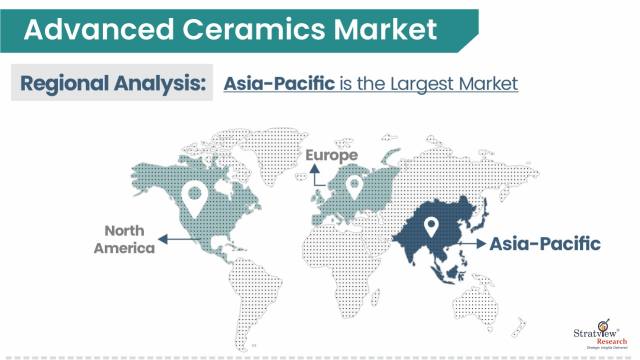
Regional Analysis

Asia-Pacific is expected to remain the largest market for advanced ceramics during the forecast period.

  • Asia Pacific led the market owing to the largest electronics, semiconductor, and automotive production, along with cost-effective manufacturing, Government support, and industrial policies. The dominance of Asia-Pacific is driven by dominant electronics manufacturing, expanding semiconductor fabs, rising automotive production (including EV), large-scale industrial production, expected increase in air passenger traffic, and rising defense budget of emerging Asian economies.
  • North America is expected to remain the second-largest market, supported by the strong presence of major aircraft OEMs, the world’s largest medical device industry, and its position as a leading producer of semiconductor equipment.
  • Europe is the third-largest market, owing to second-dominant automotive production along with a high focus on premium and high-performance vehicles, a well-established dental implant market, a well-established aerospace and defense industry, and a growing focus on energy-efficient and sustainable technologies.

Advanced-Ceramics-Market-Regional-Insights

Know the high-growth countries in this report. Register Here

Competitive Landscape

Most of the major players compete in some of the factors, including price, service offerings, and regional presence, etc. The following are the key players in the advanced ceramics market–

(Based on Dominance)

Note: The above list does not necessarily include all the top players in the market.

Are you a leading player in this market? We would love to include your name. Please write to us at [email protected]

Report Features

This report provides market intelligence most comprehensively. The report structure has been kept so that it offers maximum business value. It provides critical insights into market dynamics and will enable strategic decision-making for existing market players as well as those willing to enter the market.

The following are the key features of the report:

  • Market structure: Overview, industry life cycle analysis, supply chain analysis.
  • Market environment analysis: Growth drivers and constraints, Porter’s five forces analysis, SWOT analysis.
  • Market trend and forecast analysis.
  • Market segment trend and forecast.
  • Competitive landscape and dynamics: Market share, Service portfolio, New Product Launches, etc.
  • COVID-19 impact and its recovery curve.
  • Attractive market segments and associated growth opportunities.
  • Emerging trends.
  • Strategic growth opportunities for the existing and new players.
  • Key success factors.

Market Study Period

2019-2031

Base Year

2025

Forecast Period

2026-2031

Trend Period

2019-2024

Number of Tables & Figures

>100

Number of Segments Analysed

(Type, End-Use Type, Electrical & Electronics Application Type, Medical Application Type, Automotive Application Type, Aerospace, Defense, and Security Application Type, Industrial Application Type, Material Type, and Region)

Number of Regions Analysed

(North America, Europe, Asia-Pacific, Rest of the World)

Countries Analysed

15 (The USA, Canada, Mexico, Germany, France, Italy, The UK, China, Japan, India, Brazil, Saudi Arabia, Rest of Europe, Rest of APAC, and Rest of the World)

Free Customization Offered

10%

After Sales Support

Unlimited

Report Presentation

Complimentary

Market Dataset

Complimentary

Further Deep Dive & Consulting Services

10% Discount

Market Segmentation

The report provides detailed insights into the market dynamics to enable informed business decision-making and growth strategy formulation based on the opportunities present in the market.

The advanced ceramics market is segmented into the following categories:

By Type

  • Structural Ceramics (Regional Analysis: North America, Europe, Asia-Pacific, and Rest of World)
  • Functional Ceramics (Regional Analysis: North America, Europe, Asia-Pacific, and Rest of World)

By End-Use Industry Type

  • Electrical & Electronics (Regional Analysis: North America, Europe, Asia-Pacific, and Rest of World)
  • Medical (Regional Analysis: North America, Europe, Asia-Pacific, and Rest of World)
  • Automotive (Regional Analysis: North America, Europe, Asia-Pacific, and Rest of World)
  • Aerospace, Defense, and Security (Regional Analysis: North America, Europe, Asia-Pacific, and Rest of World)
  • Industrial (Regional Analysis: North America, Europe, Asia-Pacific, and Rest of World)
  • Other End-Use Industries (Regional Analysis: North America, Europe, Asia-Pacific, and Rest of World)

By Electrical & Electronics Application Type

  • Electrical & Electronic Components (Regional Analysis: North America, Europe, Asia-Pacific, and Rest of World)
  • Deposition (Regional Analysis: North America, Europe, Asia-Pacific, and Rest of World)
  • Etch (Regional Analysis: North America, Europe, Asia-Pacific, and Rest of World)
  • Other Applications (Regional Analysis: North America, Europe, Asia-Pacific, and Rest of World)

By Medical Application Type

  • Dental (Regional Analysis: North America, Europe, Asia-Pacific, and Rest of World)
  • Orthopedic & Other Implants (Regional Analysis: North America, Europe, Asia-Pacific, and Rest of World)
  • Medical and Pharmaceutical Equipment (Regional Analysis: North America, Europe, Asia-Pacific, and Rest of World)

By Automotive Application Type

  • Powertrain Components (Regional Analysis: North America, Europe, Asia-Pacific, and Rest of World)
  • Electronic Components (Regional Analysis: North America, Europe, Asia-Pacific, and Rest of World)
  • Sensor Components (Regional Analysis: North America, Europe, Asia-Pacific, and Rest of World)
  • Other Applications (Regional Analysis: North America, Europe, Asia-Pacific, and Rest of World)

By Aerospace, Defense, and Security Application Type

  • Propulsion and Controls (Regional Analysis: North America, Europe, Asia-Pacific, and Rest of World)
  • Armor and Security Protection (Regional Analysis: North America, Europe, Asia-Pacific, and Rest of World)
  • Antenna and Navigation Components (Regional Analysis: North America, Europe, Asia-Pacific, and Rest of World)
  • Electronic Systems and Lighting (Regional Analysis: North America, Europe, Asia-Pacific, and Rest of World)
  • Other Applications (Regional Analysis: North America, Europe, Asia-Pacific, and Rest of World)

By Industrial Application Type

  • Bearings, Bushings, and Seals (Regional Analysis: North America, Europe, Asia-Pacific, and Rest of World)
  • Tooling & Machinery (Regional Analysis: North America, Europe, Asia-Pacific, and Rest of World)
  • Sensor Components (Regional Analysis: North America, Europe, Asia-Pacific, and Rest of World)
  • Other Applications (Regional Analysis: North America, Europe, Asia-Pacific, and Rest of World)

By Material Type

  • Alumina (Regional Analysis: North America, Europe, Asia-Pacific, and Rest of World)
  • Silicon Carbide (Regional Analysis: North America, Europe, Asia-Pacific, and Rest of World)
  • Zirconia (Regional Analysis: North America, Europe, Asia-Pacific, and Rest of World)
  • Other Materials (Regional Analysis: North America, Europe, Asia-Pacific, and Rest of World)

By Region

  • North America (Country Analysis: The USA, Canada, and Mexico)
  • Europe (Country Analysis: Germany, France, the UK, Russia, and the rest of Europe)
  • Asia-Pacific (Country Analysis: Japan, China, India, and Rest of Asia-Pacific)
  • Rest of the World (Country Analysis: Brazil and Rest of the World)

Research Methodology

  • This strategic assessment report from Stratview Research provides a comprehensive analysis that reflects today’s advanced ceramics market realities and future market possibilities for the forecast period.
  • The report segments and analyzes the market in the most detailed manner in order to provide a panoramic view of the market.
  • The vital data/information provided in the report can play a crucial role for market participants and investors in identifying the low-hanging fruit available in the market and formulating growth strategies to expedite their growth process.
  • This report offers high-quality insights and is the outcome of a detailed research methodology comprising extensive secondary research, rigorous primary interviews with industry stakeholders, and validation and triangulation with Stratview Research’s internal database and statistical tools.
  • More than 1,000 authenticated secondary sources, such as company annual reports, fact books, press releases, journals, investor presentations, white papers, patents, and articles, have been leveraged to gather the data.
  • We conducted more than 25 detailed primary interviews with market players across the value chain in all four regions and industry experts to obtain both qualitative and quantitative insights.

Customization Options

With this detailed report, Stratview Research offers one of the following free customization options to our respected clients:

Company Profiling

  • Detailed profiling of additional market players (up to three players)
  • SWOT analysis of key players (up to three players)

Competitive Benchmarking

  • Benchmarking of key players on the following parameters: Service portfolio, geographical reach, regional presence, and strategic alliances.

Custom Research: Stratview Research offers custom research services across sectors. In case of any custom research requirement related to market assessment, competitive benchmarking, sourcing and procurement, target screening, and others, please send your inquiry to [email protected].

Frequently Asked Questions (FAQs)

The global advanced ceramics market was valued at USD 13.1 billion in 2025 and is expected to reach USD 17.0 billion by 2031, growing at a CAGR of 4.3% during 2026–2031. The market is witnessing steady growth, supported by increasing demand from high-performance applications across electronics, automotive, medical, and industrial sectors.

Asia-Pacific leads the global advanced ceramics market, driven by its strong electronics manufacturing base, expanding semiconductor industry, and growing automotive production. Countries such as China, Japan, South Korea, and India are key contributors, supported by increasing investments in advanced manufacturing and electric mobility.

The market is primarily driven by the rapid expansion of the semiconductor and electronics industry, where advanced ceramics are widely used for their thermal stability and electrical insulation properties. In addition, rising adoption in electric vehicles, medical implants, and high-temperature industrial applications is accelerating demand for materials such as alumina, silicon carbide, and zirconia.

The electrical & electronics industry dominates the advanced ceramics market, driven by their extensive use in semiconductor manufacturing equipment, electronic components, and substrates. Other key demand centers include industrial applications, automotive systems, medical devices, and aerospace systems, where performance under extreme conditions is critical.

Advanced ceramics play a critical role in semiconductor fabrication, particularly in wafer processing, deposition, and etching equipment. Their resistance to high temperatures, plasma environments, and chemical corrosion makes them essential for maintaining precision and reliability in chip manufacturing. As semiconductor complexity increases, the demand for high-purity ceramic components continues to rise.

Major materials in the advanced ceramics market include alumina, silicon carbide, zirconia, aluminum nitride, and silicon nitride. Among these, alumina remains the most widely used due to its cost-effectiveness and balanced performance, while silicon carbide and aluminum nitride are gaining traction in high-power and high-temperature applications.

Key players include Kyocera Corporation, CoorsTek, Inc., CeramTec GmbH, Niterra Co., Ltd., Morgan Advanced Materials plc, and NGK Insulators, Ltd. These companies are focusing on material innovation, application-specific product development, and expansion in high-growth sectors such as semiconductors, electric vehicles, and medical devices. Strategic investments in advanced processing technologies and global supply capabilities remain a key priority.