




404
+1-313-307-4176

FRP Rebar Market Analysis | 2026-2030

FRP Rebar Market Size, Share, Trend, Forecast, Competitive Landscape & Growth Opportunities: 2026-2030
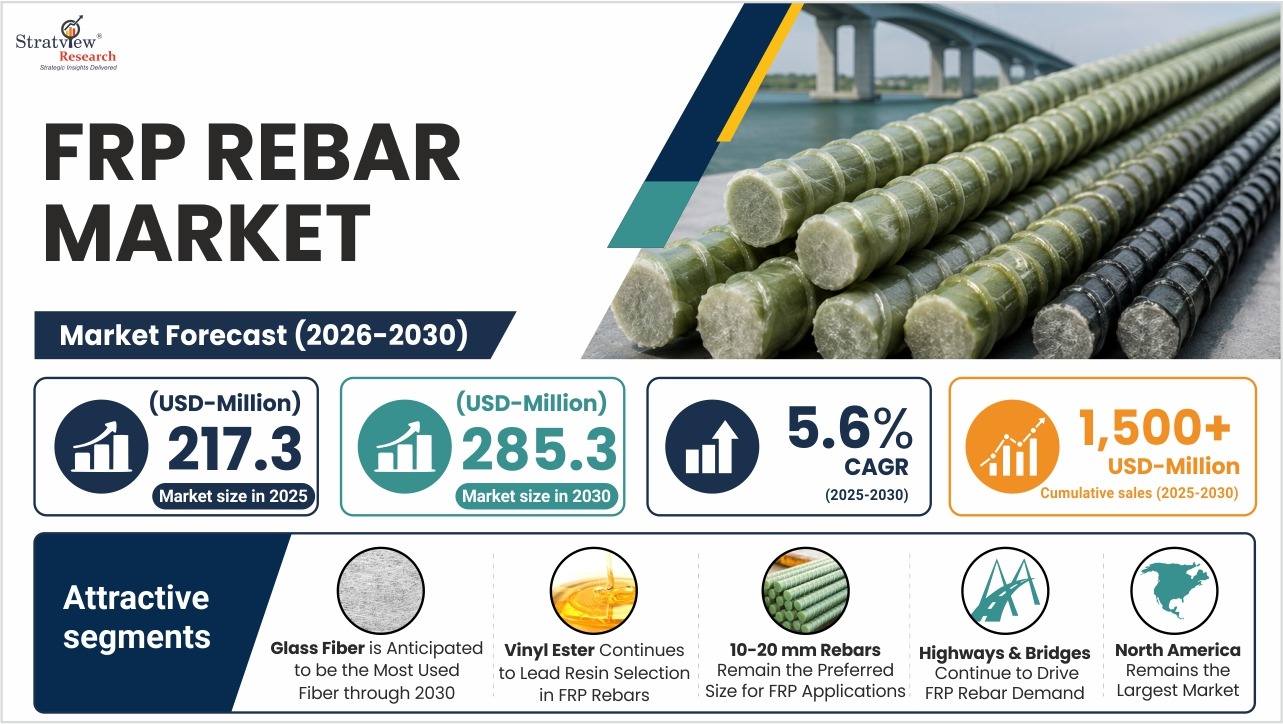
“The FRP rebar market size is projected to reach USD 234.7 million in 2026 and offering robust growth opportunities for the market stakeholders. With the market expected to grow at a CAGR of 5%, annual sales will hit the USD 285.3 million mark by 2030, highlighting the increasing demand for corrosion-resistant and lightweight reinforcement solutions across highways, bridges, marine structures, and water treatment infrastructure.”
The annual demand for FRP rebar was USD 217.3 million in 2025 and is expected to reach USD 234.7 million in 2026, up 8.0% from the value in 2025.
During the forecast period (2026-2030), the FRP rebar market is expected to grow at a CAGR of 5.0%. The annual demand will reach USD 285.3 million in 2030, which is almost 1.3 times the demand in 2026.
North America is expected to remain the largest market, generating the highest demand across regions during the forecast period.
By fiber type, Glass Fiber is anticipated to remain the dominant and fastest-growing fiber type during the forecast period.
By resin type, Vinyl Ester accounts for the largest share, attributed to its higher durability and resistance to heat, water, and corrosion.
By application type, Highways & Bridges is expected to remain the dominant application, driven by rising demand for renovation and strengthening of new and existing structures.
“According to Senior Analyst at Stratview Research, the FRP rebar market will generate a cumulative sales opportunity worth more than USD 1,500 million during 2026-2030. During the next five years, Glass Fiber, Highways & Bridges, & North America are some of the high-opportunity segments to bank upon.”
Sharpen your strategies to explore this USD 1,500+ million opportunity. Get free sample of our report here.
Have a look at the sales opportunities presented by the FRP rebar market in terms of growth and market forecast.
|
Market Statistics |
Value (in USD Million) |
Market Growth (%) |
|
Market Size in 2025 |
USD 217.3 million |
- |
|
Market Size in 2026 |
USD 234.7 million |
YoY Growth in 2026: 6.0% |
|
Market Size in 2030 (forecast horizon can be extended to 2034) |
USD 285.3 million |
CAGR 2026-2030: 5.0% |
|
Cumulative Sales Opportunity during 2026-2030 |
USD 1,500 million + |
- |
|
Top 10 Countries’ Market Share in 2025 |
USD 160 million + |
> 75% |
|
Top 10 Companies’ Market Share in 2025 |
USD 130 million + |
> 60% |
Want to explore the market opportunities? Get free sample here.
The FRP rebar market is expanding as infrastructure owners increasingly seek corrosion-resistant, lightweight, and durable reinforcement solutions with the increasing non-residential construction. Growing applications across bridges, highways, marine structures, and water treatment facilities are supporting adoption, particularly where long service life and reduced maintenance are critical.
Want to explore the market growth factors? Get free sample here
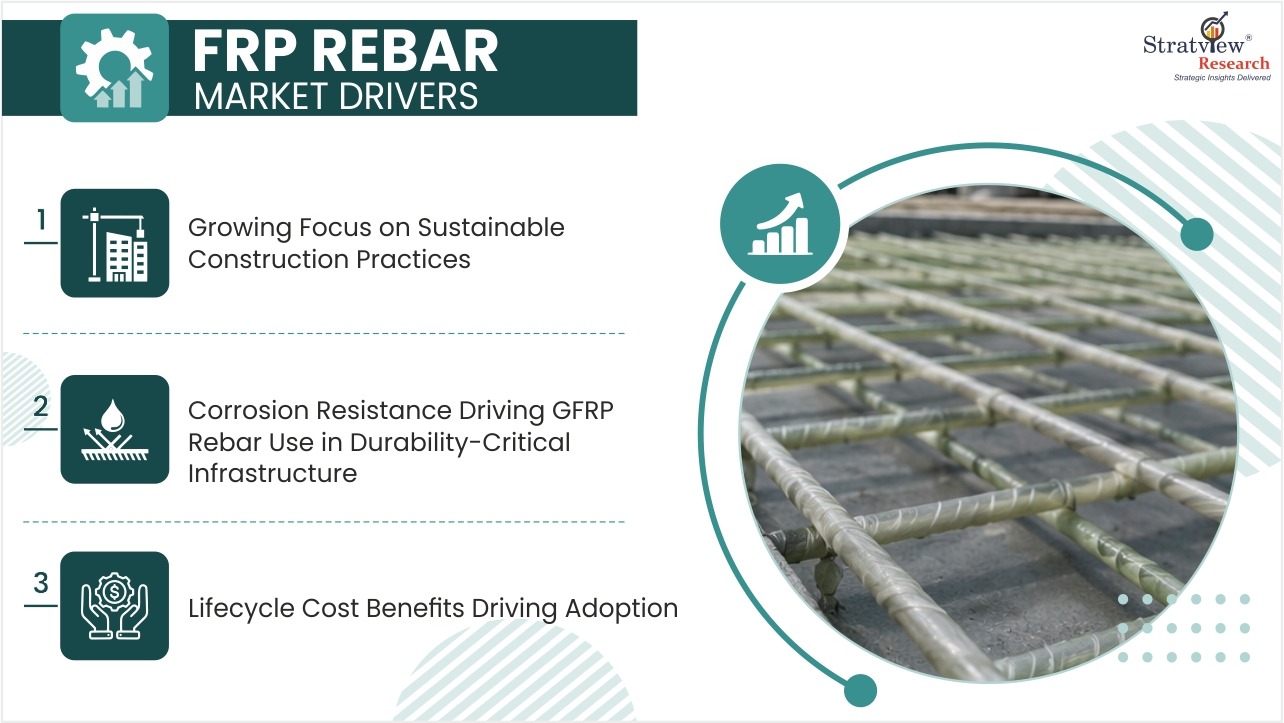
Growing Focus on Sustainable Construction Practices
Sustainability is emerging as an important consideration in construction investment, with approximately 13% of new investment in the construction industry directed toward sustainability initiatives, according to recent research. FRP rebar offers several sustainability-related advantages over conventional steel reinforcement, including corrosion resistance, lower weight, and reduced maintenance requirements. Its lower weight can also reduce transportation-related energy consumption during construction. These characteristics can support lower lifecycle environmental impacts in applications where durability and maintenance reduction are important considerations.
Corrosion Resistance Driving GFRP Rebar Use in Durability-Critical Infrastructure
Corrosion resistance remains a key reason for specifying GFRP rebar in concrete structures exposed to aggressive environments. Oregon Department of Transportation’s 2025 Bridge Design Manual documents the use of GFRP bars on multiple projects, particularly in bridge decks and sound walls, and identifies corrosion resistance and non-conductivity among the reasons for their use. The manual also notes that GFRP is suitable for concrete reinforcement and identifies bridge decks and other structures in corrosive environments as applications where GFRP can provide a corrosion-resistant alternative to ferrous reinforcement.
Growing Non-Residential Construction Activity Expanding the Addressable Market for FRP Rebar
Continued construction activity across building and infrastructure applications is expanding the potential project base for FRP rebar. In the U.S., institutional construction spending is forecast to increase 2.8% in 2026 and 2.7% in 2027, while healthcare construction is projected to grow 4.4% in 2027, according to the AIA Consensus Construction Forecast. Commercial construction is also expected to grow 5.8% in 2027, although this outlook is heavily influenced by data-center activity. These trends indicate continued construction activity across several end-use segments, expanding the addressable project base for reinforcement materials such as GFRP rebar.
“As per the analyst, the global FRP rebar industry is evolving fast. While conducting the market analysis and speaking with the leading players, it is quite clear that the next decade will be defined by trends like greater adoption of GFRP rebars in critical infrastructure, development of hybrid composite reinforcement systems, and growing emphasis on lifecycle cost-based procurement in construction projects.”
Align with the mega trends shaping the industry. Get free sample here.
Higher Initial Cost Compared with Conventional Steel Reinforcement
Higher initial cost remains an important consideration when selecting FRP rebar over conventional steel reinforcement. A 2025 Austroads comparative analysis identifies the higher initial cost of GFRP bars as a limitation, while also recognizing their corrosion resistance, lightweight characteristics, and high strength-to-weight ratio as application-specific advantages. The upfront cost difference can constrain adoption in projects where initial material expenditure is prioritized, particularly where corrosion exposure is limited and the long-term durability benefits of GFRP are less significant.
Weak Architecture Billings Signaling Pressure on the Future Construction Pipeline
Weak architecture activity presents a potential constraint on the future project pipeline for FRP rebar in building applications. The AIA/Deltek Architecture Billings Index, which typically leads nonresidential construction spending by approximately 9–12 months, has shown declining billings since early 2023, with weakness persisting into 2026.AIA also notes that project inquiries have remained relatively resilient, but interest is not consistently converting into billable work as owners and developers reassess construction costs, budgets, financing conditions, and broader economic risks. A weaker pipeline of new nonresidential projects can therefore limit near-term opportunities for GFRP reinforcement, although the impact varies across construction segments.
Get insights on high-growth segments. Get free sample here.
“Glass fiber is expected to remain the most dominant and fastest-growing fiber type in the market during the forecast period.”
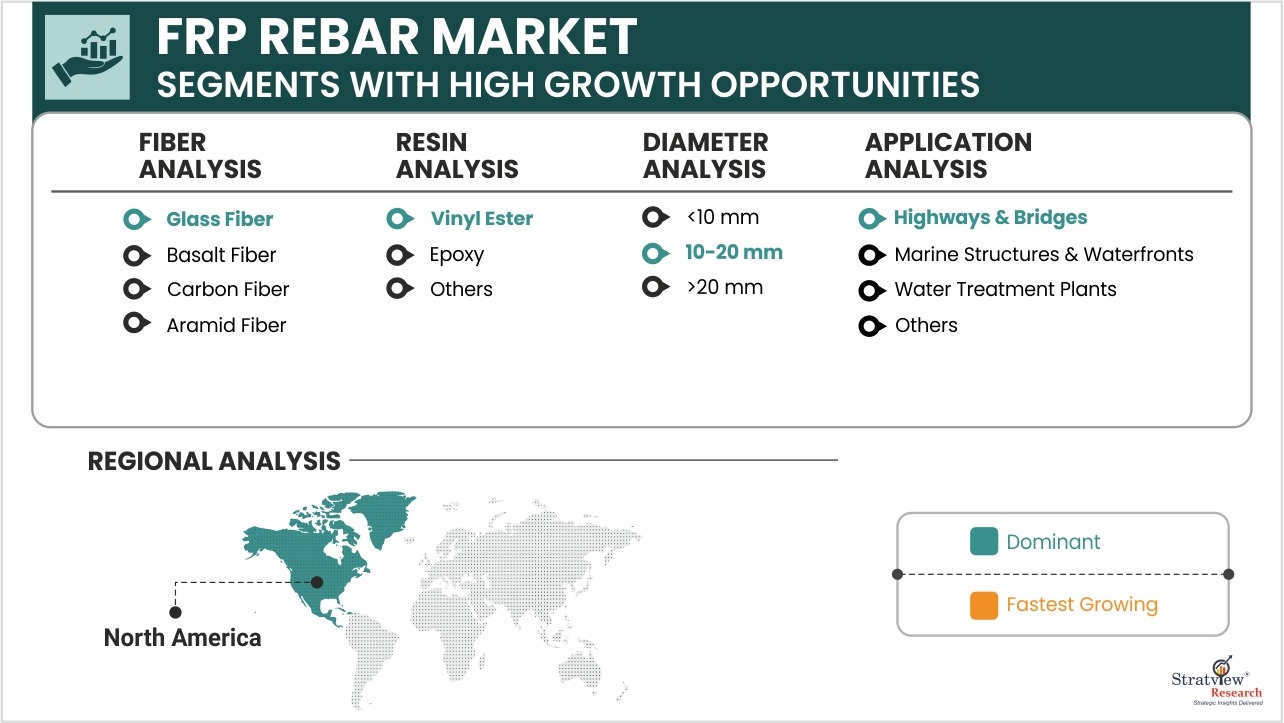
The FRP rebar market is segmented into glass fiber, basalt fiber, carbon fiber, and aramid fiber. Glass fiber is expected to remain the most dominant and fastest-growing fiber type in the market during the forecast period due to its significantly lower price compared to basalt and carbon fiber rebars and improved qualities including strength, flexibility, durability, stability, lightweight, and resistance to heat, temperature, and moisture. Construction of roads, bridges, maritime constructions, buildings, waterfronts, and water treatment facilities are among the major applications of glass fiber rebar. The wide availability of raw materials, established manufacturing infrastructure, and proven field performance across diverse climatic conditions further reinforce the dominance of glass fiber in this market.
“Vinyl ester is anticipated to remain the dominant resin type in the market during the forecast period.”
Based on the resin type, the market is segmented into vinyl ester, epoxy, and others. Vinyl ester is anticipated to remain the dominant resin type in the market during the forecast period due to its increased toughness, heat, water, and corrosion resistance. Another important aspect contributing to its growing market share is its lower cost when compared to epoxy resins. It is a hybrid polyester resin that has epoxy resin added to it to make it stronger. Due to its superior physical performance compared to polyester resins and economic advantages over epoxies, vinyl ester resin is the most widely utilized in FRP rebars around the world.
“10-20 mm diameter is the most widely used diameter segment in the FRP rebar market.”
Based on diameter, the market is segmented into <10 mm, 10-20 mm, and >20 mm. The 10-20 mm diameter segment is widely used in the FRP rebar market, as this range is most compatible with standard construction reinforcement requirements for bridges, highways, and buildings. The 10–20 mm range offers an optimal balance between tensile load capacity and ease of installation, making it the preferred choice across a wide variety of civil infrastructure applications. Larger diameter rebars (>20 mm) are increasingly being adopted for heavy-duty industrial and marine applications.
“Highways and bridges are expected to remain the dominant application type in the market during the forecast period.”
The market is segmented into highways and bridges, marine structures and waterfronts, water treatment plants, and others. Highways and bridges are expected to remain the dominant application type in the market during the forecast period. The demand for these rebars in this market is driven by the rise in demand for remodeling and strengthening of new and existing structures to lower repair and maintenance costs and extend the life cycle of the structures. Demand for FRP rebars in highways, bridges, and buildings is primarily concentrated in countries with large infrastructure development and rehabilitation programs, including the USA, Canada, China, Japan, India, Germany, France, the UK, Saudi Arabia, Brazil, and Mexico.
“North America is projected to lead the FRP rebar market in terms of market share.”
North America is expected to remain the largest market for FRP rebars due to strong infrastructure rehabilitation needs, particularly for aging bridges, highways, and marine structures exposed to corrosion. The region also benefits from early adoption of composite reinforcement technologies and extensive use of durable materials in public infrastructure projects. In addition, sustained government funding for transportation upgrades, increasing focus on lifecycle cost reduction, and growing emphasis on resilient and low-maintenance construction continue to drive demand for corrosion-resistant FRP reinforcement solutions across the region. The USA is expected to remain the single largest country market during the forecast period.
“The study indicates that the Top 10 countries generate >75% of the annual sales for the FRP rebar market. A few countries are the demand powerhouses and will drive the regional markets in big ways, offering attractive business opportunities.”
Speak to us for deep dive into a country/region specific opportunity. Contact us here.
The FRP rebar market is moderately concentrated with the presence of some regional and global players. Most of the major players compete on governing factors including price, product offerings, regional presence, and technical capabilities. Leading players hold strong market positions with diverse product portfolios and established distribution networks.
The following are the key players in the FRP rebar market:
Pultron Composites
Dextra Group
Schöck Bauteile GmbH
FiReP Group
Owens Corning
Composite Group Chelyabinsk
B&B FRP Manufacturing Inc.
Kodiak Fiberglass Rebar LLC
Exel Composites
Mateenbar USA Inc.
Note: The above list is not an exhaustive list of the key players in the market. If your company is active in this market and would like to be considered for inclusion in future editions of this study, please contact us at [email protected].
Have the competitive edge with our intelligence. Get free sample here.
Recent mergers & acquisitions and other developments in the FRP rebar market reflect evolving market trends and impact the market. Below are a few recent developments in the market –
August 2026 | Pultron Composites | Market Expansion
Pultron Composites expanded into Western Australia with the appointment of a Business Development Manager to support growth across infrastructure, resources, and defense markets, with Mateenbar GFRP rebar specifically included in the portfolio.
March 2026 | Pultron Composites | Geographic Expansion
Pultron Composites established a permanent Australian base within the Moreton Bay innovation precinct, supporting its infrastructure portfolio including Mateenbar GFRP rebar, Mateenbar Mesh, and Mateenbar Bends.
November 2025 | Pultron Composites | Sustainability Certification
Pultron Composites obtained an Environmental Product Declaration (EPD) for its fiberglass infrastructure solutions, including Mateenbar GFRP rebar in 46 GPa and 60 GPa variants.
October 2025 | MST Rebar | Manufacturing Investment
MST Rebar announced an investment of more than USD 15.5 million to establish its first U.S. fiberglass rebar manufacturing facility in Bladenboro, North Carolina. The planned 56,000-square-foot facility is expected to create 83 jobs, expanding domestic fiberglass rebar manufacturing capacity.
October 2025 | Dextra Group | Product Development
Dextra Group successfully deployed its Durabar GFRP reinforcement carpet at its Thailand manufacturing facility as an internal pilot to evaluate installation efficiency, durability, and safety under continuous industrial loads ahead of broader market rollout.
This report provides market intelligence most comprehensively. The report structure has been kept so that it offers maximum business value. It provides critical insights into market dynamics and will enable strategic decision-making for existing market players as well as those willing to enter the market
The following are the key features of the report:
Market structure: Overview, industry life cycle analysis, supply chain analysis.
Market environment analysis: Growth drivers and constraints, Porter’s five forces analysis, SWOT analysis.
Market trend and forecast analysis.
Market segment trend and forecast.
Competitive landscape and dynamics: Market share, Service portfolio, New Product Launches, etc.
Attractive market segments and associated growth opportunities.
Emerging trends.
Strategic growth opportunities for the existing and new players.
Key success factors.
|
Market Study Period |
2020-2030 |
|
Base Year |
2025 |
|
Forecast Period |
2026-2030 |
|
Trend Period |
2020-2025 |
|
Number of Tables & Figures |
>100 |
|
Number of Segments Analysed |
5 (Fiber Type, Resin Type, Diameter Type, Application Type, and Region) |
|
Number of Regions Analysed |
4 (North America, Europe, Asia-Pacific, Rest of the World) |
|
Countries Analysed |
15 (The USA, Canada, Mexico, Germany, France, Italy, The UK, China, Japan, India, Brazil, Saudi Arabia, Rest of Europe, Rest of APAC, and Rest of the World) |
|
Free Customization Offered |
10% |
|
After Sales Support |
Unlimited |
|
Report Presentation |
Complimentary |
|
Market Dataset |
Complimentary |
|
Further Deep Dive & Consulting Services |
10% Discount |
Want a report tailor-made to your objectives? Speak with our analyst
The report provides detailed insights into the market dynamics to enable informed business decision-making and growth strategy formulation based on the opportunities present in the market
The FRP rebar market is segmented into the following categories:
FRP Rebar Market, by Fiber Type
Glass Fiber
Basalt Fiber
Carbon Fiber
Aramid Fiber
FRP Rebar Market, by Resin Type
Vinyl Ester
Epoxy
Others
FRP Rebar Market, by Diameter Type
<10 mm
10-20 mm
>20 mm
FRP Rebar Market, by Application Type
Highways & Bridges
Marine Structures & Waterfronts
Water Treatment Plants
Others
FRP Rebar Market, by Region
North America (Country Analysis: The USA, Canada, and Mexico)
Europe (Country Analysis: Germany, France, The UK, Russia, and Rest of Europe)
Asia-Pacific (Country Analysis: China, Japan, India, and Rest of Asia-Pacific)
Rest of the World (Country Analysis: Brazil, Saudi Arabia, and Others)
Looking for a deep dive? Speak with our analyst
This strategic assessment report from Stratview Research provides a comprehensive analysis that reflects today’s FRP rebar market realities and future market possibilities for the forecast period.
The report segments and analyzes the market in the most detailed manner to provide a panoramic view of the market.
The vital data/information provided in the report can play a crucial role for market participants and investors in identifying the low-hanging fruits available in the market and formulating growth strategies to expedite their growth process.
This report offers high-quality insights and is the outcome of a detailed research methodology comprising extensive secondary research, rigorous primary interviews with industry stakeholders, and validation and triangulation with Stratview Research’s internal database and statistical tools.
More than 1,000 authenticated secondary sources, such as company annual reports, fact books, press releases, journals, investor presentations, white papers, patents, and articles, have been leveraged to gather the data.
We conducted more than 15 detailed primary interviews with market players across the value chain in all four regions and industry experts to obtain both qualitative and quantitative insights.
With this detailed report, Stratview Research offers one of the following free customization options to our valued clients:
Forecast Extension
The forecast horizon can be extended to 2034
Company Profiling
Detailed profiling of additional market players (up to three players)
SWOT analysis of key players (up to three players)
Competitive Benchmarking
Benchmarking of key players on the following parameters: Service portfolio, geographical reach, regional presence, and strategic alliances
Custom Research: Stratview Research offers custom research services across sectors. In case of any custom research requirement related to market assessment, competitive benchmarking, sourcing and procurement, target screening, and others, please send your inquiry to [email protected].
The report is delivered digitally through our online portal. Buyers receive login credentials from our team to access the report and may update their credentials at any time after the initial login.
Delivery timelines depend on the status of the report:
For the most accurate delivery timeline, please contact us to confirm the current status of the report.
Yes. You may request a complimentary preview of the report through a video conference with our team.
Yes. The scope of the report can be fully customized to align with your specific research objectives and information requirements.
Please contact us at [email protected], and our team will be happy to discuss your requirements and propose a tailored solution.
Yes. Selected sections of the report can be purchased separately based on your requirements. Please contact us at [email protected] to discuss your needs.
Yes, AI can help gather publicly available information, but its outputs are only as reliable as the data it accesses. Stratview Research reports are built using validated data, extensive primary interviews with industry stakeholders, and the expertise of our experienced research team.
Additionally, many critical insights, including market dynamics, competitive intelligence, and industry-specific trends, are not publicly available and therefore cannot be captured through AI alone.
The FRP rebar market is expected to grow from USD 234.7 million in 2026 to USD 285.3 million by 2030.
North America is estimated to remain the largest market for FRP rebars during the forecast period. Strong adoption of composite reinforcement technologies, extensive bridge rehabilitation programs, significant transportation infrastructure investments, and growing emphasis on reducing lifecycle maintenance costs continue to support the region's market leadership.
The market is expected to grow at a CAGR of 5.0% during the forecast period of 2026-2030.
Highways and bridges are likely to be the dominant application due to the increase in demand for renovation and strengthening of new and existing structures. Glass fiber and North America are additional high-opportunity segments during the forecast period.
Key market participants include Pultron Composites, Dextra Group, Schöck Bauteile GmbH, FiReP Group, Composite Group Chelyabinsk, B&B FRP Manufacturing Inc., Kodiak Fiberglass Rebar LLC, Mateenbar USA Inc., BP Composites Ltd., and Neuvokas Corporation.
The United States is expected to remain the largest country-level market due to extensive infrastructure rehabilitation requirements, strong transportation investments, and growing acceptance of composite reinforcement materials.


WE ACCEPT