




404
+1-313-307-4176

Electronic Countermeasures Market Analysis | 2026-2032

Electronic Countermeasures Market Size, Share, Trend, Forecast, Competitive Landscape & Growth Opportunities: 2026-2032
The annual demand for electronic countermeasures was USD 21.2 billion in 2025 and is expected to reach USD 22.6 billion in 2026, up 6.7% than the value in 2025.
During the forecast period (2026-2032), the electronic countermeasures market is expected to grow at a CAGR of 5.8%. The annual demand will reach USD 31.7 billion in 2032.
During 2026-2032, the electronic countermeasures industry is expected to generate a cumulative sales opportunity of USD 189.9 billion.
By platform type, air is expected to remain the dominant segment in the market during the forecast period.
By frequency type, EO-IR countermeasure is expected to remain the dominant as well as the fastest-growing segment during the forecast period.
By product type, laser-based countermeasures are expected to be the fastest-growing segment in the market during the forecast period.
Have a look at the sales opportunities presented by the electronic countermeasures market in terms of growth and market forecast.
|
Electronic Countermeasures Market Data & Statistics |
|
||
|
Market Statistics |
Value (in USD Billion) |
Market Growth (%) |
|
|
Annual Market Size in 2024 |
USD 19.8 billion |
- |
|
|
Annual Market Size in 2025 |
USD 21.2 billion |
YoY Growth in 2025: 7.0% |
|
|
Annual Market Size in 2026 |
USD 22.6 billion |
YoY Growth in 2026: 6.7% |
|
|
Annual Market Size in 2032 |
USD 31.7 billion |
CAGR 2026-2032: 5.8% |
|
|
Cumulative Sales Opportunity during 2026-2032 |
USD 189.9 billion |
- |
|
|
Top 10 Countries’ Market Share in 2025 |
USD 17.0 billion + |
> 80% |
|
|
Top 10 Company’s Market Share in 2025 |
USD 10.6 billion to USD 14.8 billion |
50% - 70% |
|
Electronic countermeasures systems are designed to deny, deceive, or disrupt hostile electronic activities, such as radar signals, communications, or guided munitions. The electronic countermeasures market has experienced significant growth in recent years due to the increasing sophistication of electronic threats and the growing demand for enhanced electronic warfare capabilities. Key factors driving the market include the modernization of defense forces, the need for advanced situational awareness, and the evolving nature of electronic warfare tactics.
Rising Global Defense Spending
Rising global defense spending is a primary growth driver for the electronic countermeasures market, as nations increasingly prioritize electronic warfare (EW) capabilities to strengthen platform survivability and mission effectiveness. Analysts at Forecasts International estimate that top-line global defense spending is expected to reach $2.6 trillion by the end of 2026, and is well on track to hit $2.9 trillion by the end of the decade.
A clear example is the U.S. FY2025 defense budget, which allocates significant funding toward advanced ECM programs such as the Next Generation Jammer (NGJ) for the EA-18G Growler, the F-15 Eagle Passive Active Warning and Survivability System (EPAWSS), and the Common Infrared Countermeasures (CIRCM) system. These systems are designed to autonomously detect, identify, and neutralize RF and missile threats, reinforcing the growing strategic importance of electronic countermeasures in modern warfare.
Increasing Geopolitical Conflicts
As global conflicts intensify, the need to control the electromagnetic spectrum is driving strong demand for electronic countermeasures systems.
For example, the ongoing Russia–Ukraine war has demonstrated large-scale use of electronic warfare to jam communications, disrupt GPS-guided weapons, and interfere with drones. Similarly, tensions involving Iran–U.S. highlight the growing need for advanced ECM to counter signal interference and drone threats. As conflicts become more technology-driven, demand for ECM systems continues to accelerate.
Growth of UAVs and Autonomous Systems
As UAVs and autonomous systems increasingly rely on GPS and data links, their vulnerability to electronic attacks is driving strong demand for advanced anti-jamming and electronic countermeasures solutions.
Programs like U.S. SOF modernization are investing in AI-enabled, multi-mission ECM systems to enhance survivability and situational awareness. As unmanned platforms become central to surveillance and combat, ECM solutions are becoming essential for ensuring secure and uninterrupted operations.
High Development & Integration Costs
High development and integration costs remain a key challenge in the electronic countermeasures market, as advanced ECM systems require sophisticated RF engineering, AI integration, and complex platform compatibility. These high costs can limit adoption, particularly among countries with smaller defense budgets, restricting large-scale deployment and slowing overall market growth.
Shift Toward Network-Centric Warfare
The shift toward network-centric warfare is creating strong growth opportunities in the electronic countermeasures market, as modern militaries increasingly rely on real-time data, interconnected sensors, and secure communication networks. This dependence is driving demand for advanced ECM systems capable of protecting, disrupting, and dominating the electromagnetic spectrum, ensuring reliable and resilient battlefield communications.
Advancements in AI & Cognitive Electronic Warfare
Advancements in AI and cognitive electronic warfare are opening new opportunities in the electronic countermeasures market by enabling adaptive and intelligent threat response systems. AI-powered ECM solutions can analyze complex signal environments in real time, automatically detect threats, and deploy optimized countermeasures, enhancing operational efficiency, survivability, and spectrum superiority in dynamic combat scenarios.
|
Segmentations |
List of Sub-Segments |
Segments with High Growth Opportunity |
|
Platform Type Analysis |
Air, Land, and Naval |
Air is expected to remain the dominant segment in the market during the forecast period. |
|
Frequency Type Analysis |
Electro-optical/Infrared (EO-IR) Countermeasures and Radio Frequency (RF) Countermeasures |
EO-IR countermeasure is expected to remain the dominant as well as the fastest-growing segment in the market during the forecast period. |
|
Product Type Analysis |
Protective Jamming, Laser-based Countermeasures, Expendable Countermeasures, Decoys, and Anti Radiation Missiles |
Laser-based countermeasures are expected to be the fastest-growing segment in the market during the forecast period. |
|
Regional Analysis |
North America, Europe, Asia-Pacific, and Rest of the World |
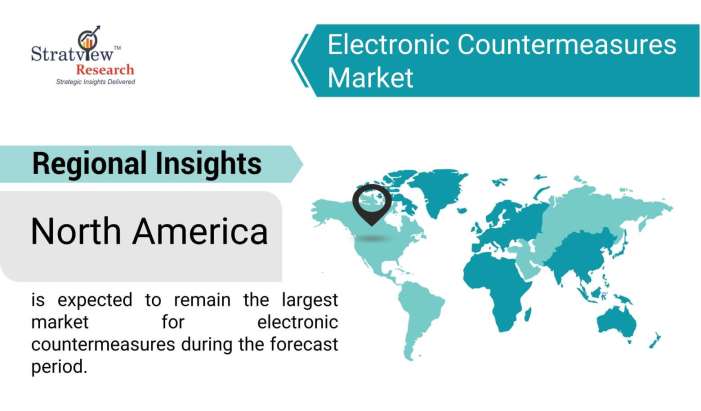
North America is expected to remain the largest market for electronic countermeasures during the forecast period. |
“Air is expected to remain the dominant platform type in the market during the forecast period.”
The electronic countermeasures market is segmented into air, land, and naval platforms, with the air segment expected to remain dominant during the forecast period, driven by the expansion and modernization of global military aircraft fleets. The global military aircraft fleet is projected to expand from approximately 56,350 aircraft in 2025 to around 58,700 by 2034, reflecting sustained aircraft deliveries and long-term fleet modernization programs.
Platforms such as fighter jets, UAVs, and surveillance aircraft are leading ECM adoption due to their operation in high-threat, contested environments.The integration of electronic countermeasure systems enables coordinated electronic warfare operations, improving threat detection, real-time response, and overall mission effectiveness.
“EO-IR countermeasure is expected to remain the dominant as well as the fastest-growing segment during the forecast period.”
The electronic countermeasures market is segmented into EO-IR countermeasures and RF countermeasures, with EO-IR countermeasures expected to remain both dominant and the fastest-growing segment during the forecast period. This growth is driven by the increasing use of infrared-guided missiles and passive EO/IR sensors in modern warfare.
Recent advancements are significantly strengthening this segment. Technologies such as Directed Infrared Countermeasures (DIRCM) use high-power lasers to disrupt heat-seeking missile guidance, offering superior protection compared to traditional flares.
A key example is the Common Infrared Countermeasures (CIRCM) system developed by Northrop Grumman, which uses advanced EO/IR technology to detect and defeat incoming missile threats. Nearly 700 Northrop’s CIRCM systems have been deployed globally, accumulating over 70,000 operational flight hours across platforms such as AH-64, CH-47, and UH-60 helicopters, with a strong performance record.
Continuous innovations in laser-based jamming, multi-band detection, and advanced decoy capabilities are further enhancing the effectiveness and reliability of EO-IR countermeasure systems, making them critical for next-generation platform survivability.
“North America is expected to remain the largest market for electronic countermeasures during the forecast period.”
North America is expected to remain the largest market for electronic countermeasures during the forecast period, driven by strong defense spending and continuous advancements in electronic warfare (EW) technologies.
Recent reports indicate that U.S. military spending could reach $1.5 trillion by 2027, significantly higher than the $901 billion approved for 2026, reflecting a growing focus on next-generation defense capabilities, including ECM systems. This sustained investment, along with robust R&D infrastructure and ongoing modernization programs, is expected to drive steady market growth in the region.
Additionally, the United States, in particular, benefits from a well-established defense ecosystem supported by leading players such as Raytheon Technologies, Lockheed Martin, Northrop Grumman, and L3Harris Technologies, which are actively involved in the development and deployment of advanced electronic countermeasure systems.
Know the high-growth countries in this report. Click Here
Most of the major players compete in some of the factors, including price, service offerings, regional presence, etc. The following are the key players in the electronic countermeasures market -
Northrop Grumman Corporation
BAE Systems
Raytheon Technologies Corporation
L3Harris Technologies, Inc.
Thales S.A.
Elbit Systems
Chemring Group PLC
Leonardo S.p.A.
Note: The above list does not necessarily include all the top players in the market.
Are you the leading player in this market? We would love to include your name. Write to us at [email protected]
In March 2026, BAE Systems secured a contract to support the AN/ALQ-221 Advanced Defensive System, an integrated electronic countermeasures suite deployed on U-2 aircraft. The program focuses on system sustainment, repairs, and software upgrades to enhance electronic warfare performance, threat detection, and survivability in contested electromagnetic environments.
In March 2026, Northrop Grumman expanded its electronic countermeasures footprint by delivering 47 CIRCM (Directed Infrared Countermeasures) systems to Germany for CH-47 Chinook helicopters. These advanced EO/IR-based ECM systems enhance aircraft survivability by countering infrared-guided missile threats, supporting NATO operational readiness and modernization efforts.
In February 2026, Allen-Vanguard secured a multi-million-dollar contract from a South American military for its EQUINOX NG (vehicle-based) and SCORPION 2 (manportable) ECM systems, highlighting growing demand for counter-IED and counter-drone electronic countermeasures in emerging defense markets.
This report provides market intelligence most comprehensively. The report structure has been kept so that it offers maximum business value. It provides critical insights into market dynamics and will enable strategic decision-making for existing market players as well as those willing to enter the market.
The following are the key features of the report:
Market structure: Overview, industry life cycle analysis, supply chain analysis.
Market environment analysis: Growth drivers and constraints, Porter’s five forces analysis, SWOT analysis.
Market trend and forecast analysis.
Market segment trend and forecast.
Competitive landscape and dynamics: Market share, Service portfolio, New Product Launches, etc.
COVID-19 impact and its recovery curve.
Attractive market segments and associated growth opportunities.
Emerging trends.
Strategic growth opportunities for the existing and new players.
Key success factors.
|
Market Study Period |
2019-2032 |
|
Base Year |
2025 |
|
Forecast Period |
2026-2032 |
|
Trend Period |
2019-2024 |
|
Number of Tables & Figures |
>100 |
|
Number of Segments Analysed |
5 (Platform Type, Frequency Type, Application Type, Product Type, and Region) |
|
Number of Regions Analysed |
4 (North America, Europe, Asia-Pacific, Rest of the World) |
|
Countries Analysed |
15 (The USA, Canada, Mexico, Germany, France, Italy, The UK, China, Japan, India, Brazil, Saudi Arabia, Rest of Europe, Rest of APAC, and Rest of the World) |
|
Free Customization Offered |
10% |
|
After Sales Support |
Unlimited |
|
Report Presentation |
Complimentary |
|
Market Dataset |
Complimentary |
|
Further Deep Dive & Consulting Services |
10% Discount |
Market Segmentation
The report provides detailed insights into the market dynamics to enable informed business decision-making and growth strategy formulation based on the opportunities present in the market.
The electronic countermeasures market is segmented into the following categories.
By Platform Type
Air
Land
Naval
By Frequency Type
EO-IR Countermeasure
RF Countermeasure
By Application Type
Defensive Countermeasures
Offensive Countermeasures
By Product Type
Protective Jamming
Laser-based Countermeasures
Expendable Countermeasure
Decoys
Anti Radiation Missiles
By Region
North America (Country Analysis: The USA, Canada, and Mexico)
Europe (Country Analysis: Germany, France, The UK, Russia, and The Rest of Europe)
Asia-Pacific (Country Analysis: China, Japan, India, and The Rest of Asia-Pacific)
Rest of the World (Country Analysis: Saudi Arabia, Israel, and Others)
This strategic assessment report, from Stratview Research, provides a comprehensive analysis that reflects today’s electronic countermeasures market realities and future market possibilities for the forecast period.
The report segments and analyzes the market in the most detailed manner in order to provide a panoramic view of the market.
The vital data/information provided in the report can play a crucial role for market participants as well as investors in the identification of the low-hanging fruits available in the market as well as to formulate growth strategies to expedite their growth process.
This report offers high-quality insights and is the outcome of a detailed research methodology comprising extensive secondary research, rigorous primary interviews with industry stakeholders, and validation and triangulation with Stratview Research’s internal database and statistical tools.
More than 1,000 authenticated secondary sources, such as company annual reports, fact books, press releases, journals, investor presentations, white papers, patents, and articles, have been leveraged to gather the data.
We conducted more than 15 detailed primary interviews with market players across the value chain in all four regions and industry experts to obtain both qualitative and quantitative insights.
With this detailed report, Stratview Research offers one of the following free customization options to our respectable clients:
Company Profiling
Detailed profiling of additional market players (up to three players)
SWOT analysis of key players (up to three players)
Competitive Benchmarking
Benchmarking of key players on the following parameters: Product portfolio, geographical reach, regional presence, and strategic alliances.
Custom Research: Stratview Research offers custom research services across sectors. In case of any custom research requirement related to market assessment, competitive benchmarking, sourcing and procurement, target screening, and others, please send your inquiry to [email protected].
Electronic countermeasures systems are designed to deny, deceive, or disrupt hostile electronic activities, such as radar signals, communications, or guided munitions. The electronic countermeasures market has experienced significant growth in recent years due to the increasing sophistication of electronic threats and the growing demand for enhanced electronic warfare capabilities. Key factors driving the market include the modernization of defense forces, the need for advanced situational awareness, and the evolving nature of electronic warfare tactics. Electronic countermeasure systems jam, deceive, or disrupt enemy electronic systems or adversaries, including radars, communication networks, and guided missiles.
The electronic countermeasures market is likely to reach an estimated value of US$ 31.7 billion in 2032.
The electronic countermeasure market is estimated to grow at a CAGR of 5.8% by 2032, driven by the modernization of defense forces, increasing global defense spending, the need for advanced situational awareness, and the evolving nature of electronic warfare tactics.
Northrop Grumman Corporation, BAE Systems, Raytheon Technologies Corporation, L3Harris Technologies, Inc., Thales S.A., Elbit Systems, Chemring Group PLC, and Leonardo S.p.A. are the leading players in the market.
North America is estimated to remain dominant in the market in the foreseeable future. The USA is a hub for technological advancements in electronic countermeasure systems. The presence of established manufacturers, suppliers, and support infrastructure contributes to the dominance and growth of the electronic countermeasures market in the region.
Air is expected to remain the largest platform type in the market during the forecast period owing to large military and commercial aircraft fleets, increasing threats to aircraft, military modernization programs, technological advancements, and an increase in air warfare.
EO-IR countermeasures are expected to remain the dominant segment of the market during the forecast period, driven by the increasing use of EO-IR systems in military and defense applications, as well as the need for advanced countermeasures to mitigate the risks of enemy attacks.


WE ACCEPT