




404
+1-313-307-4176

eVTOL Market

eVTOL Market Size, Share, Trend, Forecast, Competitive Analysis, and Growth Opportunities: 2025-2040
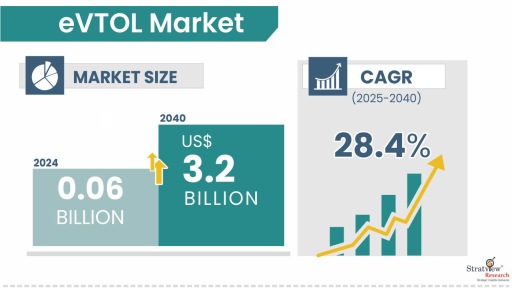
The annual demand for eVTOL was USD 0.06 billion in 2024 and is expected to reach USD 0.08 billion in 2025, up 27.9% than the value in 2024.
During the forecast period (2025-2040), the eVTOL market is expected to grow at a CAGR of 28.4%. The annual demand will reach USD 3.3 billion in 2040.
During 2025-2040, the eVTOL industry is expected to generate a cumulative sales opportunity of USD 17.2 billion.
Want to get a free sample? Register Here
Asia-Pacific region, driven primarily by China, dominates the eVTOL market with the largest share.
By configruation type, wingless/multirotor is likely to remain dominant, whereas vectored and lift + cruise are estimated to grow at a greater pace in the coming years.
By application type, passenger is likely to remain dominant in the market, whereas cargo transport is expected to witness significant growth.
By seating capacity type, 2-seater and 5-seater aircraft are likely to be the most attractive market categories.
Have a look at the sales opportunities presented by the eVTOL market in terms of growth and market forecast.
|
eVTOL Market Data & Statistics |
|
||
|
Market Statistics |
Value (in USD Billion) |
Market Growth (%) |
|
|
Annual Market Size in 2024 |
USD 0.06 billion |
- |
|
|
Annual Market Size in 2025 |
USD 0.08 billion |
YoY Growth in 2025: 27.9% |
|
|
Annual Market Size in 2040 |
USD 3.3 billion |
CAGR 2025-2040: 28.4% |
|
|
Cumulative Sales Opportunity during 2025-2040 |
USD 17.2 billion |
- |
|
Electric Vertical Take-Off and Landing (eVTOL) aircraft are electrically powered aircraft that can take off and land vertically like helicopters but fly efficiently like fixed-wing airplanes. They typically use distributed electric propulsion, multiple rotors, and advanced battery systems to enable low-emission, low-noise, short-distance urban and regional air mobility. It is designed for urban air mobility (UAM) applications such as air taxis, cargo delivery, and emergency services.
eVTOL has been a hotbed in the past five years, with investments pouring in from several fields. At present, there are 500+ eVTOL companies active worldwide. 2023-2024 proved to be a fruitful period, with EHang and Autoflight receiving type certification and Joby and Archer delivering the first of their aircraft. As key programs near the final stages of certification, OEMs are preparing for commercial production for their eVTOLs. Efforts to develop vertiports are also progressing rapidly, setting the stage for the widespread adoption of these vehicles shortly.
Stratview estimates that approximately 183 eVTOLs were delivered in 2024. The eVTOL deliveries are expected to grow at a handsome CAGR of more than 15% (2025-2040) to reach 10,000+ cumulative deliveries by 2040.
Urban Congestion & Demand for Faster Mobility
Rapid urbanization and rising traffic congestion in major cities are driving the demand for faster and more efficient transportation solutions, supporting the growth of the eVTOL market.
eVTOL aircraft enable advanced urban air mobility (UAM) by significantly reducing travel time on congested routes where traditional infrastructure is saturated.
By offering point-to-point aerial transport, eVTOLs can transform short-distance commutes into minutes rather than hours, making them an attractive solution for urban passengers and business travellers seeking reliable, time-efficient mobility.
Strong Government & Regulatory Support
Government initiatives and regulatory backing are playing a pivotal role in accelerating the development and commercialization of eVTOL aircraft.
For instance, the Federal Aviation Administration has launched an advanced pilot program supporting eight projects across 26 U.S. states to facilitate testing and integration of eVTOLs into existing airspace. Through close collaboration with OEMs, operators, and state authorities, the program is streamlining certification via extensive flight evaluations, while also focusing on the safe integration of eVTOLs alongside conventional air traffic. In parallel, efforts to establish adequate charging infrastructure are ensuring operational readiness for large-scale deployment. Such structured regulatory support is expected to significantly accelerate commercial adoption over the next five years.
Technological Advancements
Ongoing technological advancements are enhancing the performance and commercial viability of the eVTOL market. Innovations in electric propulsion systems are improving energy efficiency and lowering operating costs, while advancements in lightweight battery technologies are increasing flight range and payload capacity.
In addition, distributed propulsion architectures are enabling safer and more stable flight operations. These developments are accelerating the transition of eVTOL aircraft from prototype stages to scalable urban air mobility solutions, strengthening their adoption across commercial applications.
Cost-Effective Operations Compared to Helicopters
Lower operating costs compared to conventional helicopters are strengthening the commercial viability of the eVTOL market. Electric Vertical Take-Off and Landing (eVTOL) aircraft are designed to be quieter, more energy-efficient, and less maintenance-intensive.
Notably, Bristow Group estimates that eVTOLs can achieve 60–70% lower operating costs, making them a cost-effective solution for urban air mobility, air taxi services, and regional transportation.
Regulatory & Certification Barriers
Complex regulatory requirements and lengthy certification processes continue to challenge the growth of the eVTOL market. These evolving frameworks demand extensive safety validation and standardization, which may delay commercialization timelines and hinder the large-scale adoption of eVTOL aircraft across global markets.
Infrastructure Limitations (Vertiports)
Limited infrastructure development is another major challenge impacting the growth of the eVTOL market. The successful deployment of eVTOL aircraft requires dedicated vertiports, advanced charging systems, and seamless integration with existing air traffic management networks. The high cost and complexity of building such infrastructure may slow adoption, particularly in densely populated urban environments
Cargo & Logistics Applications
The growing demand for faster and more efficient last-mile delivery is creating strong opportunities in the eVTOL market. eVTOL aircraft can enable efficient last-mile and regional cargo transport by bypassing congested ground networks and operating from compact spaces.
In March 2026, BETA Technologies announced that it is advancing the eVTOL market through its participation in the FAA’s Integration Pilot Program, deploying electric aircraft across key regions in the United States, including New York, Texas, Utah, Maryland, Virginia, Louisiana, Florida, and North Carolina. These operations span cargo logistics, organ delivery, rural healthcare access, and offshore energy support, highlighting scalable eVTOL cargo and logistics applications across diverse regional use cases.
Military & Defense Applications
The eVTOL market is also gaining traction in military and defense applications due to its low-noise operation and vertical lift capabilities, which are ideal for sensitive missions. These aircraft can support reconnaissance, troop transport, and logistics in challenging environments.
For instance, in the 3rd quarter of 2025, Joby Aviation partnered with L3Harris Technologies to develop a hybrid autonomous VTOL aircraft for defense applications. Designed for low-altitude missions, the platform supports reconnaissance and logistics, with flight testing underway and operational demonstrations planned for 2026, strengthening the eVTOL market in military applications.
|
Segmentations |
List of Sub-Segments |
Segments with High Growth Opportunity |
|
Configuration Type |
Vectored Thrust, Lift + Cruise, and Wingless/Multirotor |
Wingless/Multirotor is likely to remain dominant. Vectored and Lift + Cruise are estimated to grow at a greater pace in the coming years. |
|
Application Type |
Passenger, Cargo, and Other Applications |
Passenger is likely to remain dominant in the market, whereas cargo transport is expected to witness significant growth. |
|
Seating Capacity |
1-Seater, 2-Seater, 3-Seater, 4-Seater, 5-Seater, 5+ Seater, and Cargo |
2-seater and 5-seater aircraft are likely to be the most attractive market categories. |
|
Region Analysis |
North America, Europe, China, Rest of Asia-Pacific, and the Rest of the World |
North America and China are the frontrunners in the market. |
“Wingless/Multirotor is expected to be the leading segment in the market during the forecast period.”
Wingless/multirotor designs are expected to remain dominant in the eVTOL market due to their simpler architecture, enhanced stability, and suitability for short-range urban air mobility operations, making them easier to certify and deploy.
However, vectored thrust and lift + cruise configurations are projected to grow at a faster pace, as they offer greater range, higher speeds, and improved energy efficiency, making them ideal for regional air mobility and longer-distance commercial applications.
“Passenger applications maintain market dominance, with cargo segment set for rapid growth in the future.”
The passenger segment is expected to remain dominant in the eVTOL market due to strong demand for urban air mobility solutions, particularly air taxis that reduce travel time in congested cities.
Meanwhile, cargo transport is projected to witness significant growth, driven by rising demand for fast, efficient last-mile delivery and logistics optimization. eVTOL cargo applications face fewer regulatory hurdles, enabling quicker adoption and scalability compared to passenger services.
“Asia-Pacific region, driven primarily by China, dominates the eVTOL market with the largest share.”
The Asia-Pacific (APAC) region dominates the eVTOL market, primarily driven by China, which accounts for over 70% of the regional share. This leadership is supported by strong government backing, favorable regulatory frameworks, and early approvals for commercial eVTOL operations.
China’s rapid advancements in autonomous flight technology and large-scale urban air mobility deployments further accelerate market growth. Additionally, the presence of leading OEMs such as EHang, AutoFlight, and XPeng AeroHT strengthens innovation and commercialization, positioning APAC as a global hub for next-generation aerial mobility solutions.
Major OEMs in the market are striving to achieve type certification for their eVTOL aircraft. After completing certification, they collaborate with established aircraft and automotive giants to accelerate commercial manufacturing. The following are the key players in the eVTOL market.
Here is the list of the Top Players (Based on Dominance)
EHang
Joby Aviation, Inc.
Archer Aviation
Autoflight
Eve Air Mobility
Xpeng AeroHT
Vertical Aerospace Ltd.
Elroy Air
Volant Aerotec
Note: The above list does not necessarily include all the top players in the market.
Are you the leading player in this market? We would love to include your name. Please write to us at [email protected]
In February 2026, AutoFlight achieved a major milestone by completing a full transition flight of its Matrix eVTOL in China. The five-ton-class aircraft successfully demonstrated vertical takeoff, forward flight, and landing, highlighting rapid advancements in the eVTOL market and large-scale electric aviation capabilities.
In December 2025, Joby Aviation expanded its commercial readiness by conducting piloted flight demonstrations in the UAE (Middle East). The initiative supports pilot training, infrastructure validation, and regulatory coordination, strengthening its phased entry into the urban air mobility (UAM) market.
In November 2025, Sarla Aviation announced plans to invest ₹1,300 crore in a 500-acre eVTOL manufacturing facility in Andhra Pradesh, India. This development highlights India’s growing role in the global eVTOL market manufacturing ecosystem.
In November 2025, Qatar (Middle East) successfully conducted an autonomous eVTOL urban flight trial, demonstrating real-world feasibility of AI-powered flight systems. The milestone highlights growing regional momentum in advanced air mobility and autonomous eVTOL deployment.
In October 2025, EHang expanded commercial deployment of its EH216-S autonomous passenger eVTOL in China and select Asian markets following additional regulatory approvals. This strengthens its leadership in autonomous urban air mobility solutions.
In July 2025, Eve Air Mobility progressed its eVTOL program by advancing prototype development and urban air traffic management integration in Brazil. The initiative supports scalable urban air mobility operations through combined aircraft and digital ecosystem solutions.
This report provides market intelligence most comprehensively. The report structure has been kept so that it offers maximum business value. It provides critical insights into market dynamics and will enable strategic decision-making for existing market players as well as those willing to enter the market.
The following are the key features of the report:
Market structure: Overview, industry life cycle analysis, supply chain analysis.
Market environment analysis: Growth drivers and constraints, Porter’s five forces analysis, SWOT analysis.
Market trend and forecast analysis.
Market segment trend and forecast.
Competitive landscape and dynamics: Market share, Service portfolio, New Product Launches, etc.
COVID-19 impact and its recovery curve.
Attractive market segments and associated growth opportunities.
Emerging trends.
Strategic growth opportunities for the existing and new players.
Key success factors.
|
Market Study Period |
2019-2040 |
|
Base Year |
2025 |
|
Forecast Period |
2025-2040 |
|
Trend Period |
2019-2024 |
|
Number of Tables & Figures |
>100 |
|
Number of Segments Analysed |
4 (Configuration Type, Application Type, Seating Capacity Type, and Region) |
|
Number of Regions Analysed |
4 (North America, Europe, Asia-Pacific, Rest of the World) |
|
Countries Analysed |
15 (The USA, Canada, Mexico, Germany, France, Italy, The UK, China, Japan, India, Brazil, Saudi Arabia, Rest of Europe, Rest of APAC, and Rest of the World) |
|
Free Customization Offered |
10% |
|
After Sales Support |
Unlimited |
|
Report Presentation |
Complimentary |
|
Market Dataset |
Complimentary |
|
Further Deep Dive & Consulting Services |
10% Discount |
The report provides detailed insights into the market dynamics to enable informed business decision-making and growth strategy formulation based on the opportunities present in the market.
The eVTOL market is segmented into the following categories:
eVTOL Market, By Configuration Type
Vectored thrust (Regional Analysis: North America, Europe, Asia-Pacific, and RoW)
Lift + Cruise (Regional Analysis: North America, Europe, Asia-Pacific, and RoW)
Multirotor/Wingless (Regional Analysis: North America, Europe, Asia-Pacific, and RoW)
eVTOL Market, By Application Type
Passenger
Cargo
Other Applications
eVTOL Market, By Seating Capacity Type
1-Seater
2-Seater
3-Seater
4-Seater
5-Seater
5+Seater
Cargo
eVTOL Market, By Region
North America
Europe
China
Rest of Asia-Pacific
Rest of the World
This strategic assessment report from Stratview Research provides a comprehensive analysis that reflects today’s eVTOL market realities and future market possibilities for the forecast period.
The report segments and analyzes the market in the most detailed manner to provide a panoramic view of the market.
The vital data/information provided in the report can play a crucial role for market participants and investors in identifying the low-hanging fruits available in the market and formulating growth strategies to expedite their growth process.
This report offers high-quality insights and is the outcome of a detailed research methodology comprising extensive secondary research, rigorous primary interviews with industry stakeholders, and validation and triangulation with Stratview Research’s internal database and statistical tools.
More than 1,000 authenticated secondary sources, such as company annual reports, fact books, press releases, journals, investor presentations, white papers, patents, and articles, have been leveraged to gather the data.
We conducted more than 15 detailed primary interviews with market players across the value chain in all four regions and industry experts to obtain both qualitative and quantitative insights.
With this detailed report, Stratview Research offers one of the following free customization options to our respectable clients:
Company Profiling
Detailed profiling of additional market players (up to three players)
SWOT analysis of key players (up to three players)
Competitive Benchmarking
Benchmarking of key players on the following parameters: Service portfolio, geographical reach, regional presence, and strategic alliances
Custom Research: Stratview Research offers custom research services across sectors. In case of any custom research requirement related to market assessment, competitive benchmarking, sourcing and procurement, target screening, and others, please send your inquiry to [email protected]
An eVTOL (electric vertical takeoff and landing) is an aircraft that uses electric propulsion to take off, hover, and land vertically. It is designed for urban air mobility, regional transport, or cargo delivery and focuses on sustainability, efficiency, and reduced noise.
The eVTOL market is estimated to grow at a CAGR of 28.4% from 2025 to 2040.
China has the largest market share and leads the growth in the region. Government-backed initiatives in China to develop UAM are driving the emergence of more eVTOL companies. Additionally, North America will showcase significant growth during the forecast period, driven by the presence of major eVTOL players (Joby, Archer, and Beta) and investment from local and government investors.
The eVTOL market size is USD 0.06 billion in 2024.
The eVTOL market size will be USD 3.3 billion in 2040.
Rising urban population and traffic congestion, the government's push for sustainable transportation to minimize carbon footprint, expected EIS, and pre-orders of upcoming eVTOL programs are some of the key market drivers.
EHang, Joby Aviation, Inc., Archer Aviation, Autoflight, Eve Air Mobility, Xpeng AeroHT, Vertical Aerospace Ltd., Elroy Air, Lilium GmbH, and Volant Aerotech are the top players in the eVTOL market.


WE ACCEPT