




404
+1-313-307-4176

Chemical Anchor Market Analysis | 2025-2031

Chemical Anchor Market Size, Share, Trend, Dynamics, Forecast, & Growth Analysis: 2025-2031
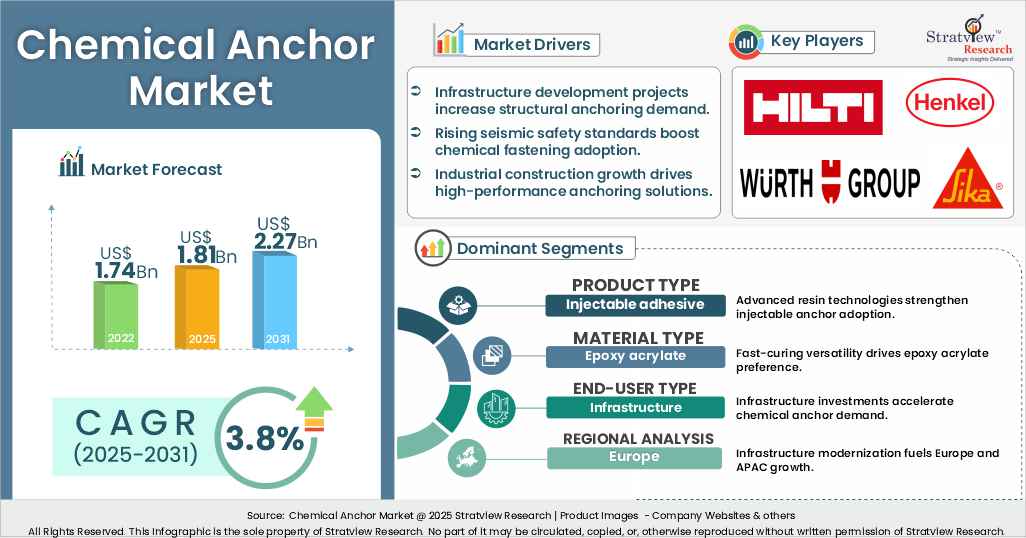
"Chemical anchor market size was USD 1.74 billion in 2024.”
Want to know more about the market scope? Register Here
High-Growth Market Segments:
Have a look at the sales opportunities presented by the chemical anchor market in terms of growth and market forecast.
|
Chemical Anchor Market Data & Statistics |
||
|
Market Statistics |
Value (in USD Billion) |
Market Growth (%) |
|
Annual Market Size in 2023 |
USD 1.72 billion |
- |
|
Annual Market Size in 2024 |
USD 1.74 billion |
YoY Growth in 2024: 1.2% |
|
Annual Market Size in 2025 |
USD 1.81 billion |
YoY Growth in 2025: 4.0% |
|
Annual Market Size in 2031 |
USD 2.27 billion |
CAGR 2025-2031: 3.8% |
|
Cumulative Sales Opportunity during 2025-2031 |
USD 14.37 billion |
- |
|
Top 10 Countries’ Market Share in 2024 |
USD 1.3 billion+ |
> 80% |
|
Top 10 Company’s Market Share in 2024 |
USD 0.8 billion to USD 1.2 billion |
50% - 70% |
What is a chemical anchor?
Chemical anchors, also known as adhesive anchors, are a fastening system that secures structural and non-structural elements to base materials such as concrete, masonry, or natural stone using resin-based adhesives. Unlike mechanical anchors, which rely on expansion for load transfer, chemical anchors use a bonding mechanism between the anchor rod and the substrate to deliver high load-bearing capacity, improved stress distribution, and resistance to dynamic forces such as vibration and seismic activity. These properties make them particularly useful in demanding structural applications.
|
Segmentations |
List of Sub-Segments |
Segments with High-Growth Opportunity |
|
Product Type Analysis |
Injectable Adhesive and Capsule Adhesive |
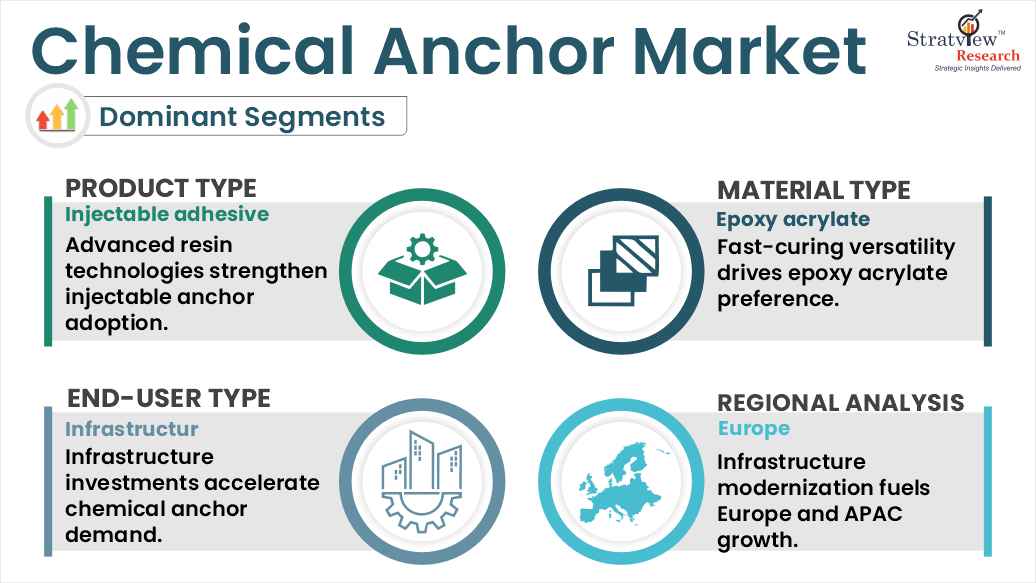
Injectable adhesive is likely to remain the largest product type in the years to come. |
|
Material Type Analysis |
Pure Epoxy, Epoxy Acrylate, Unsaturated Polyester, and Other Materials |
Epoxy acrylate is expected to be the dominant material of the market during the forecast period. |
|
Substrate Type Analysis |
Concrete, Masonry, Natural Stone, and Other Substrates |
Concrete is estimated to remain the largest substrate for chemical anchors during the forecast period. |
|
End-User Type Analysis |
Infrastructure, Industrial, Commercial, and Residential |
Infrastructure is expected to be the dominant end-user of the market during the forecast period. |
|
Region Analysis |
North America, Europe, Asia-Pacific, and The Rest of the World |
Europe is expected to remain the largest market throughout the forecast period, whereas Asia-Pacific is likely to grow at the fastest rate. |
“Injectable adhesive is anticipated to be the dominant product of the chemical anchors market during the forecast period.”
“Epoxy acrylate is expected to be the most preferred material type of the chemical anchors market during the forecast period.”
“Concrete is expected to hold the major share in the chemical anchors market during the forecast period.”
Want to have a closer look at this market report? Click Here
“Infrastructure is likely to be the biggest demand generator for chemical anchors throughout the forecast period.”
"Europe is expected to remain the leading region in the chemical anchors market, while Asia-Pacific is projected to be the fastest-growing region throughout the forecast period."
Most of the major players compete in some of the factors, including price, service offerings, regional presence, etc. The following are the key players in the chemical anchor market:
Here is the list of the Top Players (Based on Dominance)
Note: The above list does not necessarily include all the top players in the market.
Are you the leading player in this market? We would love to include your name. Please write to us at [email protected]
This report provides market intelligence most comprehensively. The report structure has been kept so that it offers maximum business value. It provides critical insights into market dynamics and will enable strategic decision-making for existing market players as well as those willing to enter the market.
The following are the key features of the report:
|
Market Study Period |
2019-2031 |
|
Base Year |
2024 |
|
Forecast Period |
2025-2031 |
|
Trend Period |
2019-2023 |
|
Number of Tables & Figures |
>100 |
|
Number of Segments Analysed |
5 (Product Type, Material Type, Substrate Type, End-Use Type, and Region) |
|
Number of Regions Analysed |
4 (North America, Europe, Asia-Pacific, Rest of the World) |
|
Countries Analysed |
15 (The USA, Canada, Mexico, Germany, France, Italy, The UK, China, Japan, India, Brazil, Saudi Arabia, Rest of Europe, Rest of APAC, and Rest of the World) |
|
Free Customization Offered |
10% |
|
After Sales Support |
Unlimited |
|
Report Presentation |
Complimentary |
|
Market Dataset |
Complimentary |
|
Further Deep Dive & Consulting Services |
10% Discount |
The report provides detailed insights into the market dynamics to enable informed business decision-making and growth strategy formulation based on the opportunities present in the market.
The chemical anchors market is segmented into the following categories:
By Product Type
By Material Type
By Substrate Type
By End-User Industry Type
By Region
With this detailed report, Stratview Research offers one of the following free customization options to our respected clients:
Company Profiling
Competitive Benchmarking
Custom Research: Stratview Research offers custom research services across industries. In case of any custom research requirement related to market assessment, competitive benchmarking, sourcing and procurement, target screening, and others, please send your inquiry to [email protected].
Chemical anchors are specialized fastening systems used in construction to securely bond bolts, rods, or reinforcement bars into materials like concrete, masonry, or stone. Unlike mechanical anchors, which rely on friction or expansion, chemical anchors use a two-part adhesive (typically epoxy, polyester, or vinyl ester resin) that hardens after injection into a drilled hole, creating a high-strength bond with the substrate. They are ideal for heavy-load applications, such as structural steel connections, seismic retrofitting, and infrastructure projects, due to their superior load-bearing capacity and resistance to vibrations. Additionally, chemical anchors distribute stress evenly, minimize cracking risks, and perform well in porous or cracked substrates, making them a preferred choice in modern construction.
The forecasted value for the market is USD 2.27 billion in 2031.
Chemical anchor market size was USD 1.74 billion in 2024 and is expected to grow from USD 1.81 billion in 2025 to USD 2.27 billion in 2031, witnessing an impressive market growth (CAGR) of 3.8% during the forecast period (2025-2031).
The key drivers of the chemical anchors market include the rising demand for durable and high-performance anchoring solutions in construction and infrastructure projects. As urbanization and industrialization accelerate globally, there is a growing need for reliable fastening systems that can withstand heavy loads, dynamic forces, and harsh environmental conditions, requirements that chemical anchors are well-equipped to meet. Additionally, stricter building safety codes and seismic regulations are pushing contractors and engineers to adopt advanced anchoring technologies to enhance structural integrity. The market is further supported by technological advancements in adhesive formulations, including fast-curing and temperature-resistant resins, which expand the usability of chemical anchors across various climates and construction scenarios.
Europe is estimated to remain dominant in the chemical anchor market in the foreseeable future. Increasing demand for residential buildings, commercial buildings, and infrastructure development, coupled with increasing population and demand for sustainable buildings, are likely to fuel the growth of the region’s market.
Asia-Pacific is estimated to remain the fastest-growing market for chemical anchors in the foreseeable future. The construction industry in Asia-Pacific has been expanding rapidly in recent years, particularly in countries like China and India. In addition to that, increasing demand for residential construction and infrastructure development due to urbanization and population increase is further expected to fuel the region’s market growth.
The infrastructure is estimated to be the dominant end-user in the chemical anchors market in the coming years. This dominance is driven by the surge in global infrastructure development projects, including the construction and rehabilitation of bridges, highways, tunnels, railways, airports, and ports. Governments and private investors are increasingly focusing on enhancing public infrastructure to support economic growth, urbanization, and population expansion. Chemical anchors are widely used in infrastructure applications due to their superior load-bearing capacity, durability, and effectiveness in anchoring to concrete and other substrates under challenging conditions.
Hilti Corporation, Henkel AG & Company, KGaA, Fischer Group, Würth Group, Sika AG, Illinois Tool Works Inc., and EJOT Holding GmbH & Co.KG are the leading players in the chemical anchor market.


WE ACCEPT