




404
+1-313-307-4176

Ceramic Matrix Composites Market | 2026-2034

Ceramic Matrix Composites Market Size, Share, Trend, Forecast, Competitive Landscape & Growth Opportunities: 2026-2034
The market size in 2024 was USD 2.9 billion. In 2025, the market experienced a YoY growth of 1.6% to reach a value of USD 3.0 billion.
The market is expected to reach USD 3.2 billion in 2026, witnessing an annual growth of 6.7%.
The market size will reach USD 4.4 billion in 2034, witnessing a market growth (CAGR) of 4.1% during the forecast period of 2026-2034.
The annual demand for ceramic matrix composites (CMCs) was USD 3.0 billion in 2025 and is expected to reach USD 3.2 billion in 2026, up 6.7% than the value in 2025.
During the forecast period (2026-2034), the ceramic matrix composites (CMCs) market is expected to grow at a CAGR of 4.1%. The annual demand will reach USD 4.4 billion in 2034.
With more than 70% of demand expected from aerospace & defense, continued adoption in aircraft engines, braking systems, and defense platforms will remain a key pillar of ceramic matrix composites market growth.
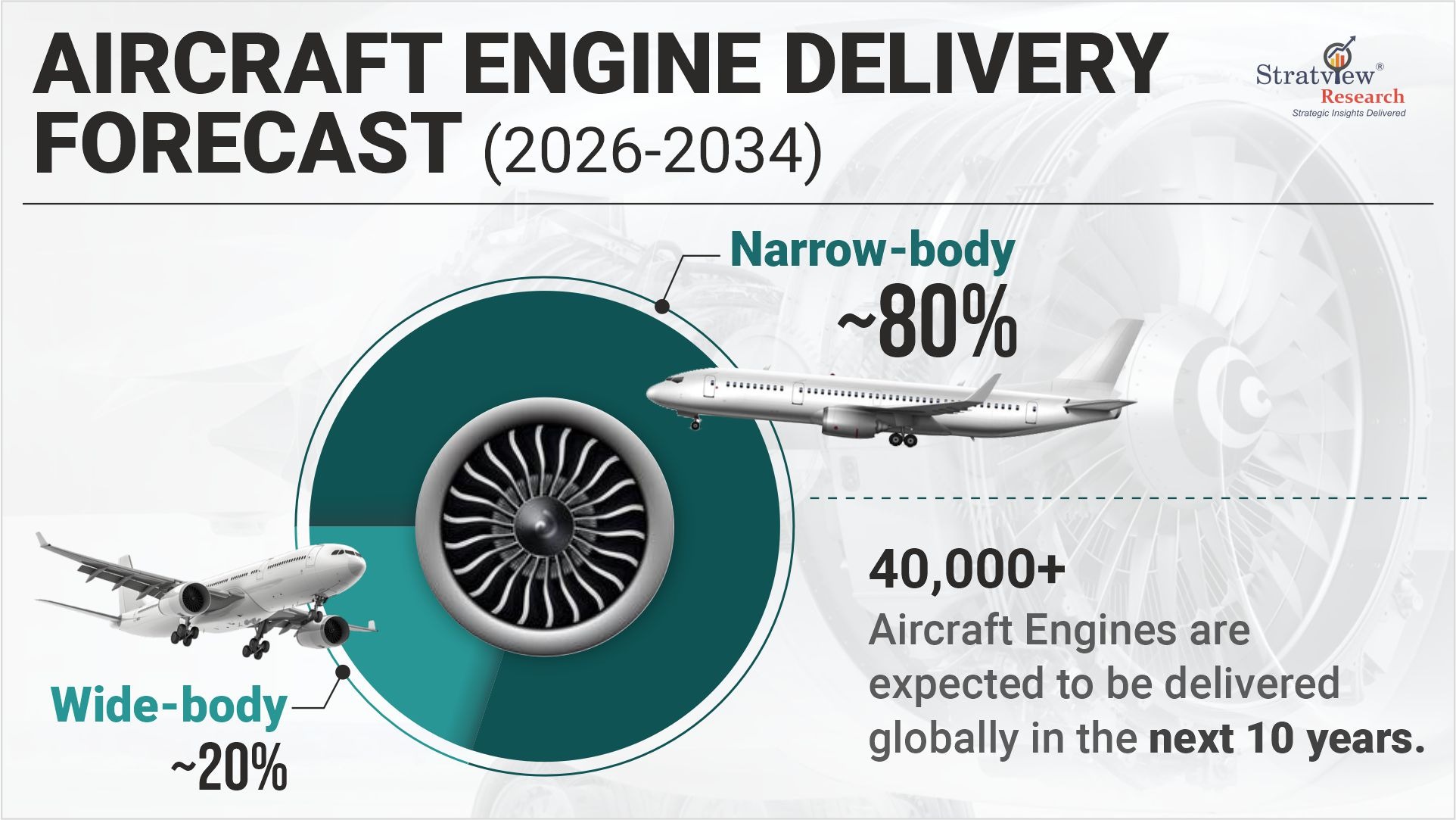
Growing use of CMCs in hotter aircraft engine sections, where they withstand extreme temperatures, is accelerating market demand, further supported by expected production of more than 40,000 aircraft engines in the coming decade.
During 2026-2034, the ceramic matrix composites (CMCs) industry is expected to generate a cumulative sales opportunity of USD 35.1 billion.
 Market 1_54435.webp)
Want to get a free sample? Register Here
North America is expected to maintain its leading position in the CMC market, while Asia-Pacific is anticipated to experience the fastest growth during the forecast period.
By end-use industry type, aerospace & defense is expected to remain dominant, whereas electrical & electronics is likely to be the fastest-growing segment during the forecast period.
By product type, carbon/carbon (C/C) is forecasted to remain the leading segment in the CMC market, whereas SiC/SiC is set to experience the fastest growth.
By reinforcement type, continuous fiber composites are anticipated to retain their dominance in the CMC market, while short fiber composites are likely to grow at the fastest pace throughout the forecast period.
Have a look at the sales opportunities presented by the ceramic matrix composites (CMCs) market in terms of growth and market forecast.
|
Ceramic Matrix Composites (CMCs) Market Data & Statistics |
||
|
Market Statistics |
Value (in USD Billion) |
(%) |
|
Annual Market Size in 2024 |
USD 2.9 billion |
- |
|
Annual Market Size in 2025 |
USD 3.0 billion |
YoY Growth in 2025: 1.6% |
|
Annual Market Size in 2026 |
USD 3.2 billion |
YoY Growth in 2026: 6.7% |
|
Annual Market Size in 2034 |
USD 4.4 billion |
CAGR 2026-2034: 4.1% |
|
Cumulative Sales Opportunity during 2026-2034 |
USD 35.1 billion |
- |
|
Top 10 Countries’ Market Share in 2025 |
USD 2.4 billion + |
> 80% |
|
Top 10 Company’s Market Share in 2025 |
USD 1.5 billion to USD 2.1 billion |
50% - 70% |
Ceramic Matrix Composites (CMCs) are advanced materials combining ceramic matrices with fiber reinforcements, offering exceptional thermal stability, oxidation resistance, and lightweight characteristics. These materials are increasingly used in high-temperature and performance-critical applications such as aircraft engines, braking systems, energy systems, and semiconductor processing equipment. Their ability to operate at higher temperatures than conventional metals enables improved efficiency, reduced emissions, and enhanced durability across industries, driven by rising aircraft production, increasing engine demand, and a strong focus on fuel-efficient technologies.
Aerospace Sector Emerges as a Key Driver of CMC Demand
Aerospace stands as the single largest demand-generating industry for ceramic matrix composites globally, making aircraft production volumes a critical indicator of future CMC consumption. Within the aerospace sector, brake systems represent the leading application for CMCs, valued for their ability to withstand extreme thermal and mechanical stress while significantly reducing aircraft weight.
Engine components follow as the second major application, where CMCs are increasingly replacing conventional superalloys in high-temperature sections such as turbine shrouds and combustion liners. On the engine side specifically, close to 40,000 commercial aircraft engines are projected to be produced over the next decade, of which approximately 80% will power narrowbody aircraft, with the remaining 20% destined for widebody platforms, both segments being strong drivers of CMC uptake.
Together, these dynamics ensure that every new aircraft entering service translates directly into measurable CMC demand, making projected production figures over the next decade a reliable and relevant benchmark for evaluating market opportunity.
Want to Explore the Market Opportunities? Register Here
Lightweighting and Emissions Targets are Driving Demand for CMCs
Growing focus on fuel efficiency and emissions reduction continues to support ceramic matrix composites market demand, particularly as aerospace OEMs prioritize lightweight, high-performance materials.
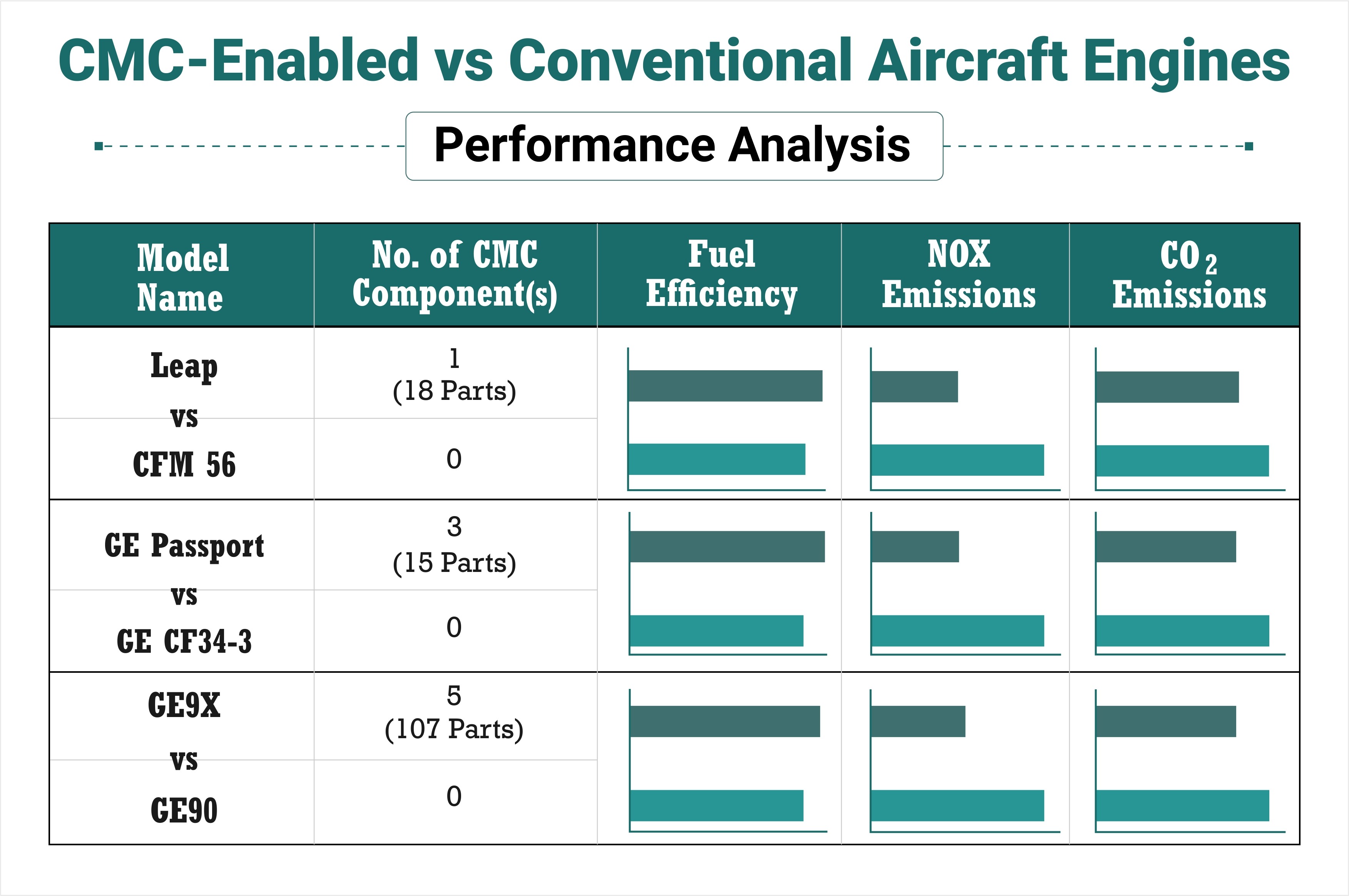
CMCs have a material density one-third that of nickel-based alloys, enabling over 50% reduction in turbine component weight. Even small reductions in aircraft weight can contribute to improved fuel efficiency and lower CO2 emissions, making advanced ceramic matrix composites increasingly valuable in next-generation engines.
Rising Demand for Premium Vehicles
Growing demand for premium and high-performance vehicles is contributing to expansion in the ceramic matrix composites market, as CMCs are increasingly integrated into advanced braking systems in these vehicles.
In particular, carbon/silicon carbide (C/SiC) materials are widely adopted due to their lightweight properties, superior thermal performance, and durability, making them well-suited for high-performance braking applications.
Their performance advantages were validated by early applications in the Porsche 911 GT2 and Mercedes CL 55 AMG F1 Limited Edition, whose CMC brake discs delivered 60% lower weight than conventional steel discs along with superior heat resistance.
High Manufacturing and Processing Costs Compared to Metal Alloys Continue to Constrain Adoption
Higher production and processing costs remain a significant restraint on the CMCs market, particularly when compared to conventional metal alloys. Complex fabrication processes, expensive ceramic fibers, and multi-step densification methods increase component costs, limiting broader demand in cost-sensitive applications and slowing market growth, especially beyond aerospace and defense.
Additive Manufacturing Is Opening New Growth Opportunities for CMCs
The shift toward additive manufacturing is creating a strong opportunity in the ceramic matrix composites market by overcoming design limitations associated with conventional processing methods such as injection molding, casting, and subtractive machining.
Through layer-by-layer fabrication, additive manufacturing enables complex, customized CMC components with enhanced performance characteristics and greater design flexibility. Technologies such as stereolithography (SLA), digital light processing (DLP), and direct ink writing (DIW) further support mold-free production, helping reduce processing time and fabrication costs while overcoming challenges related to brittleness and formability. This advancement is poised to support long-term market growth by expanding CMC applications in high-performance sectors.
|
Segmentations |
List of Sub-Segments |
Segments with High-Growth Opportunity |
|
End-Use Industry Analysis |
Aerospace & Defense, Transportation, Electrical & Electronics, Industrial, and Other Industries |
Aerospace & defense is expected to remain dominant, whereas electrical & electronics is likely to be the fastest-growing end user type during the forecast period. |
|
Product Analysis |
Oxide/Oxide (Ox/Ox), Silicon Carbide/Silicon Carbide (SiC/SiC), Carbon/Carbon (C/C), and Others |
Carbon/carbon (C/C) is forecasted to remain the leading segment in the CMC market, whereas SiC/SiC is set to experience the fastest growth. |
|
Reinforcement Analysis |
Continuous Fiber Composites, Short Fiber Composites, and Other Composites |
Continuous fiber composites are anticipated to retain their dominance in the CMC market, while short fiber composites are likely to grow at the fastest pace throughout the forecast period. |
|
Regional Analysis |
North America, Europe, Asia-Pacific, and The Rest of the World |
North America is expected to maintain its leading position in the CMC market, while Asia-Pacific is anticipated to experience the fastest growth during the forecast period. |
“Aerospace & defense is expected to remain dominant, whereas electrical & electronics is likely to be the fastest-growing end user segment during the forecast period.”
The CMC market is segmented by end-use industry type into aerospace & defense, transportation, electrical & electronics, industrial, and other industries. Among these, aerospace & defense segment continues to lead, capturing more than half of the market, while the electrical & electronics is projected to be the fastest-growing end-user segment during the forecast period.
The dominance of aerospace & defense is supported by the widespread use of CMCs in aircraft engines, braking systems, and structural components, where high-temperature resistance (withstand temperatures up to ~2000°C), lightweight characteristics, and strong mechanical performance are essential. CMCs enable aircraft engines to operate efficiently at higher temperatures while reducing weight, improving fuel efficiency and emissions, key priorities for modern aviation programs. Their proven use in turbine components further strengthens adoption across defense platforms.
Get Insights on High-Growth Segments. Get Free Sample Here
Meanwhile, the electrical & electronics segment is emerging as the fastest-growing area in the CMC market growth landscape, driven by rising demand for thermal management materials in semiconductors, power electronics, and high-performance devices. Increasing miniaturization and heat dissipation challenges are accelerating the use of advanced ceramic matrix composites in next-generation electronic systems.
“Carbon/carbon (C/C) is expected to remain dominant, whereas SiC/SiC is likely to be the fastest-growing product type during the forecast period.”
The ceramic matrix composites market is segmented into oxide/oxide (Ox/Ox), silicon carbide/silicon carbide (SiC/SiC), carbon/carbon (C/C), and others. Among these, carbon/carbon (C/C) continues to lead due to its strong presence in high-temperature aerospace applications, while SiC/SiC is projected to witness the fastest CMC market growth during the forecast period.
The dominance of carbon/carbon (C/C) in the CMC market is driven by its extensive use in aerospace braking systems and other high-temperature applications, where lightweight properties, exceptional thermal shock resistance, and superior friction performance are critical. Notably, according to various estimates, over 80% of CMC applications in aerospace are concentrated in braking systems, further strengthening the segment’s dominance.
The fastest growth of SiC/SiC composites in the CMC market growth landscape is primarily attributed to their increasing adoption in next-generation aircraft engines and high-temperature turbine components. Their ability to withstand extreme temperatures, offer oxidation resistance, and improve engine efficiency makes them a preferred material for enhancing fuel performance and reducing emissions in advanced aerospace applications.
 segment_51663.webp)
Want to get more details about the segmentations? Register Here
“Continuous fiber composites are expected to remain dominant, whereas short fiber is likely to be the fastest-growing reinforcement type during the forecast period.”
Based on reinforcement type, the CMC market is divided into continuous fiber, short fiber, and other composites. Continuous fiber composites remain the preferred choice for demanding applications, while short fiber composites are gaining traction and are expected to grow at the fastest pace.
Continuous fiber composites maintain a dominant position in the CMC market, driven by their exceptional strength, thermal stability, and load-bearing performance. Compared to short fiber variants, they can deliver up to 2–3 times higher tensile and flexural strength, which significantly enhances durability in demanding environments. These advantages make them indispensable for critical aerospace applications such as aircraft engines and braking systems, where consistent performance under high-temperature and high-stress conditions is essential.
Short fiber composites are witnessing the fastest growth, driven by their lower production costs and ease of processing. Their ability to integrate with near-net-shape manufacturing techniques like injection molding and slip casting allows for scalable production and reduced material waste. This makes them well-suited for applications in transportation, industrial, and electronics sectors that demand complex designs and cost-effective solutions.
“North America is expected to maintain its leading position in the CMC market, while Asia-Pacific is anticipated to experience the fastest growth during the forecast period.”
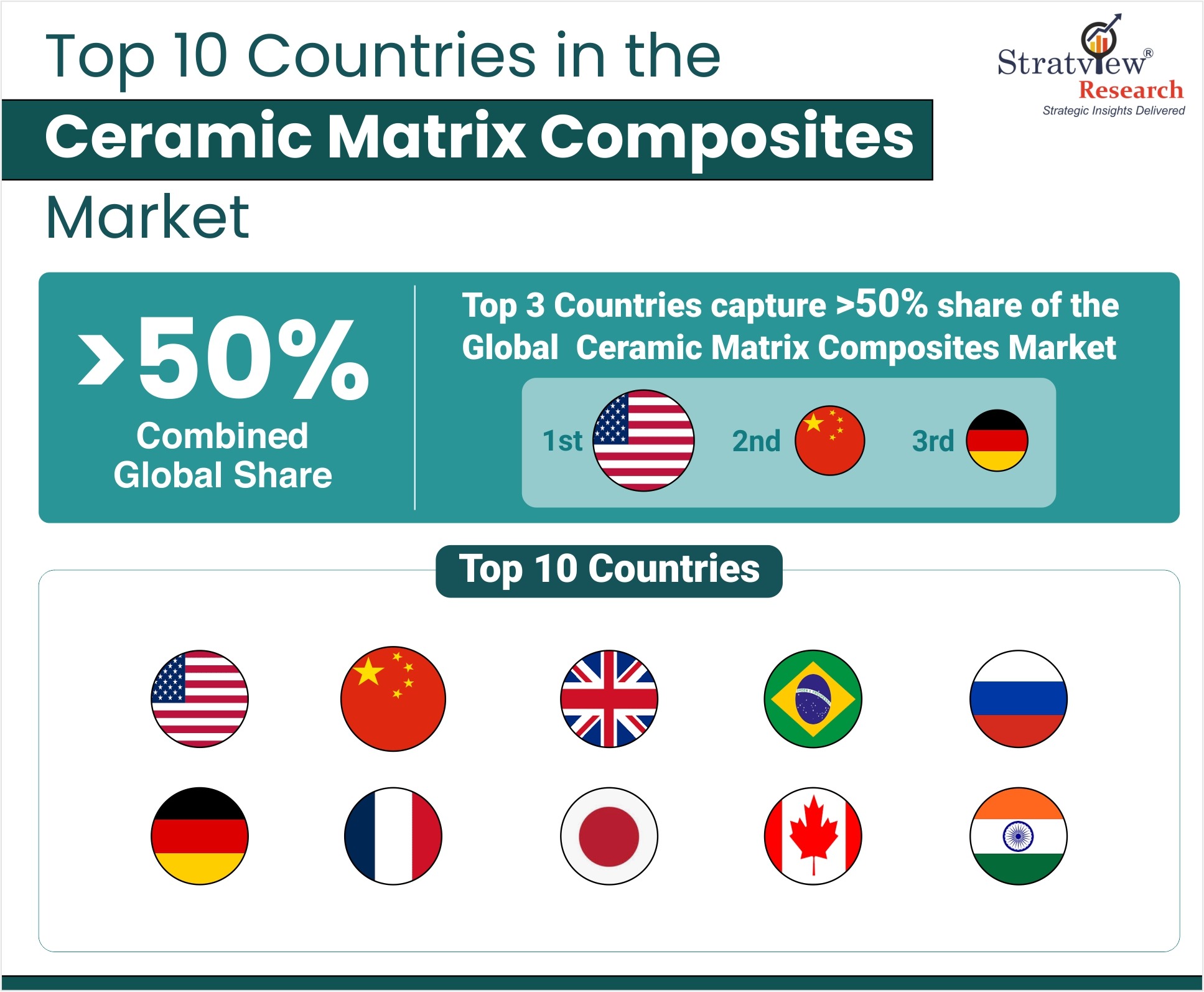
North America’s leadership in the CMC market is driven by the strong presence of major aerospace OEMs, including GE Aerospace, Pratt & Whitney, Boeing, Lockheed Martin, and Northrop Grumman, along with advanced manufacturing capabilities and high defense spending, particularly in the US. This industrial strength is further reinforced by government-funded R&D through NASA, DARPA, the DoE, and AFRL, accelerating innovation and expanding CMC adoption in next-generation aircraft engines, propulsion technologies, and defense systems.
In contrast, Asia-Pacific is witnessing the fastest growth, driven by increasing aerospace investments, expanding industrial capabilities, and growing demand for advanced materials, particularly in China, Japan, and India. Government initiatives to develop domestic aerospace manufacturing and the rising adoption of high-performance materials across industries are further accelerating market growth in the region.
Most of the major players compete in some of the factors, including price, service offerings, and regional presence, etc. The following are the key players in the ceramic matrix composites (CMCs) market (Based on Dominance) -
Safran S.A.
Collins Aerospace
Honeywell Aerospace Technologies
Brembo SGL Carbon Ceramic Brakes
Parker Meggitt
GE Aerospace
CoorsTek
CeramTec GmbH
Morgan Advanced Materials
Pratt & Whitney
Note: The above list does not necessarily include all the top players in the market.
Are you a leading player in this market? We would love to include your name. Please write to us at [email protected]
In September 2025, Brembo expanded its production facilities in Italy and Germany, increasing capacity by approximately 50% for high-performance carbon-ceramic brake discs serving premium and luxury vehicles. The expansion reflects rising demand for advanced braking materials and supports growing adoption of ceramic matrix composites in high-performance automotive applications.
In March 2025, GE Aerospace announced a nearly $1 billion investment to expand U.S. manufacturing capacity and strengthen supply chains, including scaling production of ceramic matrix composite components for next-generation engines. The initiative includes factory upgrades across 16 states and the addition of approximately 5,000 jobs, reinforcing long-term growth and innovation in the market.
In August 2024, Collins Aerospace expanded its carbon/carbon (C/C) aircraft brake production facility in Spokane, Washington, adding 70,000 square feet and increasing its manufacturing footprint by approximately 50%. The expansion was undertaken to support rising demand from commercial aviation and military customers, reinforcing capacity growth in advanced braking materials.
This report provides market intelligence most comprehensively. The report structure has been kept so that it offers maximum business value. It provides critical insights into market dynamics and will enable strategic decision-making for existing market players as well as those willing to enter the market.
The following are the key features of the report:
Market structure: Overview, industry life cycle analysis, supply chain analysis.
Market environment analysis: Growth drivers and constraints, Porter’s five forces analysis, SWOT analysis.
Market trend and forecast analysis.
Market segment trend and forecast.
Competitive landscape and dynamics: Market share, Service portfolio, New Product Launches, etc.
COVID-19 impact and its recovery curve.
Attractive market segments and associated growth opportunities.
Emerging trends.
Strategic growth opportunities for the existing and new players.
Key success factors.
|
Market Study Period |
2019-2034 |
|
Base Year |
2025 |
|
Forecast Period |
2026-2034 |
|
Trend Period |
2019-2024 |
|
Number of Tables & Figures |
>100 |
|
Number of Segments Analysed |
4 (End-Use Industry Type, Product Type, Reinforcement Type, and Region) |
|
Number of Regions Analysed |
4 (North America, Europe, Asia-Pacific, Rest of the World) |
|
Countries Analysed |
15 (The USA, Canada, Mexico, Germany, France, Italy, The UK, China, Japan, India, Brazil, Saudi Arabia, Rest of Europe, Rest of APAC, and Rest of the World) |
|
Free Customization Offered |
10% |
|
After Sales Support |
Unlimited |
|
Report Presentation |
Complimentary |
|
Market Dataset |
Complimentary |
|
Further Deep Dive & Consulting Services |
10% Discount |
The report provides detailed insights into the market dynamics to enable informed business decision-making and growth strategy formulation based on the opportunities present in the market.
The ceramic matrix composites (CMCs) market is segmented into the following categories.
Ceramic Matrix Composites (CMCs) market, By End Use Industry Type
Aerospace & Defence
Transportation
Industrial
Electrical & Electronics
Other Industries
Ceramic Matrix Composites (CMCs) market, By Product Type
Oxide/Oxide
Silicon Carbide/Silicon Carbide
Carbon/Carbon
Others
Ceramic Matrix Composites (CMCs) market, By Reinforcement Type
Continuous Fiber Composites
Short Fiber Composites
Other CMCs
Ceramic Matrix Composites (CMCs) market, By Region
North America (Country Analysis: The USA, Canada, and Mexico)
Europe (Country Analysis: Germany, France, The UK, Russia, and Rest of Europe)
Asia-Pacific (Country Analysis: Japan, China, India, and Rest of Asia-Pacific)
Rest of the World (Country Analysis: Brazil, Saudi Arabia, and Others)
This strategic assessment report from Stratview Research provides a comprehensive analysis that reflects today’s ceramic matrix composites (CMCs) market realities and future market possibilities for the forecast period.
The report segments and analyzes the market in the most detailed manner to provide a panoramic view of the market.
The vital data/information provided in the report can play a crucial role for market participants and investors in identifying the low-hanging fruits available in the market and formulating growth strategies to expedite their growth process.
This report offers high-quality insights and is the outcome of a detailed research methodology comprising extensive secondary research, rigorous primary interviews with industry stakeholders, and validation and triangulation with Stratview Research’s internal database and statistical tools.
More than 1,000 authenticated secondary sources, such as company annual reports, fact books, press releases, journals, investor presentations, white papers, patents, and articles, have been leveraged to gather the data.
We conducted more than 15 detailed primary interviews with market players across the value chain in all four regions and industry experts to obtain both qualitative and quantitative insights.
With this detailed report, Stratview Research offers one of the following free customization options to our respected clients:
Company Profiling
Detailed profiling of additional market players (up to three players)
SWOT analysis of key players (up to three players)
Competitive Benchmarking
Benchmarking of key players on the following parameters: Service portfolio, geographical reach, regional presence, and strategic alliances
Custom Research: Stratview Research offers custom research services across industries. In case of any custom research requirement related to market assessment, competitive benchmarking, sourcing and procurement, target screening, and others, please send your inquiry to [email protected]
The report is delivered digitally through our online portal. Buyers receive login credentials from our team to access the report and may update their credentials at any time after the initial login.
Delivery timelines depend on the status of the report:
For the most accurate delivery timeline, please contact us to confirm the current status of the report.
Yes. You may request a complimentary preview of the report through a video conference with our team.
Yes. The scope of the report can be fully customized to align with your specific research objectives and information requirements.
Please contact us at [email protected], and our team will be happy to discuss your requirements and propose a tailored solution.
Yes. Selected sections of the report can be purchased separately based on your requirements. Please contact us at [email protected] to discuss your needs.
Yes, AI can help gather publicly available information, but its outputs are only as reliable as the data it accesses. Stratview Research reports are built using validated data, extensive primary interviews with industry stakeholders, and the expertise of our experienced research team.
Additionally, many critical insights, including market dynamics, competitive intelligence, and industry-specific trends, are not publicly available and therefore cannot be captured through AI alone.
The global ceramic matrix composites market is projected to reach approximately US$ 4.4 billion by 2034, driven by increasing adoption in aerospace engines, braking systems, and high-temperature industrial applications.
The ceramic matrix composites market is estimated to grow at a CAGR of 4.1% by 2034, driven by increasing adoption in aerospace engines, high-performance braking systems, and energy applications.
The key drivers include the rising production of aircraft and increasing engine output, along with the growing adoption of CMC components in next-generation engines. Additionally, the strong industry focus on fuel efficiency and low-emission technologies is further accelerating the demand for CMCs across aerospace and related applications.
Aerospace & defense is the key segment offering high-growth opportunities in the ceramic matrix composites market, driven by increasing adoption in aircraft engines, braking systems, and thermal protection systems, supported by rising demand for lightweight, high-temperature, and fuel-efficient technologies.
North America holds the largest market share in the ceramic matrix composites market, primarily driven by the US, which leads due to its strong aerospace and defense ecosystem, advanced manufacturing capabilities, and significant investments in next-generation propulsion technologies.
Asia-Pacific is expected to witness the highest market growth in the ceramic matrix composites market during the forecast period, driven by expanding aerospace investments, strengthening domestic manufacturing capabilities, and increasing adoption of advanced materials across countries such as China, Japan, and India.
The top players in the CMCs market include Safran S.A., Collins Aerospace, Honeywell Aerospace Technologies, Brembo SGL Carbon Ceramic Brakes, Parker Meggitt, GE Aerospace, CoorsTek, CeramTec GmbH, Morgan Advanced Materials, Pratt & Whitney, and others.


WE ACCEPT