




404
+1-313-307-4176

All-Terrain Robot Market Analysis | 2026-2032

All-Terrain Robot Market Size, Share, Trends, Dynamics, Forecast, & Growth Analysis: 2026-2032
All-Terrain Robot Market is segmented by Type (Wheeled, Tracked, Legged, Hybrid), by Application Type (Military & Defense, Mining & Construction, Agriculture, Others) and by Region (North America ([The USA, Canada, and Mexico], Europe [Germany, France, The UK, Russia, and the Rest of Europe], Asia-Pacific [China, Japan, India, and the Rest of Asia-Pacific], and the Rest of the World [Brazil, Saudi Arabia, and Others]).
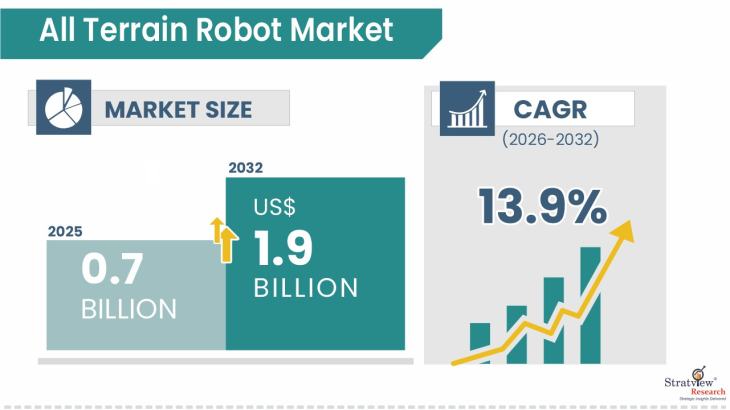
The all-terrain robot market was estimated at USD 0.7 billion in 2025 and is likely to grow at a CAGR of 13.9% during 2026-2032 to reach USD 1.9 billion in 2032.
Want to know more about the market scope? Register Here
All-terrain robots are a series of robots that are intended for use with scholarly study, surveillance, and most practical robotic applications to drive over any type of terrain. It can work on both outdoor and indoor surfaces. All-terrain robots powered by Artificial Intelligence (AI) can conduct remote processes, be portable across dangerous terrain, transmit border patrolling, and perform monitoring tasks. Over the years, the capabilities of robots have been expanding substantially.
|
Segmentations |
List of Sub-Segments |
Segments with High Growth Opportunity |
|
Application Type Analysis |
Military & Defense, Mining & Construction, Agriculture, Others |
The military & defense segment witnessed the largest share in 2025. |
|
Reinforcement Type Analysis |
Airborne, Ground, Marine, Space, UAVs, and Weapons |
Glass fiber composite is projected to remain the most dominant segment of the market during the forecast period, driven by a wide array of advantages including low cost, good mechanical performance, and excellent corrosion and abrasion resistance. |
|
End-Use Industry Type Analysis |
Residential, Non-Residential |
Wind energy is likely to maintain its dominance in the total continuous fiber composites market during the forecast period. |
|
Regional Analysis |
North America, Europe, Asia-Pacific, and Rest of the World |
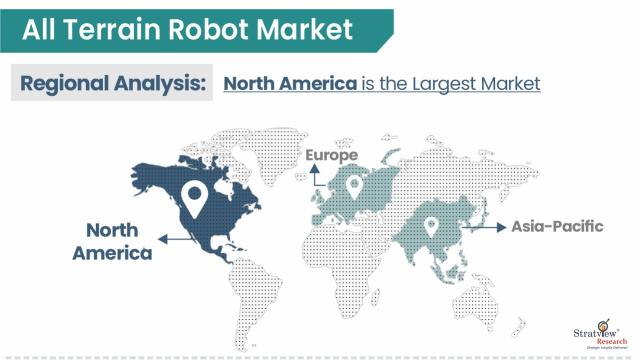
North America garnered the highest market share in 2025 and is likely to grow at a healthy CAGR during the forecast period |
"The military & defense segment accounted for the largest market share."
By application, the all-terrain robot market has been categorized into military& defense, mining & construction, agriculture, and others. The military & defense segment witnessed the largest share in 2025 owing to their increasing adoption in military applications for monitoring of coastal waters for adversaries, air strikes on evasive targets, execution of search & rescue operations, supply of emergency services, reconnaissance missions, and the performance of several other tasks.
"North America accounted for the largest market share."
On the basis of region, North America garnered the highest market share in 2025 and is likely to grow at a healthy CAGR during the forecast period.
The military & defense and mining industries are two of the most common end-use segments for all-terrain robots. As the pandemic hit, the military & defense sectors witnessed a substantial blow with delayed military exercises and the shutdown of military weaponry production, thus affecting the demand for all-terrain robots. Moreover, mining activities were partially or completely shut down in most of the countries due to stringent lockdown norms, further impacting market growth.
Know the high-growth countries in this report. Register Here
The Key players operating in the all-terrain robot market are:
Note: The above list does not necessarily include all the top players of the market.
Are you the leading player in this market? We would love to include your name. Write to us at [email protected]
Recent mergers & acquisitions and other developments in the all-terrain robot market reflect evolving market trends, and impact the market. Below given are a few recent developments in the market –
In April 2026, Unimech Aerospace and Manufacturing acquired Hobel Bellows, a specialized manufacturer of metallic bellows, flexible tubing components, and precision-engineered assemblies, for an investment of up to ₹450 crore, strengthening Unimech’s capabilities in advanced tubing and engineered assemblies for aerospace and other high-precision applications.
In December 2025, AeroFlow Technologies acquired G&L Tube and Evans Alloys from O’Neal Industries, expanding its portfolio of welded and seamless tubing, tube assemblies, and precision metal components for aerospace, defense, and space applications.
In September 2025, Lion Equity Partners acquired Custom Tube Products, a manufacturer of precision metal tubing assemblies and components serving the aerospace, medical, and industrial markets, and integrated it with its portfolio company Elkhart Tri-Went Industrial.
In July 2025, Cogenuity Partners acquired Tech Tube and Tube Methods, manufacturers of small-diameter metallic tubing serving aerospace, defense, medical, power generation, and industrial applications, expanding its capabilities in precision tubing.
In April 2025, Tinicum agreed to acquire Leggett & Platt’s Aerospace Products Group for $285 million, acquiring a business that manufactures complex, highly engineered tube and duct assemblies primarily for commercial and military aircraft and space launch vehicles.
In April 2026, Blackstone and Tinicum agreed to acquire Senior plc for approximately £1.4 billion. Following the acquisition, Tinicum’s AeroFlow Technologies, which manufactures aerospace ducts and tubes, is expected to operate under common ownership with Senior, strengthening their combined capabilities in aerospace fluid-management systems.
This strategic assessment report, from Stratview Research, provides a comprehensive analysis that reflects today’s all-terrain robot market realities and future market possibilities for the forecast period of 2026 to 2032. After a continuous interest in our all-terrain robot market report from the industry stakeholders, we have tried to further accentuate our research scope to the all-terrain robot market to provide the most crystal-clear picture of the market. The report segments and analyses the market in the most detailed manner to provide a panoramic view of the market. The vital data/information provided in the report can play a crucial role for the market participants as well as investors in the identification of the low-hanging fruits available in the market as well as to formulate the growth strategies to expedite their growth process.
This report offers high-quality insights and is the outcome of a detailed research methodology comprising extensive secondary research, rigorous primary interviews with industry stakeholders, and validation and triangulation with Stratview Research’s internal database and statistical tools. More than 1000 authenticated secondary sources, such as company annual reports, fact books, press releases, journals, investor presentations, white papers, patents, and articles, have been leveraged to gather the data. We conducted more than 15 detailed primary interviews with the market players across the value chain in all four regions and industry experts to obtain both qualitative and quantitative insights.
This report provides market intelligence in the most comprehensive way. The report structure has been kept such that it offers maximum business value. It provides critical insights into market dynamics and will enable strategic decision-making for existing market players as well as those willing to enter the market. The following are the key features of the report:
This report studies the market, covering a period of 12 years of trends and forecasts. The report provides detailed insights into the market dynamics to enable informed business decision-making and growth strategy formulation based on the opportunities present in the market.
The all-terrain robot market is segmented into the following categories:
By Type
By Application Type
By Region
With this detailed report, Stratview Research offers one of the following free customization options to our respectable clients:
Company Profiling
Competitive Benchmarking
Custom Research: Stratview Research offers custom research services across sectors. In case of any custom research requirement related to market assessment, competitive benchmarking, sourcing and procurement, target screening, and others, please send your inquiry to [email protected].
The report is delivered digitally through our online portal. Buyers receive login credentials from our team to access the report and may update their credentials at any time after the initial login.
Delivery timelines depend on the status of the report:
For the most accurate delivery timeline, please contact us to confirm the current status of the report.
Yes. You may request a complimentary preview of the report through a video conference with our team.
Yes. The scope of the report can be fully customized to align with your specific research objectives and information requirements.
Please contact us at [email protected], and our team will be happy to discuss your requirements and propose a tailored solution.
Yes. Selected sections of the report can be purchased separately based on your requirements. Please contact us at [email protected] to discuss your needs.
Yes, AI can help gather publicly available information, but its outputs are only as reliable as the data it accesses. Stratview Research reports are built using validated data, extensive primary interviews with industry stakeholders, and the expertise of our experienced research team.
Additionally, many critical insights, including market dynamics, competitive intelligence, and industry-specific trends, are not publicly available and therefore cannot be captured through AI alone.
The all-terrain robot market is likely to grow at a CAGR of 13.9% during 2026-2032.
The all-terrain robot market was estimated at USD 0.7 billion in 2025.
The forecasted value of the all-terrain robot market is expected to be USD 1.9 billion in 2032.
Boston Dynamics (The U.S), Dr Robot Inc. (Canada), ENDEAVOR ROBOTICS, INC. (The U.S), Evatech, Inc. (The U.S), Inspector Bots (The U.S), NIDES Ltd. (The U.S), Roboteam (The U.S), Stanley Innovation (The U.S), SuperDroid Robots, Inc. (The U.S), Telerob (Germany) are among the key players in the market.
North America garnered the highest share of the market in 2025.
The military & defense segment witnessed the largest share of the market in 2025.
Surging demand for these robots from the military & defense sector is the key driver of the market.
All-terrain robot manufacturers, All-terrain robot vendors, AI companies, Military companies, Mining companies are the target audience in the market.


WE ACCEPT