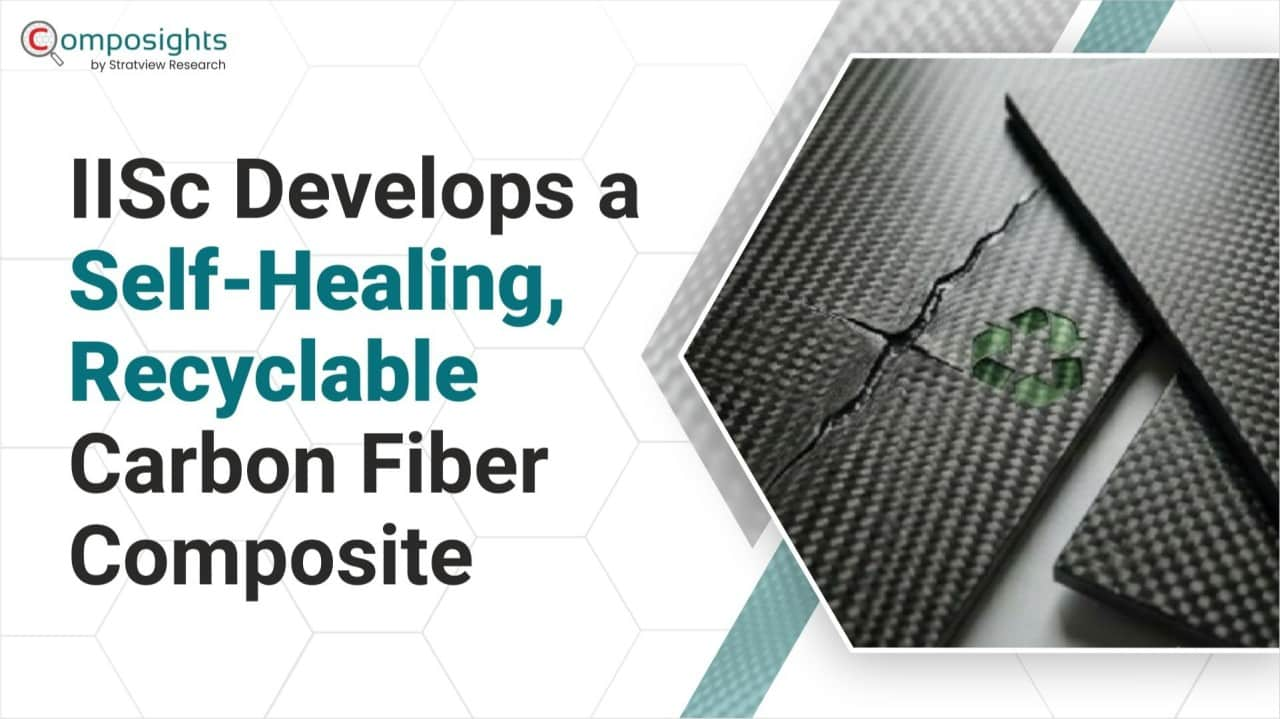
Carbon fiber-reinforced epoxy composites combine high strength and stiffness with low weight, making them valuable in aerospace, marine, and other structural applications. However, conventional epoxy matrices are difficult to repair after internal damage and cannot be readily remelted for recycling.
Researchers at the Indian Institute of Science (IISc), Bengaluru, have developed a carbon fiber-reinforced vitrimer epoxy composite designed to address these challenges. Published online on September 5, 2026, in Advanced Composites and Hybrid Materials, the study explores how dynamic polymer chemistry can enable heat-assisted self-healing and closed-loop recycling while maintaining mechanical performance.
What Is Vitrimer Chemistry?
Vitrimer chemistry uses dynamic covalent bonds that can exchange under suitable conditions, allowing a crosslinked polymer network to rearrange without simply melting like a thermoplastic. This distinguishes vitrimers from conventional thermoset epoxies, whose permanent crosslinks restrict reshaping and reprocessing after curing.
In a composite, this network rearrangement can help reconnect damaged regions during controlled heat treatment and enable the polymer to be reprocessed for reuse. The extent of recovery depends on the material design and processing conditions.
The IISc team developed a vitrimer epoxy matrix containing dynamic disulfide and silyl ether bonds. The researchers also incorporated hydroxyl-functionalized graphene oxide (hGO) and modified the carbon fiber surface with a dissociative Diels–Alder (DA) adduct. These modifications created a responsive fiber–matrix interface, helping address load transfer alongside the matrix's ability to rearrange.
Improved Mechanical Performance and Self-Healing
Compared with conventional carbon fiber-reinforced epoxy (CFRE), the modified composite demonstrated a 53% increase in flexural strength and a 47% improvement in interlaminar shear strength (ILSS). These properties indicate its resistance to bending and shear stresses between laminate layers.
The team also evaluated the composite's ability to recover performance after impact. Following a controlled heat-and-pressure treatment, the material achieved 64% self-healing efficiency, measured through the recovery of peak load in an ILSS test. The treatment involved compression moulding at 180°C and 5 MPa for 30 minutes.
Micro-computed tomography (micro-CT) showed that the largest measured defect length decreased from 1,450 μm to 120 μm after treatment. Together, these results indicate reduced internal damage and partial mechanical recovery, rather than complete restoration of the original laminate. The demonstrated healing process required controlled laboratory conditions; it was not autonomous repair during normal service.
Conductive Networks Enable EMI Shielding and De-Icing
The composite's conductive architecture also enabled electromagnetic interference (EMI) shielding and electrically assisted de-icing.
The laminate achieved a reported shielding result of approximately −46 dB across the 8–12 GHz X-band. For comparison, the vitrimer laminate without hGO recorded approximately −39 dB, while the hGO-containing laminate without the modified fiber interface recorded approximately −45 dB. The conductive carbon fiber network interacts with electromagnetic waves, while hGO contributes additional conductive pathways and dielectric losses.
The same material architecture supported de-icing through Joule heating, in which electrical resistance generates heat as current passes through the composite. The modified laminate melted the test ice in 47 seconds, compared with 62 seconds for the baseline vitrimer laminate. These results demonstrate additional functions beyond structural performance. However, laboratory testing alone does not establish readiness for operational aircraft or marine applications.
Closed-Loop Recycling of the Matrix and Fibers
Conventional composite recycling often focuses on recovering carbon fibers, while the cured polymer matrix remains difficult to reuse. The IISc team addressed both constituents using its patented SaLSO™ platform, demonstrating closed-loop recovery followed by the production of new composite laminates.
The study reported that upcycled laminates involving recovered vitrimer epoxy, recovered carbon fibers, and both recovered constituents retained 92%, 96%, and 85% of virgin-reference ILSS, respectively.
These figures describe the mechanical performance of reconstructed laminates, not the isolated properties of recovered resin or fibers. The results indicate that both constituents can be recovered and reused, although the laminate incorporating both recovered constituents retained a lower proportion of virgin-reference ILSS than the other reported configurations.
Further research is needed to establish how mechanical properties change over repeated recycling cycles and whether the process can be scaled for industrial production.
Toward More Repairable and Recyclable Composites
The study demonstrates how dynamic covalent chemistry can support two important functions in carbon fiber composites: partial recovery of mechanical performance after impact and reuse of the matrix and reinforcement. Interface engineering also helps maintain structural performance, while the conductive architecture adds EMI shielding and de-icing capabilities.
The next challenge is to validate these properties across repeated repair and recycling cycles, larger-scale processing, and application-specific operating conditions. The findings offer a research pathway toward composite materials designed with both service-life performance and end-of-life recovery in mind.