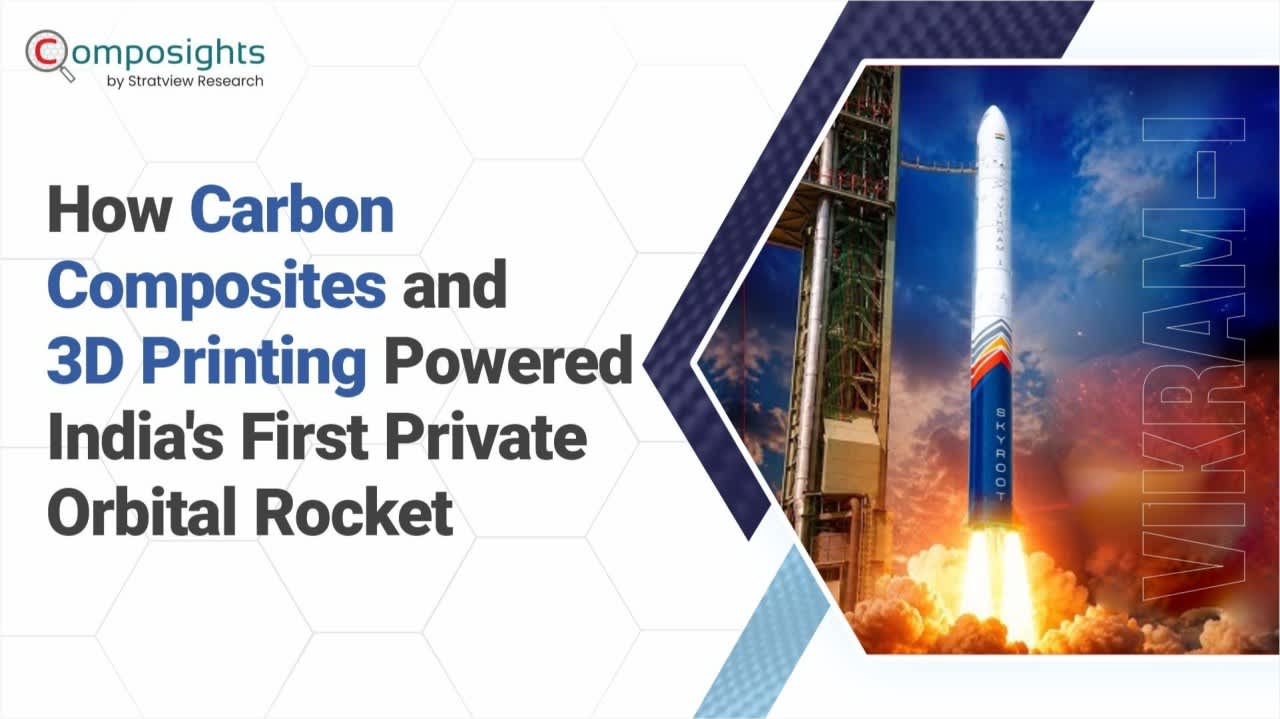
On the morning of July 18, Skyroot Aerospace's Vikram-1 lifted off from the Satish Dhawan Space Centre and, just minutes later, successfully placed multiple payloads into a 450 km orbit. It was a historic milestone; India's first privately developed orbital launch vehicle had reached space, demonstrating that private companies can now design, build, integrate, and operate complete orbital launch systems.
The headline number is straightforward: India is now the third country in the world with private orbital launch capability. But for anyone working in materials and manufacturing, the more interesting story is what the rocket is actually made of.
The Mission, in Brief
“Mission Aagaman” was designed as a technology demonstration rather than a routine commercial mission. Standing 22 metres tall with a diameter of 1.7 metres, Vikram-1 carried a payload capacity of 350 kg to Low Earth Orbit. Onboard was a diverse set of payloads, Skyroot's own SCOPE satellite, a technology demonstrator from DCUBED, Grahaa Space's SOLARAS S3, and Embrace, a robotic arm built by Cosmoserve Space to capture orbital debris. The mission also carried a symbolic 18-karat gold micro-rocket engraved with miniature sculptures of C. V. Raman, Vikram Sarabhai and A. P. J. Abdul Kalam, a tribute to the pioneers who laid the foundation of India's space programme.
Beyond delivering payloads, however, the mission validated technologies that are likely to advance the future of India's commercial launch industry.
Where the Real Engineering Story Begins
While the successful launch made headlines, Vikram-1's engineering choices deserve equal attention. The rocket features an all-carbon composite structure, including one of India's longest monolithic carbon composite rocket stages. That distinction is more than a manufacturing achievement.
In launch vehicles, every kilogram saved contributes directly to payload capability or reduces the propellant needed to reach orbit. Carbon composites combine an exceptional strength-to-weight ratio with high stiffness and strong corrosion resistance, making them well suited to structures that need to survive repeated stress cycles without adding dead weight. A monolithic composite stage further minimizes joints and fasteners, reducing potential structural weak points while simplifying the overall design.
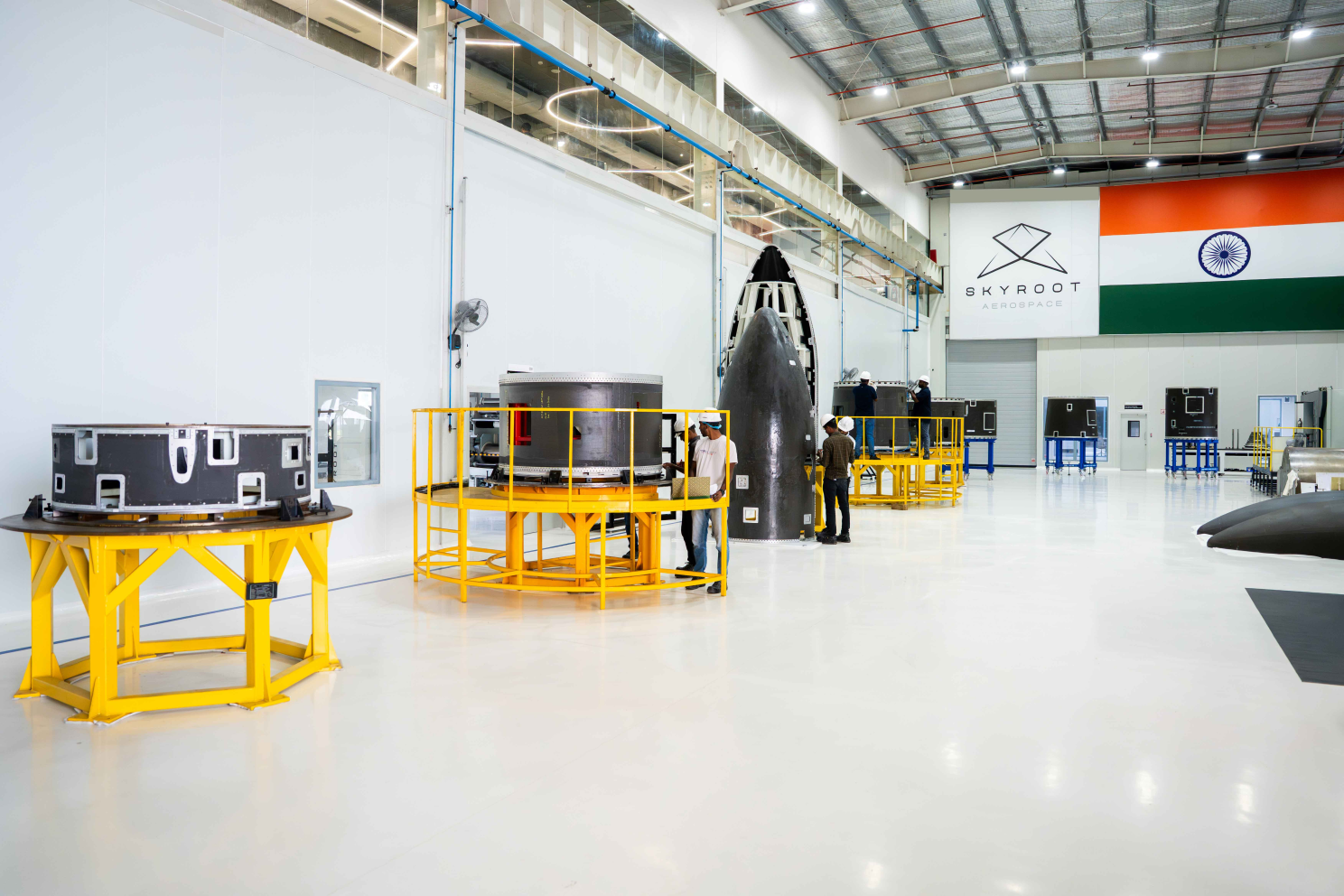
Image Courtesy of Skyroot Aerospace
Additive manufacturing is changing the equation on the propulsion side in much the same way. Vikram-1 pairs solid-fuel propulsion with a 3D-printed liquid engine that powers its Orbital Adjustment Module for precise maneuvers in orbit.
Rocket engines have traditionally required hundreds of precision-machined components, assembled through long and complex manufacturing chains. Additive manufacturing simplifies this by consolidating multiple parts into fewer integrated components, while enabling intricate internal geometries that conventional machining struggles to produce at all. The result is faster production, reduced assembly complexity, lower manufacturing costs and considerably shorter design iteration cycles.
For emerging launch providers, these technologies are more than engineering innovations, they are competitive advantages. Carbon composite structures improve structural efficiency and stretch payload potential, while additive manufacturing enables faster development, simplified production, and rapid design iteration. Together, they allow companies to build lighter, more efficient launch vehicles and bring them to market faster, helping them compete in the rapidly evolving commercial space industry.
Vikram-1 is likely to be remembered for more than being India's first privately developed orbital rocket. It's a working demonstration of how advanced composites and digital manufacturing are becoming the foundation of next-generation space systems.
A New Era for India's Space Ecosystem
Vikram-1 is more than a technological milestone; it is the outcome of an ecosystem that has rapidly evolved over the past few years. The Indian Space Policy 2023 opened the country's space value chain to private participation, while IN-SPACe created a single-window framework for regulatory approvals, industry access, and collaboration with ISRO.
The results are already visible. India's space startup ecosystem has grown from just one startup in 2014 to more than 400 today, while the country's space economy is currently valued at around USD 8.4 billion, with ambitions of touching USD 100 billion by 2040. Vikram-1 demonstrates what becomes possible when forward-looking policy meets engineering excellence. More importantly, it signals that the future of India's commercial space industry will be defined as much by advanced materials and manufacturing as by the missions they enable.