.jpg "biofibers 101")
Walk into a supermarket, hospital, automotive plant, or furniture showroom, and chances are you will encounter products containing bicomponent fibers.
They are rarely visible to consumers, yet they play a critical role in the performance of diapers, medical gowns, filtration media, automotive interiors, insulation materials, wipes, bedding products, and technical textiles. As manufacturers continue to seek materials that are lighter, softer, stronger, and more efficient, bicomponent fibers have become an important part of modern fiber engineering.
So, what exactly are bicomponent fibers, and why are they used across so many industries?
What Is a Bicomponent Fiber?
A bicomponent fiber is a synthetic fiber made by combining two different polymers within a single filament during the spinning process. Unlike blended fibers, where different fibers are simply mixed together, bicomponent fibers contain two distinct polymer components that remain integrated within the same filament structure.
The two polymers may differ in:
- Melting point
- Shrinkage behavior
- Elasticity
- Strength
- Dyeability
- Surface properties
- Chemical resistance
By combining these characteristics in a single fiber, manufacturers can create performance profiles that would be difficult to achieve using only one polymer.
How Are Bicomponent Fibers Manufactured?
Bicomponent fibers are primarily produced through a melt-spinning process.
Two polymers are melted separately and fed through a specially designed spinneret. The spinneret combines the polymers into a single filament while maintaining their distinct positions within the fiber cross-section. After extrusion, the fibers are cooled, stretched, and wound for further processing.
The final performance of the fiber depends on several factors, including polymer selection, polymer ratio, cross-sectional design, processing conditions, and post-treatment methods. Even small changes in these variables can significantly influence fiber behavior and end-use performance.
Common Types of Bicomponent Fibers and Their Applications
1) Sheath-Core Fibers
In this structure, one polymer forms the outer sheath while another forms the inner core. This design is widely used where thermal bonding capability and structural strength are required within the same fiber.
2) Side-by-Side Fibers
In side-by-side fibers, the two polymers are positioned adjacent to each other along the length of the filament. Because the polymers often shrink differently when exposed to heat, the fiber can develop a natural crimp that improves bulk, loft, and resilience.
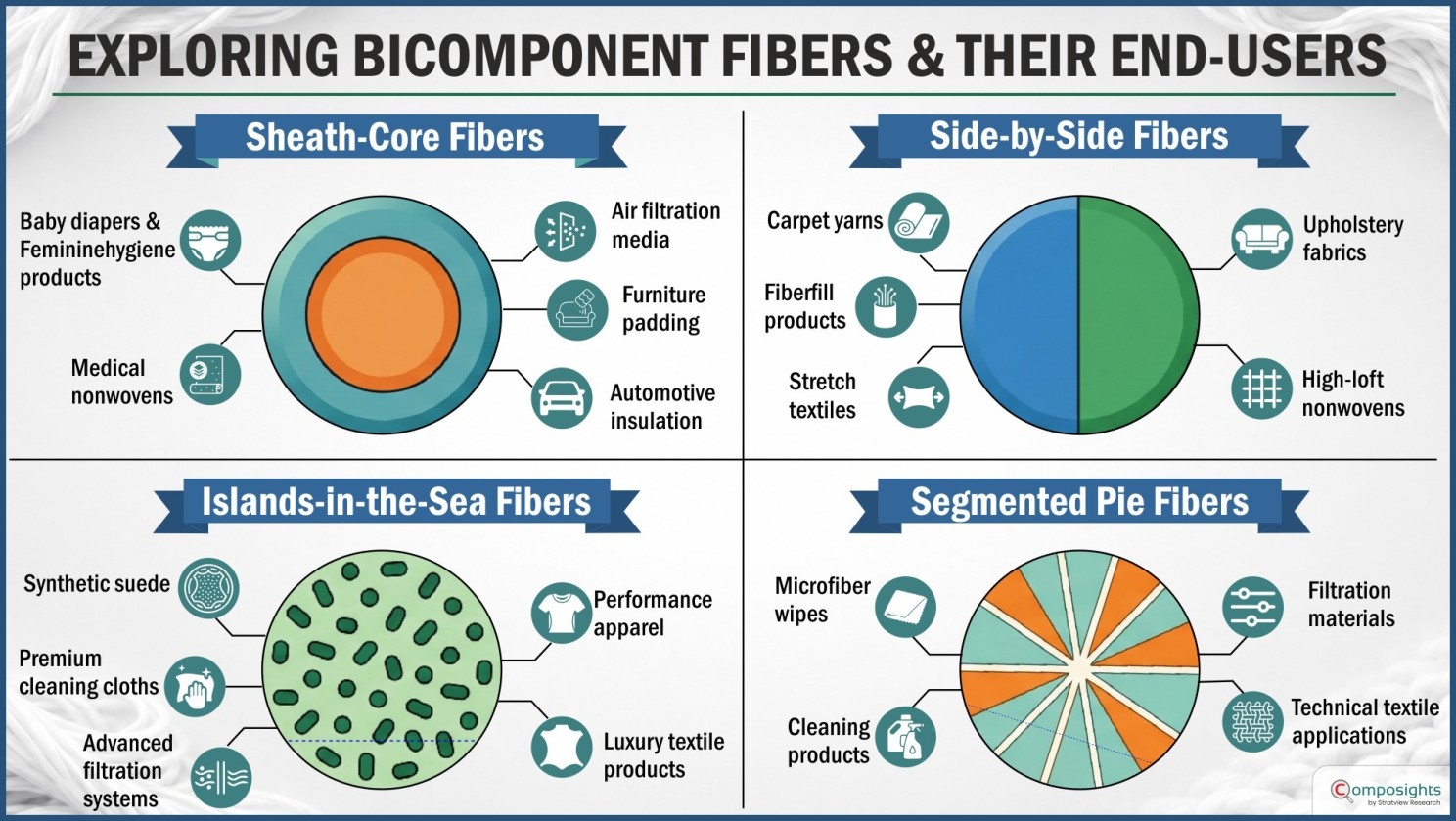
Graphic Courtesy of Stratview Research
3) Islands-in-the-Sea Fibers
This structure consists of numerous tiny polymer "islands" embedded within another polymer matrix known as the "sea." Once the sea component is removed, extremely fine microfibers remain, making this design suitable for applications requiring softness or a high surface area.
4) Segmented Pie Fibers
In segmented pie fibers, the polymers are arranged in wedge-shaped segments around the center of the filament. During processing, these segments can separate into multiple ultrafine fibers, creating materials with enhanced cleaning and filtration capabilities.
Why Are Bicomponent Fibers So Valuable?
The widespread adoption of bicomponent fibers stems from their ability to combine multiple functionalities within a single fiber structure.
- Improved Thermal Bonding
One of the most important advantages is efficient thermal bonding. A low-melting sheath can bond fibers together without damaging the higher-strength core, reducing the need for adhesives and supporting efficient manufacturing processes.
- Enhanced Softness and Comfort
Manufacturers can engineer fibers that provide a softer feel while maintaining durability and strength. This is particularly valuable in hygiene and medical applications where comfort is a key requirement.
- Self-Crimping Capability
Certain bicomponent fiber structures naturally develop crimp due to differences in polymer shrinkage. This can increase loft, bulk, cushioning performance, and recovery properties without requiring mechanical crimping processes.
- Fine Fiber Production
Special bicomponent configurations make it possible to produce ultrafine fibers used in advanced filtration systems, cleaning materials, and specialty textile applications.
- Cost Optimization
Manufacturers can strategically position higher-cost functional polymers only where their properties are needed while utilizing more economical materials elsewhere within the fiber structure. This helps balance performance and cost considerations.
Sustainability and Material Innovation
Sustainability is becoming an increasingly important consideration across the fiber industry, and bicomponent fibers are evolving alongside this shift.
Manufacturers are exploring several approaches to improve the environmental profile of these materials, including:
- Bio-based polymers
- Recyclable polymer combinations
- Reduced-energy bonding systems
- Lower-carbon production processes
New developments involving polylactic acid (PLA), recyclable polyolefins, and advanced mono-material fiber architectures are creating opportunities to improve recyclability while maintaining performance requirements.
The challenge for the industry is not simply developing more sustainable fibers, but doing so without compromising the strength, softness, durability, and processing efficiency that end-use applications demand. As sustainability targets become more ambitious across industries, material innovation is expected to remain an important area of focus for fiber manufacturers.
Market Growth and Future Outlook
The demand for bicomponent fibers continues to expand alongside the growth of hygiene products, medical nonwovens, filtration media, and lightweight industrial materials. Their versatility and ability to deliver multiple performance characteristics within a single fiber structure have supported adoption across a broad range of end-use industries.
According to Stratview Research, the global bicomponent fiber market is expected to surpass USD 5 billions by 2034, driven by increasing demand from hygiene, healthcare, filtration, and industrial applications..
Looking ahead, growth opportunities are expected to emerge from expanding filtration requirements, rising healthcare spending, and continued innovation in nonwoven materials. These trends are likely to support the adoption of bicomponent fibers across both established and emerging applications, reinforcing their role within the broader technical textiles and nonwovens industry.
Subscribe to our newsletter
Related Blogs:

Protective Films: Invisible Yet Indispensable
Didn’t find what you were looking for?
Tell us about your requirements
(Our team usually responds within a few hours)