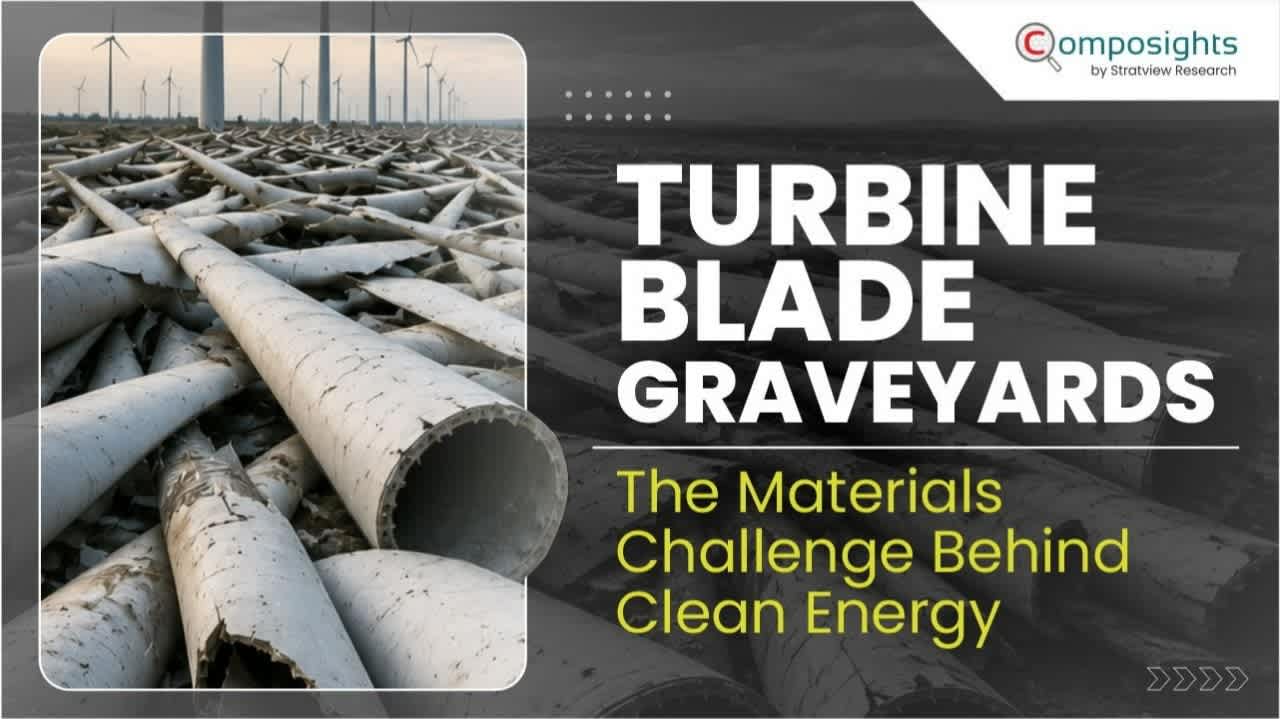
The photos are what made this story stick: rows of bone-white turbine blades, each longer than a football field, stacked in landfills outside towns like Casper, Wyoming. For an industry associated with clean energy, the optics were difficult to ignore. If wind power is renewable, why are its blades piling up like permanent waste?
The answer isn't wind power. It's about chemistry.
Why Turbine Blades Won't Melt Down
Modern wind turbine blades are among the largest composite structures ever manufactured. A utility-scale blade can extend beyond 100 meters and is designed to withstand decades of cyclic loading, UV exposure, and severe weather without failing.
That durability comes from fiber-reinforced polymers. Most blades rely on glass fiber composites, while larger offshore models incorporate carbon fiber in critical structural sections. These fibers are bonded together using thermoset resins, creating a lightweight structure capable of delivering the strength, stiffness, and fatigue resistance required for long-term operation.
For turbine designers, the trade-off was clear. Composite materials enabled longer blades, higher energy capture, and improved efficiency. The recycling challenge emerged not because the material failed, but because it performed exceptionally well in service.
Unlike thermoplastics, thermoset resins cure into a permanent cross-linked structure. Once cured, they cannot simply be melted and reshaped. Recovering the reinforcing fibers requires breaking those chemical bonds, making recycling far more complex than recycling metals or conventional plastics.
A Waste Problem with a Real Number Attached
As the global wind fleet matures, this materials challenge is becoming more visible.
Graphic Courtesy of Stratview Research
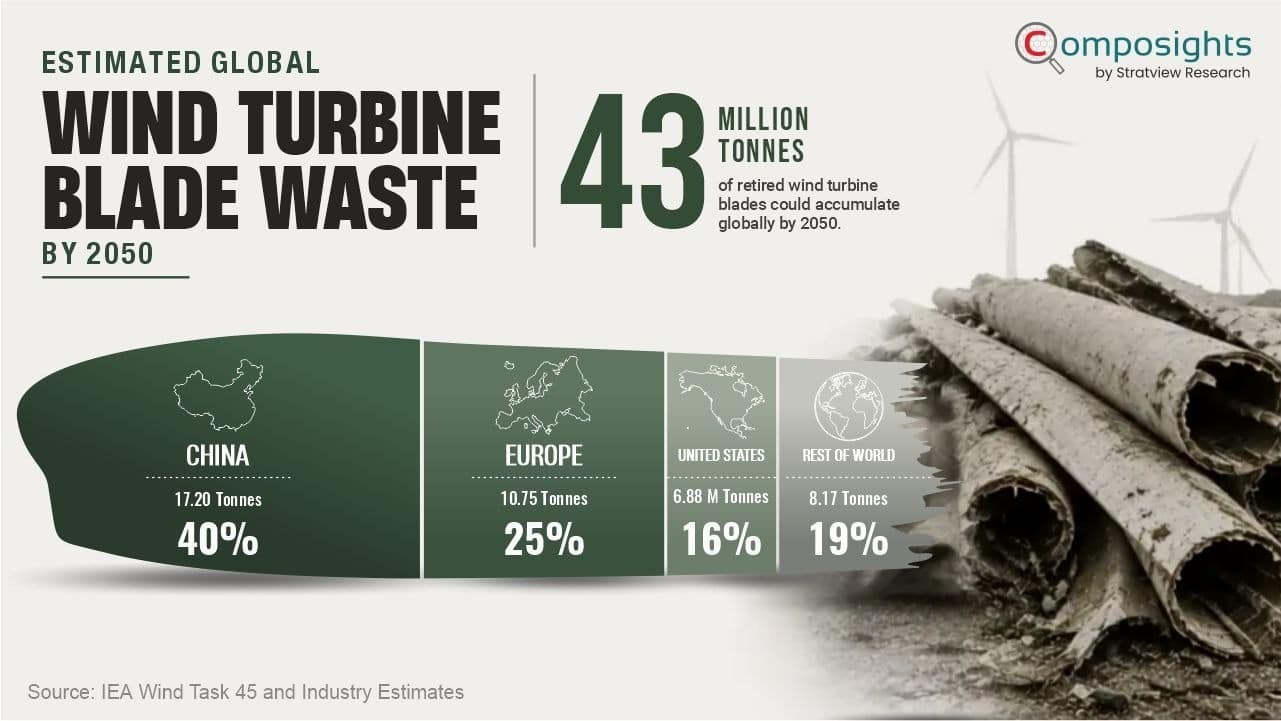
Our study suggest, cumulative global wind turbine blade waste could approach 43 million tonnes by 2050. Importantly, this figure represents cumulative retirements over several decades rather than annual waste generation.
At the same time, the issue should be viewed in context. Composite blades account for less than 15% of a turbine's total mass. The majority of turbine materials, including steel, copper, and aluminum, already move through established recycling streams.
The blade is not evidence that wind turbines are broadly unrecyclable. It is the component that continues to challenge the industry's efforts toward full material circularity.
Why Blade Graveyards Emerged
The images associated with blade graveyards emerged because disposal infrastructure developed more slowly than wind energy itself.
Retired blades are difficult and expensive to transport due to their size, while specialized recycling facilities remain limited in many regions. For years, landfilling was often the most practical and economically viable option available to operators.
As blade retirements increased, that approach began to face growing scrutiny.
A significant shift occurred in Europe on January 1, 2026 (Source: WindEurope) when the wind industry implemented a voluntary landfill ban for decommissioned blades. While not yet a legally binding EU requirement, the commitment reflects growing industry recognition that end-of-life blade management can no longer be treated as a future problem.
Where the Turbine Blades Actually Go Now
Several wind turbine blade recycling and recovery pathways are now moving beyond pilot projects and into commercial use.
Mechanical recycling remains one of the most widely adopted approaches. Retired blades are cut, shredded, and processed into material streams that can be incorporated into industrial applications.
Another increasingly common route is cement kiln co-processing. In this process, the resin contributes energy during cement production, while the glass fiber content replaces some of the raw mineral inputs required for clinker manufacturing. Rather than treating blades solely as waste, the process recovers value from both major components of the composite structure.
More advanced technologies are also attracting attention. Pyrolysis and solvolysis use thermal and chemical processes to separate reinforcing fibers from the resin matrix, offering a pathway for higher-value material recovery.
Beyond recycling, some organizations are exploring direct reuse. Sections of retired blades have already been incorporated into pedestrian bridges, noise barriers, and infrastructure projects across Europe.
The Real Fix Is Upstream, Not Downstream
While recycling technologies continue to improve, many experts believe the long-term solution begins during blade design rather than after retirement.
One example comes from the European ZEBRA project, which successfully developed and tested a 62-meter wind turbine blade using Arkema's Elium thermoplastic resin. Unlike conventional thermoset systems, thermoplastic materials can be reheated and reprocessed through more established recycling routes.
Manufacturers are also developing recyclable thermoset systems. Siemens Gamesa's recyclable blade technology is already moving beyond pilot demonstrations. The Sofia offshore wind farm in the United Kingdom incorporates 150 recyclable blades and is expected to supply electricity to up to 1.2 million homes once fully operational.
These projects will help determine whether recyclable blade technologies can be deployed at the scale required for the next generation of wind energy installations.
Closing the Loop on Composite Turbine Blades
Blade graveyards exposed a real gap in how the wind industry manages composite materials at the end of a blade's service life. What was once viewed primarily as a disposal challenge is now influencing developments in blade design, resin chemistry, and recycling technologies.
For years, engineers focused on making blades lighter, longer, and more durable. Today, another question is gaining importance: what happens to those materials after 25 or 30 years of service? That shift is encouraging manufacturers, material suppliers, and recyclers to look beyond performance and consider how blades can be recovered, reused, or repurposed once they reach the end of their operational life.
Composite materials have made today's larger, more efficient wind turbines possible. The next challenge is making sure those materials don't reach the end of their journey when the turbine does.