When defense platforms need to reduce weight without compromising structural performance, composite materials become an important part of the engineering equation. Their use continues to expand across military aircraft, helicopters, unmanned aerial vehicles (UAVs), missiles, naval systems, and other defense platforms. This growing adoption is supporting demand for advanced composite materials and opening up opportunities across the defense composites value chain.
The defense composites market was valued at USD 1,171 million in 2025 and is expected to reach USD 1,552 million by 2032, growing at a CAGR of 3.7% during 2026–2032.
Stratview Research estimates that the top 10 players accounted for 50–70% of the global defense composites market in 2025, reflecting a moderately concentrated competitive landscape.
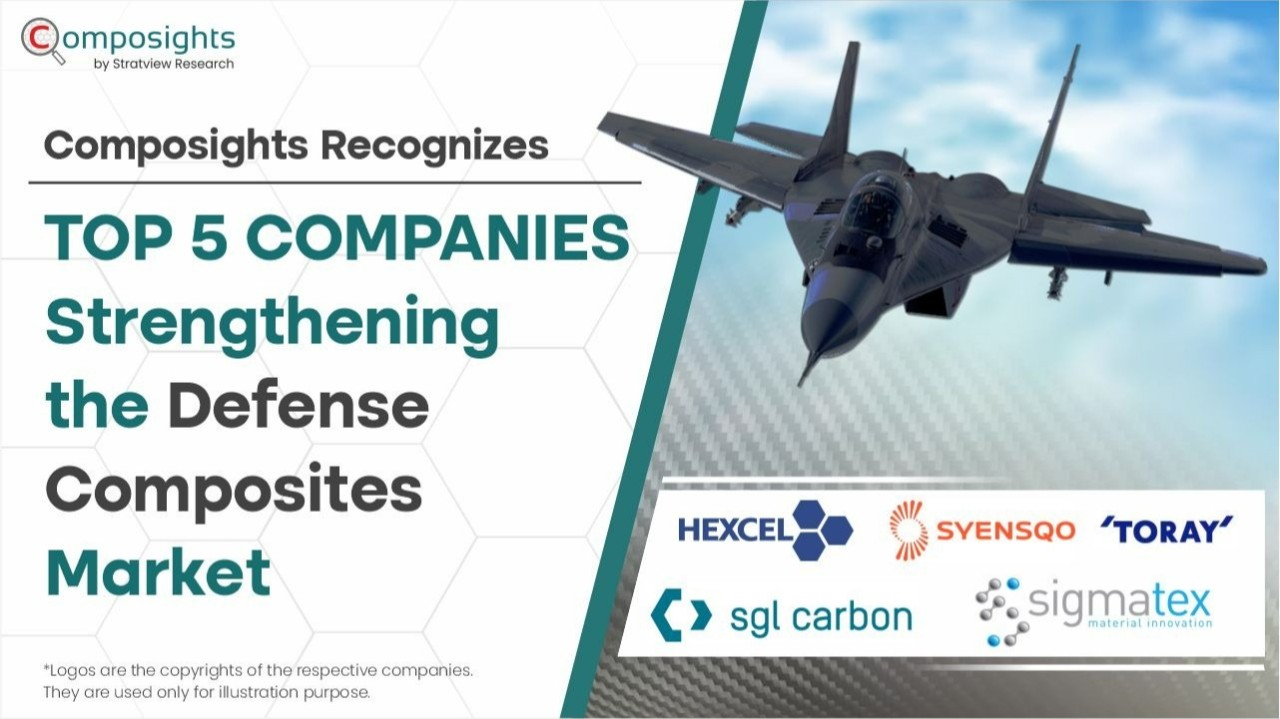
Among the leading companies identified by Composights, Hexcel Corporation, Syensqo SA, Toray Industries Inc., SGL Carbon SE, and Sigmatex Limited represent different competitive positions across various parts of the defense composites value chain.
1. Hexcel Corporation
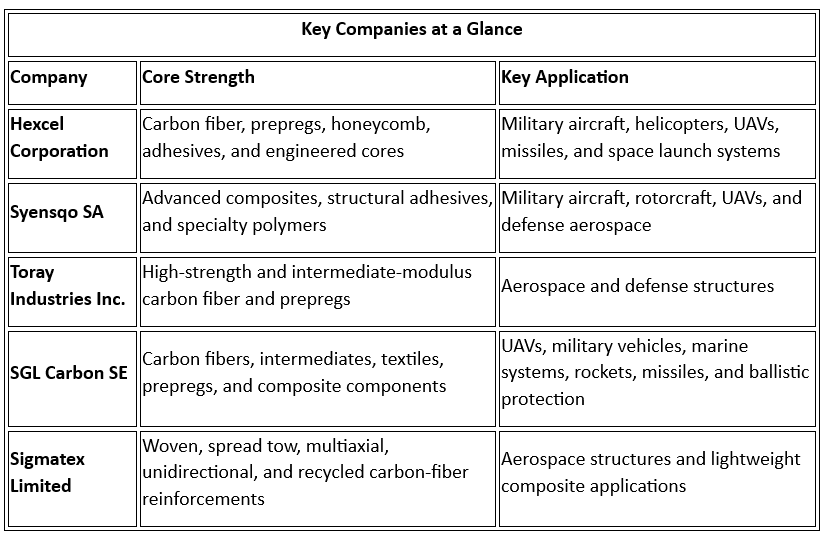
As one of the top companies recognized by Composights, Hexcel offers carbon fiber, prepregs, adhesives, honeycomb, and engineered core materials for aerospace and defense applications. The company states that its materials are qualified for more than 100 military aircraft, helicopter, and space programs, including the F-35, Rafale, Eurofighter Typhoon, and A400M.
In July 2026, Hexcel announced new and extended long-term agreements with Boeing covering commercial, defense, and space programs. The agreements include an enterprise-level composite material supply framework and an extension covering advanced acoustic engineered core for engine applications.
Along with that, in September 2026, Hexcel highlighted expanded U.S. manufacturing capability for its HexPly M901 fast-curing prepreg system, which supports applications including unmanned systems and defense platforms. The company also introduced an enhanced HexWeb Vented Flex-Core aluminum honeycomb for highly contoured aerospace structures, including next-generation space launch systems.
2. Syensqo SA
Syensqo brings advanced composite materials, structural adhesives, and specialty polymers to aerospace and defense applications.
In March 2026, Syensqo secured a new multi-year agreement with Boeing covering advanced composite and adhesive solutions for Boeing’s commercial and defense programs. The agreement covers applications including primary and secondary structures, interiors, and surfacing.
In July 2026, Syensqo announced its involvement in the U.S. Army’s MV-75 Cheyenne program, providing advanced composite materials, adhesives, and specialty polymers for structural and rotorcraft components. The company will support the program through development, qualification, and future production phases.
Syensqo also entered into a five-year strategic partnership with Toray for high-strength and intermediate-modulus carbon fiber, supporting current and future commercial and defense aerospace programs. These activities place Syensqo across material development, qualification, and supply for defense aerospace programs.
3. Toray Industries Inc.
Toray has a strong upstream position in defense composites through its carbon fiber and prepreg capabilities for aerospace and defense applications
In 2026, Toray placed Space & Defense among the priority areas of its IGNITION 2028 program, alongside commercial aircraft. The company is also expanding regular-tow carbon-fiber capacity in Korea and France, with 3,250 tons per year planned in Korea and 1,000 tons per year in France, both scheduled for the second half of 2026. A further 3,250-ton-per-year facility in the U.S. is planned for the first half of 2027.
Toray is also supplying high-strength and intermediate-modulus carbon fiber under its five-year agreement with Syensqo, effective January 2026. These developments reinforce Toray’s role in the defense composites value chain as a supplier of carbon fiber and prepreg technologies, supported by expanding production capacity and aerospace supply relationships.
4. SGL Carbon SE
SGL Carbon spans carbon fibers, fiber intermediates, textiles, prepregs, and fiber-reinforced components. Its defense applications include UAV and drone airframes, military vehicles, marine systems, rockets and missiles, and ballistic protection.
Effective January 1, 2026, SGL Carbon combined its former Carbon Fibers and Composite Solutions activities under its Fiber Composites business.
The company also identifies defense and aerospace among the high-growth target markets under its SGL Growth 2030 strategy. Its Fiber Composites business brings together multiple stages of composite material production, from fibers and intermediates through textiles, prepregs, and fiber-reinforced components.
The integration of these activities under Fiber Composites gives SGL Carbon a consolidated platform spanning fibers, intermediates, textiles, prepregs, and composite components for defense applications.
5. Sigmatex Limited
Sigmatex focuses on engineered carbon-fiber reinforcement. Its portfolio includes 2D woven, spread tow, multiaxial non-crimp fabrics (NCF), unidirectional, flat tow, and recycled carbon-fiber fabrics.
The company operates three manufacturing sites across the UK, United States, and China. Its UK facility covers approximately 110,000 sq. ft., while its U.S. facility covers 75,000 sq. ft. Both facilities hold AS9100D accreditation, while the China facility is progressing toward AS9100D certification for aerospace.
Sigmatex identifies aerospace and space among its core markets, and its published approvals include requirements from companies including Boeing, Airbus, Bombardier, Rolls-Royce, and Lockheed Martin. Its combination of specialized carbon-fiber reinforcements, multi-site manufacturing, and aerospace qualification supports its role in the reinforcement segment of the defense composites value chain.
How these Companies Are Positioned Across the Value Chain
The five companies contribute to the defense composites value chain through distinct material and manufacturing capabilities.
Hexcel combines carbon fiber, prepregs, honeycomb, adhesives, and engineered core materials. Syensqo brings composite materials, adhesives, specialty polymers, and qualification support, while Toray focuses strongly on carbon fiber and prepregs. SGL Carbon spans fibers, intermediates, textiles, prepregs, and composite components, and Sigmatex specializes in engineered carbon-fiber reinforcement.
Recent developments across these companies also highlight the importance of qualification, production readiness, supply continuity, and program experience alongside material performance. These factors influence how suppliers support demanding aerospace and defense programs through different stages of development and production.
Subscribe to our newsletter
Related Blogs:
Past Week's Key Highlights from the A&D Composites Industry
Didn’t find what you were looking for?
Tell us about your requirements
(Our team usually responds within a few hours)