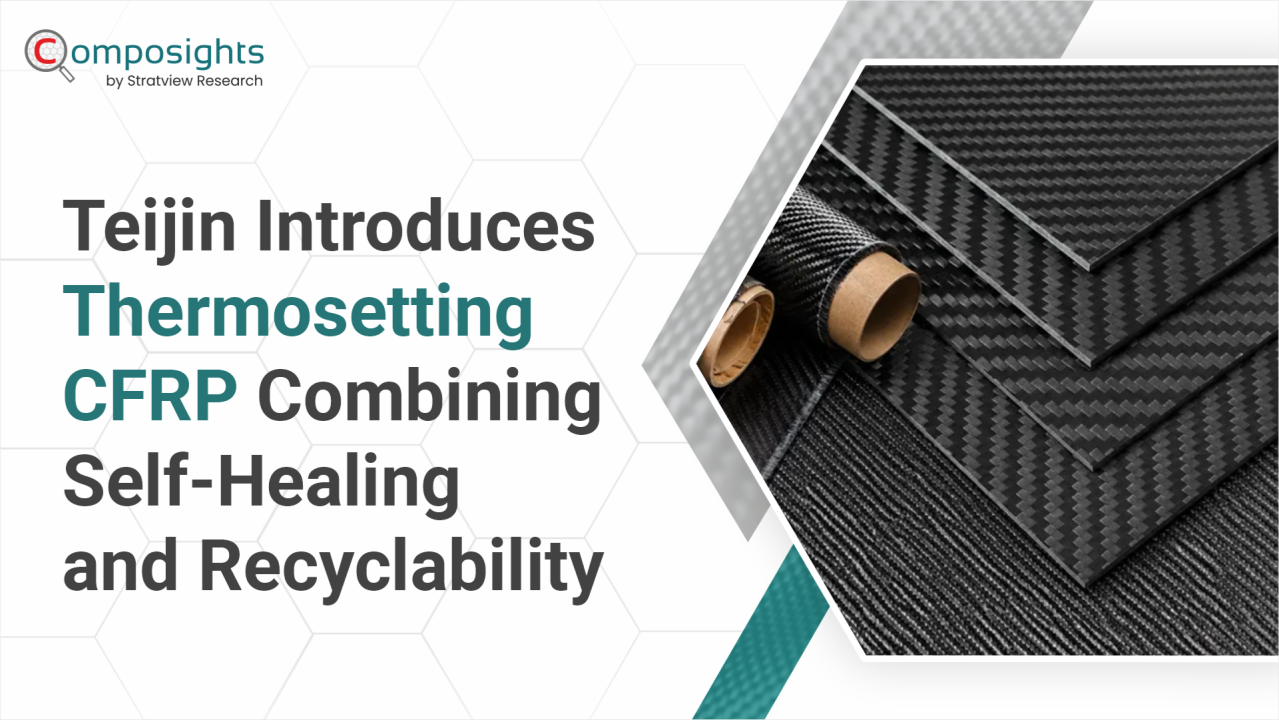
For decades, carbon fiber-reinforced plastics (CFRPs) have been the material of choice for applications where lightweight construction and high strength are essential, from commercial aircraft and high-performance vehicles to premium sporting goods. However, one major limitation has remained unchanged: once damaged, thermosetting CFRP components are often replaced rather than repaired, increasing material waste and lifecycle costs.
Teijin Limited is addressing this challenge with the newly developed thermosetting, long carbon fiber-reinforced plastic (CFRP) that combines heat-activated repairability with high recyclability, while delivering mechanical properties comparable to conventional CFRPs.

Image Courtesy of Teijin Carbon
When heated to a specified temperature for a short period, damaged sections can be restored instead of discarded, extending product life and reducing resource consumption. At the end of its service life, the material can also be recycled through a simple chemical decomposition process, overcoming one of the long-standing recycling challenges associated with thermosetting composites.
Core Technology Features
Self-Healing Through Heating
If the resin layer is damaged, the material can be repaired by heating it at a prescribed temperature for a short time, allowing components to remain in service longer while minimizing premature disposal and waste generation.
Recyclability Through Remolding
Unlike conventional thermosetting CFRPs, which cannot be reshaped once molded because the resin neither melts nor flows, Teijin's newly developed CFRP becomes flowable within a specified temperature range. This unique property enables the material to be recycled through compression molding and other remolding processes, providing a practical pathway for material recovery.
Carbon Fiber Recovery Through Resin Decomposition
Recovering carbon fibers from conventional thermosetting CFRPs typically requires prolonged thermal decomposition at temperatures exceeding 400°C, an energy-intensive process with a significant environmental footprint. The new material offers a simpler alternative by allowing the thermoset resin to be decomposed in a specialized chemical solution. This process efficiently separates and recovers long carbon fibers, enabling their reuse while reducing energy consumption and environmental impact.

Image Courtesy of Teijin Carbon
Beyond Performance: Advancing the Circular Composite Economy
The significance of this development extends beyond improved material properties. Industries such as aerospace and automotive are under growing pressure to reduce greenhouse gas emissions across the entire value chain, not just during operation, but also through manufacturing, maintenance, and end-of-life management.
By enabling both repair and recycling, Teijin's latest CFRP could help manufacturers lower maintenance costs, extend component lifespan, and reduce composite waste destined for landfills or incineration. These advantages could make advanced composites more sustainable without compromising the lightweight performance they are known for.
The Broader Industry Perspective
The significance of this development is more than just a new material launch; it reflects the changing priorities of the composites industry. As manufacturers look for ways to build products that last longer and generate less waste, innovations like this could play an important role in making advanced composites more practical and sustainable.