
Every kilogram launched into space influences more than launch costs. It affects payload capacity, mission flexibility, and overall spacecraft design. As satellite constellations expand, reusable launch systems mature, and space missions become more ambitious, manufacturers are placing greater emphasis on materials that can deliver consistent structural performance under demanding operating conditions.
Among these materials, space prepregs have become an increasingly preferred choice. By combining reinforcing fibers with a precisely controlled amount of resin before manufacturing, prepregs enable lightweight composite structures that offer the consistency and reliability required for modern spacecraft.
Why Spacecraft Depend on Prepreg Composites
Spacecraft operate in an environment where there is little room for material failure. Structures must withstand intense launch vibrations, repeated thermal cycling in orbit, and prolonged exposure to harsh space conditions while maintaining their strength and dimensional stability.
Unlike conventional composite materials, prepregs are supplied with reinforcing fibers that are pre-impregnated with a controlled amount of resin. This improves manufacturing consistency and reduces process variability, making prepregs well suited for satellites, launch vehicles, payload structures, antenna systems, solar array supports, and other mission-critical components where structural reliability is essential.
Where Space Prepreg Delivers The Greatest Value
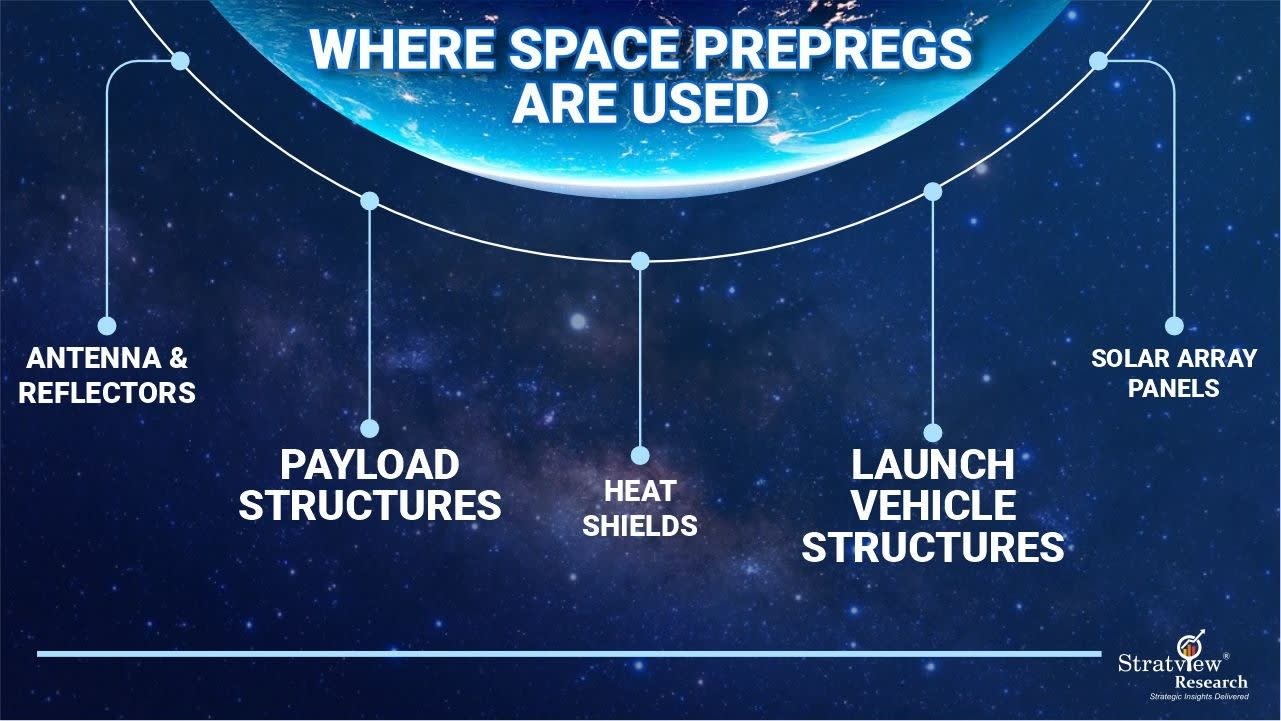
Although prepregs are used across multiple spacecraft structures, demand is concentrated in applications where weight reduction and structural precision have the greatest impact. According to Stratview Research, payload structures and launch vehicles together accounted for nearly 85% of the global space prepreg market, underscoring their importance in driving material demand.
Graphic Courtesy of Straview Research
Payload structures support communication payloads, optical instruments, antennas, and scientific equipment that must maintain precise alignment throughout a mission. Launch vehicles, meanwhile, rely on lightweight composite structures capable of withstanding significant mechanical loads during ascent without adding unnecessary mass. The combination of high stiffness, low weight, and thermal stability offered by prepreg composites makes them well suited for both applications.
Why Carbon Fiber Continues to Dominate
The performance of a prepreg is determined not only by its manufacturing process but also by the reinforcing fiber and resin system used. Carbon fiber prepregs continue to dominate the market because they provide an effective balance of stiffness, fatigue resistance, thermal stability, and lightweight performance for demanding space applications.
According to our analysis, carbon fiber prepregs accounted for more than 90% of the global space prepreg market, reflecting their widespread use across satellites, launch vehicles, and other structural applications. Thermoset prepregs, particularly epoxy-based systems, also continue to hold a leading position due to their long qualification history, predictable processing characteristics, and proven reliability in aerospace manufacturing.
Why the Market Continues to Expand
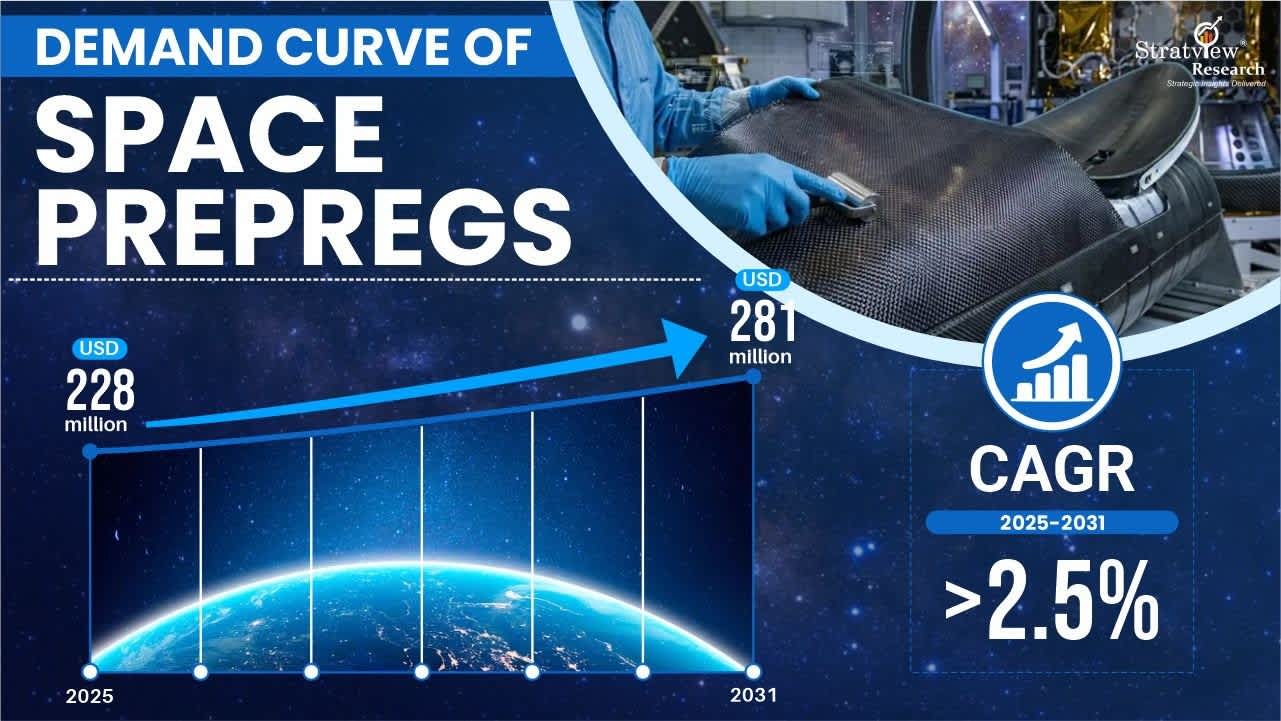
The growing use of prepregs reflects broader changes taking place across the space industry. According to Stratview Research, the global space prepreg market was valued at USD 208 million in 2025 and is projected to reach USD 281 million by 2031.
Graphic Courtesy of Straview Research
Growth is being supported by expanding satellite deployments, increasing investments in reusable launch vehicles, the commercialization of space, and continued advancements in out-of-autoclave and radiation-resistant prepreg technologies. As spacecraft manufacturing gradually shifts from one-off missions toward higher production volumes for commercial constellations and exploration programs, manufacturers are placing greater emphasis on process consistency, repeatability, and production efficiency alongside structural performance.
North America Maintains Its Leadership
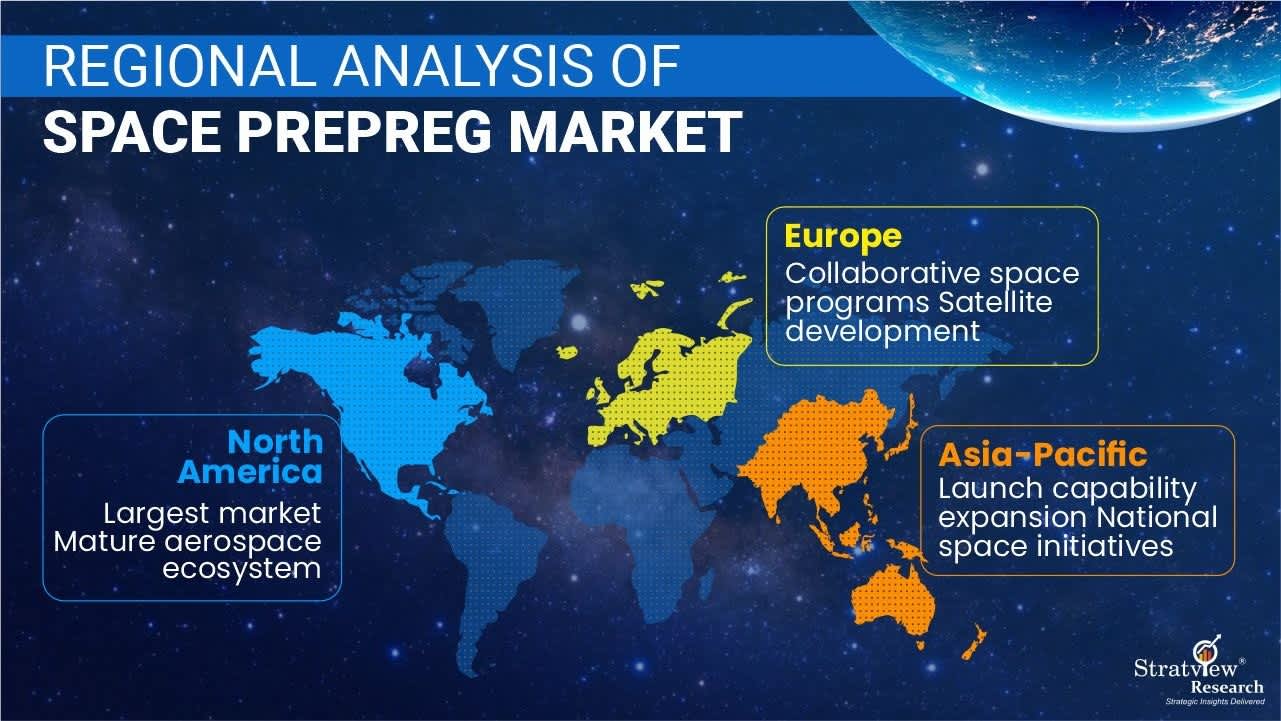
Regional demand continues to reflect the concentration of established space programs and manufacturing capabilities. According to Stratview Research, North America accounted for more than 65% of the global space prepreg market in 2025, supported by its mature aerospace ecosystem, government-funded space programs, commercial launch providers, and leading spacecraft manufacturers.
Graphic Courtesy of Straview Research
At the same time, Europe is strengthening its position through collaborative space initiatives and satellite development, while Asia-Pacific is expanding launch capabilities and spacecraft manufacturing through growing national space programs. Together, these developments are broadening the global demand for advanced composite materials.
The Next Stage of Growth Depends on Manufacturing
The expanding space economy is creating new opportunities for prepreg composites, but it is also raising new expectations. As satellite production scales and commercial missions become increasingly cost-conscious, manufacturers must deliver not only high-performance materials but also greater production efficiency and process consistency.
Advances in out-of-autoclave processing, faster curing systems, automated manufacturing, and next-generation resin technologies are already addressing many of these challenges. Their continued development is expected to improve manufacturing flexibility while supporting broader adoption across future space programs.
As these technologies mature, the role of space prepregs is likely to extend beyond enabling lightweight structures to supporting a more scalable and efficient approach to spacecraft manufacturing.
Subscribe to our newsletter
Related Blogs:

Global Space Sector Sees Key Acquisitions and Partnerships
Didn’t find what you were looking for?
Tell us about your requirements
(Our team usually responds within a few hours)