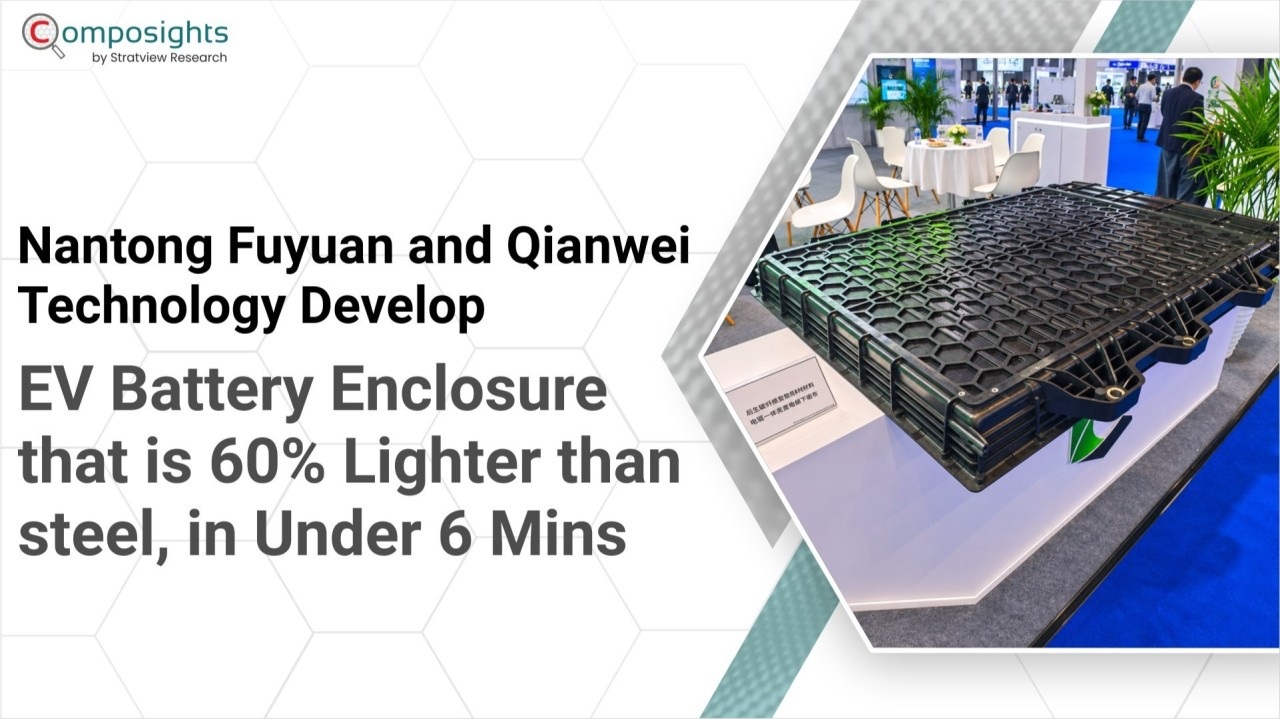
Nantong Fuyuan and Qianwei Technology have developed a lower battery enclosure using recycled carbon fiber-reinforced thermoplastic composites, demonstrating how material selection and manufacturing integration can work together to reduce component weight and production time. The enclosure weighs more than 60% less than its conventional steel counterpart, while an integrated molding process reduces the manufacturing cycle from 80–90 minutes to less than 6 minutes.
An EV battery enclosure must do more than house the battery pack. It needs to withstand demanding operating temperatures, resist corrosion, provide electrical insulation, and maintain structural integrity without adding unnecessary weight. The companies' development addresses these requirements while simplifying the manufacturing process.
Combining Fiber Strength with a Smarter Molding Process
The development brings together Fuyuan’s recycled carbon fiber materials and Qianwei Technology’s integrated molding expertise. The material solution combines discontinuous carbon fiber-reinforced thermoplastics with continuous glass fiber-reinforced composites, integrating both reinforcement forms into a single component.
To bring these materials together in one component, Qianwei Technology has developed a specialized molding platform. The 2,000-ton automated platform combines vertical clamping with horizontal injection. Infrared heating prepares continuous fiber-reinforced thermoplastic composites, while continuous glass fiber-reinforced thermoplastic sheets and short carbon fiber-reinforced pellets are brought together in the same mold.
Rather than manufacturing several parts and assembling them later, the process produces the enclosure in a single molding cycle. This allows complex geometries to be formed while combining lightweight construction with structural performance.
20 Steps Down to One
According to the companies, conventional metal battery enclosure manufacturing can involve approximately 20 processing steps and take 80–90 minutes per production cycle. The integrated composite process reduces this to a single step, with a molding cycle of less than 6 minutes.
That translates into a 95% reduction in processing steps and a reported production efficiency improvement of more than 10 times. The approach also reduces the number of components by 40%, while automation increases production-line efficiency by 50%. Fewer parts, less processing, and a shorter cycle can help reduce overall manufacturing costs.
For electric vehicle manufacturers, these gains offer more than a lighter enclosure. They point to a way of simplifying production while meeting demanding component requirements.
Less Weight, Lower Emissions, Wider Possibilities
The material benefits extend beyond weight reduction. Fuyuan reports that products made using its recycled carbon fiber materials can reduce carbon emissions by 85% per kilogram compared with products made from virgin carbon fiber. The enclosure also offers resistance to electrochemical corrosion and electrical insulation, with a designed operating temperature range of −40°C to 125°C.
Together, these properties make the development relevant to demanding battery applications, where material performance and manufacturing efficiency must work hand in hand.
The implications could extend beyond new energy vehicles. The same combination of recycled fiber materials and integrated molding may find opportunities in consumer products, rail transit, robotics, and the low-altitude economy.
For composite manufacturers, the development highlights an important possibility: recycled carbon fiber thermoplastics can do more than reduce reliance on virgin materials. When paired with an integrated manufacturing process, they can also help cut component weight, simplify production, and shorten cycle times.
News source: https://www.linkedin.com/pulse/recycled-carbon-fiber-thermoplastic-composites-enable-integrated-s4gme/