In highly contoured sandwich structures, the honeycomb core has to conform to the part geometry without creating excessive preparation work.
That makes core formability a manufacturing consideration. When the core follows complex curvature more readily, the preparation required before final assembly can also change, particularly where machining or splicing is involved.
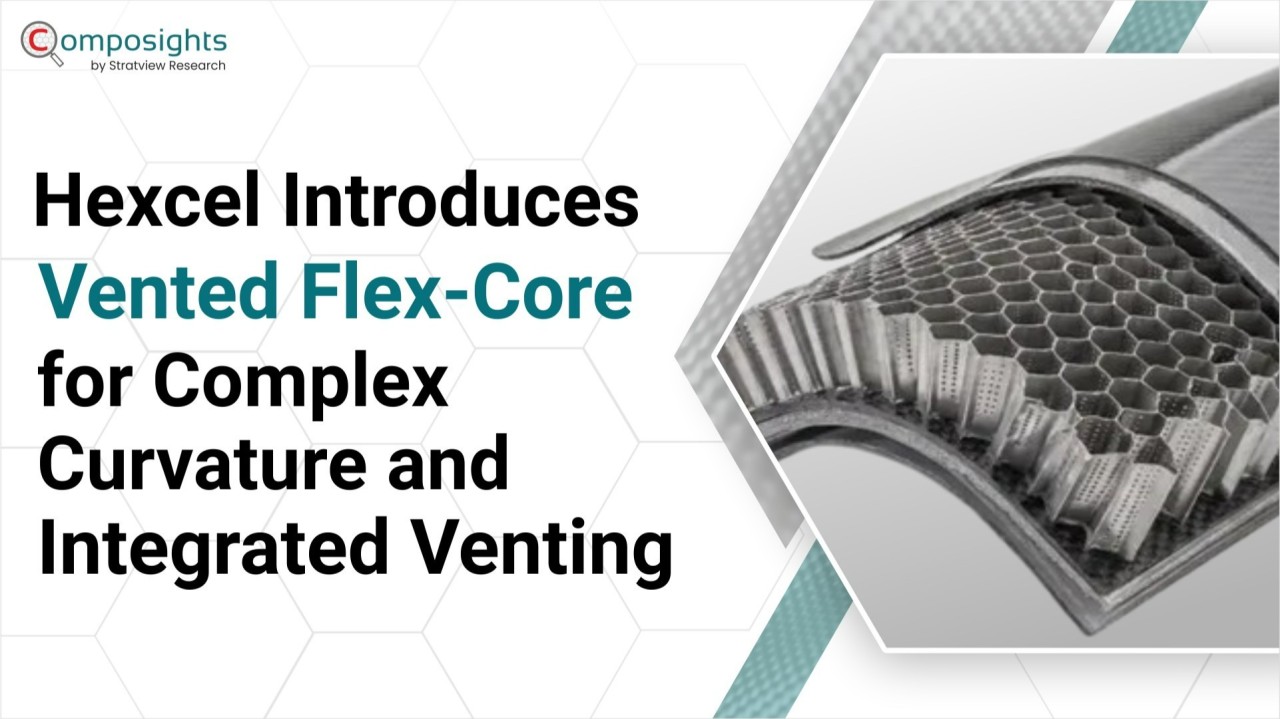
Hexcel’s latest Flex-Core® development puts this consideration into practice. On September 22, 2026, the company introduced an enhanced CRPAA-5052-F80-12.0 Vented Flex-Core® aluminum honeycomb configuration that combines its established cell architecture with integrated venting.
Complex Curvature Starts With Core Formability
Conventional hexagonal honeycomb can become difficult to form when a sandwich structure requires tight or compound curvature. As the core is shaped, deformation of the cell walls can affect how readily it conforms to the intended geometry.
Hexcel’s Flex-Core uses a different cell configuration designed to reduce anticlastic behavior and accommodate tight radii without deformation of the cell walls or loss of mechanical properties, according to the company’s technical datasheet.
The architecture is intended for highly contoured structures such as leading edges, nacelles, fairings, doors, and access covers. For the new Vented Flex-Core configuration, Hexcel states that the architecture offers significantly greater flexibility and formability than conventional hexagonal honeycomb. The company says this can reduce or eliminate machining and minimize splicing requirements.
The 2026 Development Adds Integrated Venting
The September 2026 announcement concerns an enhanced CRPAA-5052-F80-12.0 configuration rather than the introduction of Flex-Core technology itself.
The configuration uses 5052 aluminum alloy, a phosphoric acid anodized (PAA) corrosion-resistant coating, and a nominal density of 12.0 lb/ft³. It is specified for service temperatures up to 350°F (177°C) and is available in vented and non-vented configurations.
Hexcel’s existing Flex-Core literature already identifies vented options. The latest development adds a specific configuration that combines the Flex-Core architecture with integrated venting in a 5052 aluminum core.
Venting Addresses a Different Requirement
Formability and venting address different requirements within a sandwich structure. Formability determines how readily the core follows complex geometry. Venting provides pathways for managing pressure within the structure, which can become relevant during processing and in low-pressure aerospace environments.
Outgassing refers to the release of volatile material under vacuum. NASA maintains a spacecraft-material outgassing database based on vacuum testing, including measurements of total mass loss and volatile condensable material.
For the new configuration, Hexcel states that its integrated venting capability helps sandwich structures manage pressure differentials and outgassing requirements encountered during ascent and other demanding aerospace environments. This should not be read as a claim that the material itself has lower outgassing. Venting addresses pressure management within the structure, while outgassing is a material characteristic that can be evaluated through testing.
Formability Can Reduce Secondary Processing
The practical effect appears during part preparation. When a honeycomb core conforms more readily to complex geometry, some secondary preparation work may be reduced. Depending on the part and manufacturing process, that can involve fewer machining or splicing operations before assembly.
Hexcel specifically states that its enhanced Vented Flex-Core configuration can reduce or eliminate machining and minimize splicing requirements. The launch announcement does not provide quantified independent data for these reductions, so these remain manufacturer-stated benefits.
Core architecture can therefore influence how efficiently a sandwich structure is prepared for its final geometry. Formability has implications for fabrication as well as structural performance.
Aerospace Applications Bring These Requirements Together
Hexcel is positioning the new configuration for next-generation space launch vehicles and high-temperature aerospace structures, including engine nacelles. In these applications, complex geometry, environmental exposure, pressure management, and temperature capability can all influence core selection. The core therefore has to be considered alongside the structural and manufacturing requirements of the finished part.
Core Selection Is Also a Manufacturing Decision
Honeycomb core selection is typically based on properties such as density, strength, stiffness, and temperature capability. For highly contoured composite structures, formability and fabrication requirements also enter the decision.
Hexcel’s latest Vented Flex-Core configuration illustrates this connection. Its Flex-Core architecture is designed to accommodate complex curvature, while the new configuration adds integrated venting within a 5052 aluminum core.
For composite manufacturers, the way a core conforms to the part can influence how much secondary processing is needed before final assembly.