
For decades, steel gratings have been the standard choice for industrial walkways, platforms, and stair treads. They have served factories, power plants, offshore facilities, and processing units reliably, but as industries strive to build lighter, safer, and more efficient infrastructure, a new question has emerged: Why carry more weight than necessary?
The answer lies in FRP (Fiberglass Reinforced Plastic) gratings. Weighing 75% less than steel, they significantly reduce structural loads while remaining naturally corrosion-resistant, electrically non-conductive, and remarkably low-maintenance throughout their service life.
The result? A material that delivers strength without the weight penalty.
But getting there isn't as simple as pouring resin into a mold. How an FRP grating is manufactured decides how it behaves in the field, whether it's holding up a maintenance platform inside a chemical plant or keeping workers safe on a walkway above a cooling tower. The process is the product.
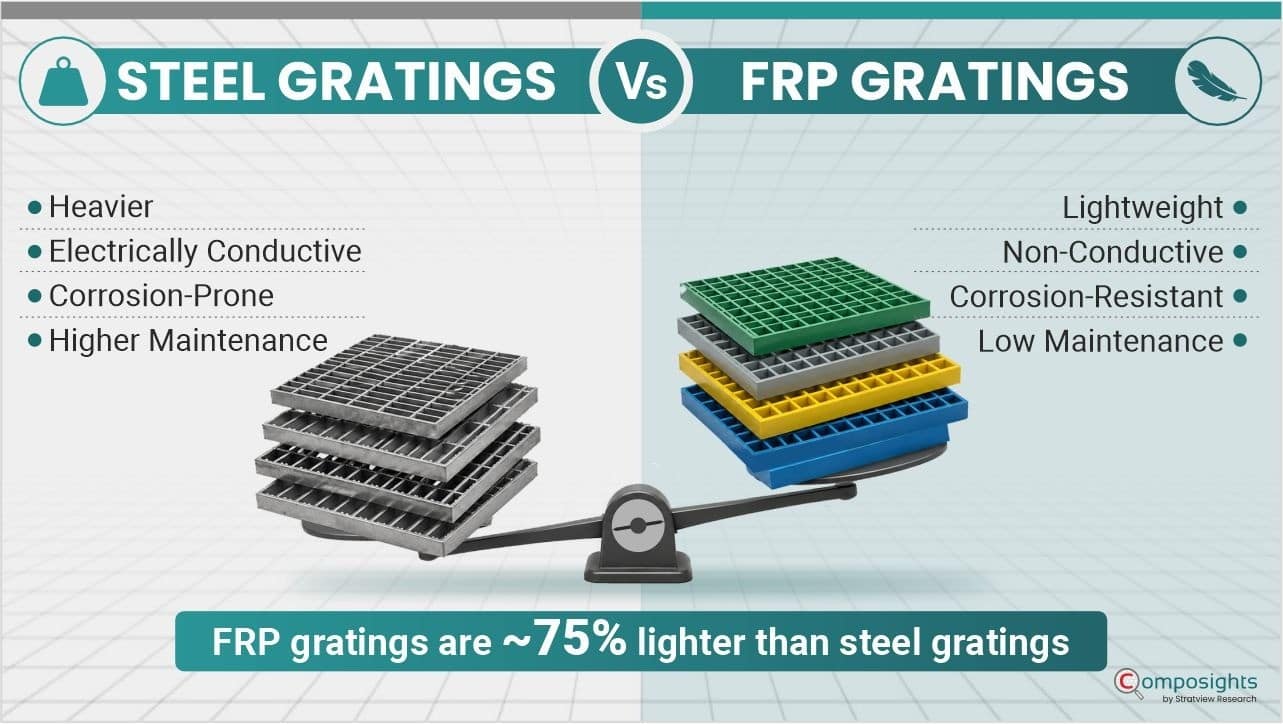
Image Courtesy of Composights (by Stratview Research)
Where Manufacturing Defines Performance
Every fiberglass grating starts with the same objective, combining fiberglass reinforcement with resin, but there are two very different ways to combine them, each engineered for a specific purpose.
The first is pultruded FRP grating, which contains nearly twice the fiberglass reinforcement of molded products, with roughly 65% fiberglass and 35% resin. The continuous fiber alignment delivers exceptional longitudinal strength, making it an excellent choice for long unsupported spans, heavy-duty platforms, and structural walkways carrying higher loads.
The second approach is moulded FRP grating. Yet, despite its lower fiber content, engineers most often specify molded FRP Grating, which represents nearly 70% of global demand. With approximately 70% resin and 30% fiberglass, it offers outstanding corrosion resistance, excellent impact performance, and greater flexibility for complex layouts. In chemical plants, cooling towers, wastewater facilities, and offshore installations, long-term durability often matters more than maximum structural strength.
While fiberglass provides the strength, the resin protects it from corrosion, moisture, and harsh chemicals. Among the available resin systems, polyester resin remains the industry's preferred choice for its balanced performance and cost-effectiveness.
Where Materials Meet the Real World
The true value of FRP gratings becomes clear in the environments where steel struggles the most. Nearly half of all installations are found across industrial facilities, where corrosion-resistant flooring, platforms, stair treads, and walkways help reduce maintenance while improving operational safety.
Their use extends well beyond factory floors. Oil & gas installations depend on them to withstand harsh offshore and onshore conditions. Water treatment facilities rely on their resistance to moisture and chemicals, while transportation infrastructure benefits from lightweight, durable access systems that simplify installation without sacrificing performance.
_27858.webp)
Image Courtesy of Composights (by Stratview Research)
The Story Continues in Asia-Pacific
Follow the demand, and it leads to Asia-Pacific, which accounts for more than half of global FRP grating consumption. The reason isn't complicated – the region is home to a dense network of manufacturing plants, oil & gas facilities, power stations, and process industries where corrosion-resistant flooring solutions are required every day.
Within Asia-Pacific, China and India continue to generate much of this demand as industrial expansion, energy projects, water management infrastructure, and cooling tower installations create a steady need for durable fiberglass reinforced plastic gratings.
Lightweight Engineering With Long-Term Value
Steel was never chosen for its light weight or its low maintenance bills, it was chosen because it could reliably carry the load. Today, however, engineers are evaluating infrastructure through a broader lens.
Facility owners today aren't just asking what a grating costs to install. They're asking what it costs to own for the next few decades – how many repaint cycles it avoids, how many corroded sections never need replacing, how much downtime never happens. On that math, FRP grating stops looking like an alternative and starts looking like the obvious answer: light enough to cut structural load, resistant enough to skip the corrosion problem entirely, and safe enough to hold its own around live electrical systems.
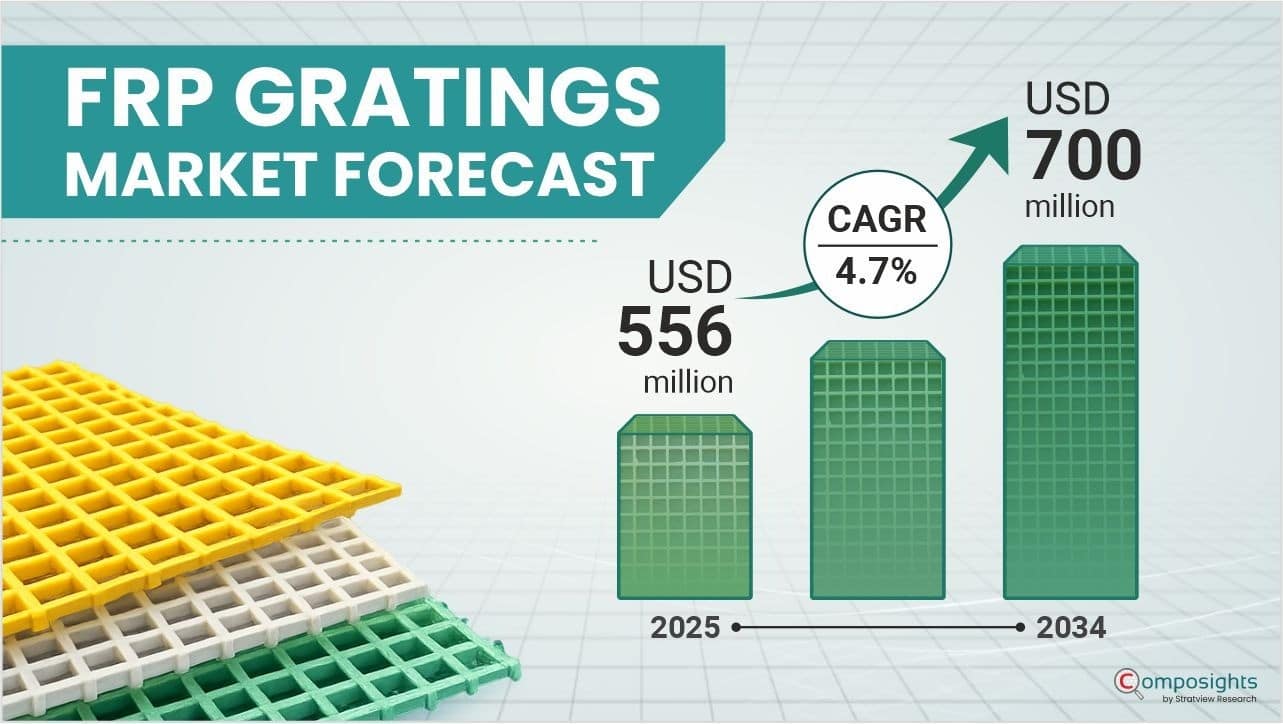
Image Courtesy of Composights (by Stratview Research)
The demand curve backs this up. Annual consumption for FRP gratings is on track to touch nearly USD 700 million by 2034, not because composites won an argument on paper, but because plant engineers keep choosing them, project after project, walkway after walkway.