
Building a wind turbine blade? Laying carbon fiber into a mold for an aircraft fuselage panel? Fabricating a racing yacht hull?
Each of these processes depends on a set of single-use materials most people outside the composites shop have never heard of, composite vacuum consumables. They are neither structural materials nor resins. What are they? Let us learn more about it, in brief here –
What are Vacuum Consumables?
Vacuum-bagging consumables are specialized auxiliary materials used to consolidate, cure, and optimize composite laminates during manufacturing. Arranged in a precise stack over the layup, they help seal the system, regulate resin flow, and enable vacuum pressure to remove trapped air, volatiles, and excess resin. These consumables are critical for achieving low-void, high-strength composites by maintaining fiber alignment, controlling resin content, and stabilizing laminate thickness.
These aren't structural materials themselves. They're enablers, and in high-stakes applications like aerospace, automotive, or wind energy. The difference between a void-free laminate and a rejected part often comes down to how well the consumable stack was selected and applied.
The Core Composite Vacuum Consumables Stack – Layer by Layer
Here's how a standard layup stack comes together:
Vacuum Bagging Film forms the outermost airtight envelope, typically a flexible nylon or polyamide film, 50–75 microns thick, depending upon the application, that contains the vacuum environment.
Perforated Release Film sits between the laminate and upper layers, controlling resin bleed through engineered perforations while preventing adhesion to the part surface.
Peel Ply, placed directly on the laminate, peels away cleanly after cure to leave a textured, contamination-free surface, ideal for secondary bonding or painting without excessive sanding.
Breather Fabric, a porous nonwoven polyester or nylon layer, creates the airflow channels that allow trapped air and volatiles to evacuate while distributing vacuum pressure uniformly.
Sealant Tape (Tacky Tape), made from butyl rubber, seals the bag to the mold perimeter, maintaining vacuum integrity throughout the entire cure cycle.
Vacuum Pumps, Connectors, and Hoses - Vacuum pumps generate the pressure differential required for laminate consolidation, while connectors, fittings, and disposable hoses maintain controlled airflow and system integrity throughout the process.
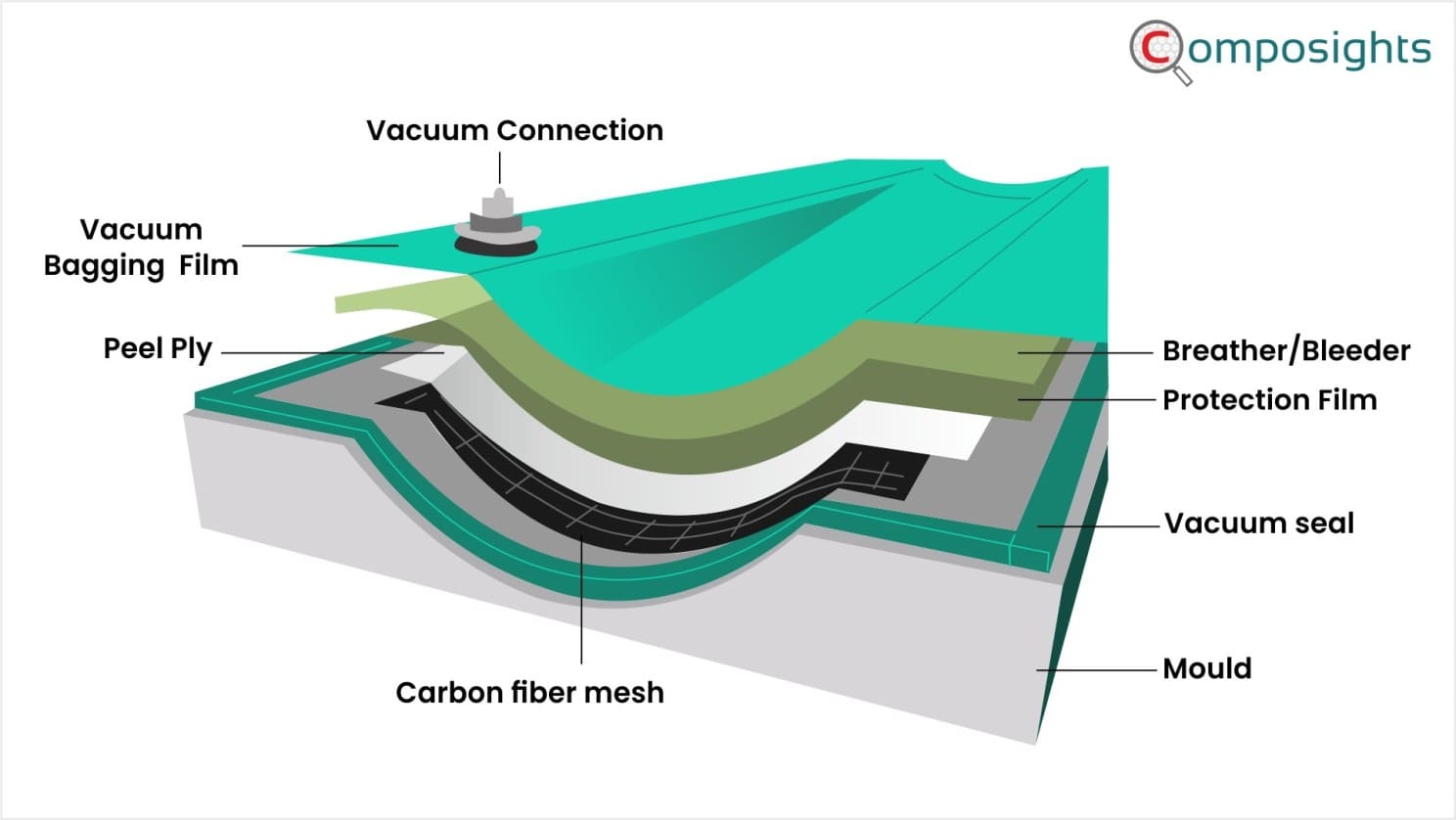
The Core Composite Vacuum Consumables Stack
Advanced Consumables for Vacuum Infusion
Flow media or infusion mesh accelerates resin distribution across the laminate by creating low-resistance flow channels. In many cases, flow media can improve resin flow rates several times compared to fiber-only flow paths.
Spiral tubing is another essential infusion consumable, ensuring even resin or vacuum distribution across large composite surfaces. Together, these materials improve infusion consistency, reduce dry spots, and support faster manufacturing cycles.
Consumables in Action – Process-Specific Material Requirements
Prepreg layup, vacuum infusion, and other advanced composite manufacturing methods all rely on vacuum bagging to consolidate laminates and remove trapped air. However, each process demands a different consumable strategy.
In Vacuum-Assisted Resin Transfer Molding (VARTM), the dominant method for large structures like wind turbine blades and marine hulls, dry fiber fabrics are laid into the mold and resin is infused under vacuum. Here, flow media (infusion mesh) and spiral tubing become critical additions, channeling resin rapidly and uniformly across large surface areas before vacuum draws it fully through the laminate thickness.
In pre-preg layup, where resin is already integrated into the reinforcement, the stack shifts. Non-perforated release film is often preferred to prevent unnecessary resin bleed, and the vacuum bag film and sealant tape must be rated for elevated cure temperatures, whether in an oven or autoclave.
Same fundamental process, but different consumable requirements.
The Industries Driving Demand for Vacuum Consumables
Demand for vacuum consumables continues to rise alongside global investments in renewable energy, lightweight transportation, and advanced infrastructure.
The wind energy sector relies heavily on these materials to scale up the production of longer, aerodynamically efficient turbine blades. Fueled by aggressive global capacity expansion, with installations rising 40% year-on-year to a record 165 GW in 2025, the wind energy sector commands the largest share of market demand.
Concurrently, the aerospace sector’s commercial aircraft build-rate recovery and the automotive industry's push for lightweight electric vehicle (EV) chassis continue to propel manufacturing volume.
As manufacturers scale production, the industry is increasingly prioritizing process efficiency, repeatability, and reduced material waste. This has driven growing adoption of ready-to-use consumable kits and optimized vacuum bagging systems.
As per Stratview Research, the global composite vacuum consumables market was valued at USD 1,150 million in 2024 and is projected to reach USD >1,570 million by 2030.
In Summary
Composite vacuum consumables rarely make headlines. They're not carbon fiber. They're not the resin. But they're the reason both of those materials perform as intended, consistently, at scale, with the void content and surface quality that structural applications demand.
As manufacturing volumes climb across the end-use sectors, the demand for reliable vacuum bagging materials, fit-for-purpose infusion consumables, and ready-to-use consumable kits will only intensify.