
A composite may be made from fiber and resin, but its performance also depends on how the reinforcement is arranged.
Fibers need to follow the load, fit the shape of the component, and work with the manufacturing process. This is where composite textiles become important. The way the fibers are woven, oriented, or formed can affect how the final composite performs.
A wind turbine blade, a printed circuit board (PCB) laminate, and an aircraft component may have little in common. Yet all three use reinforcement designed for a particular combination of strength, stiffness, weight, and processing requirements.
Graphic Courtesy of Composights
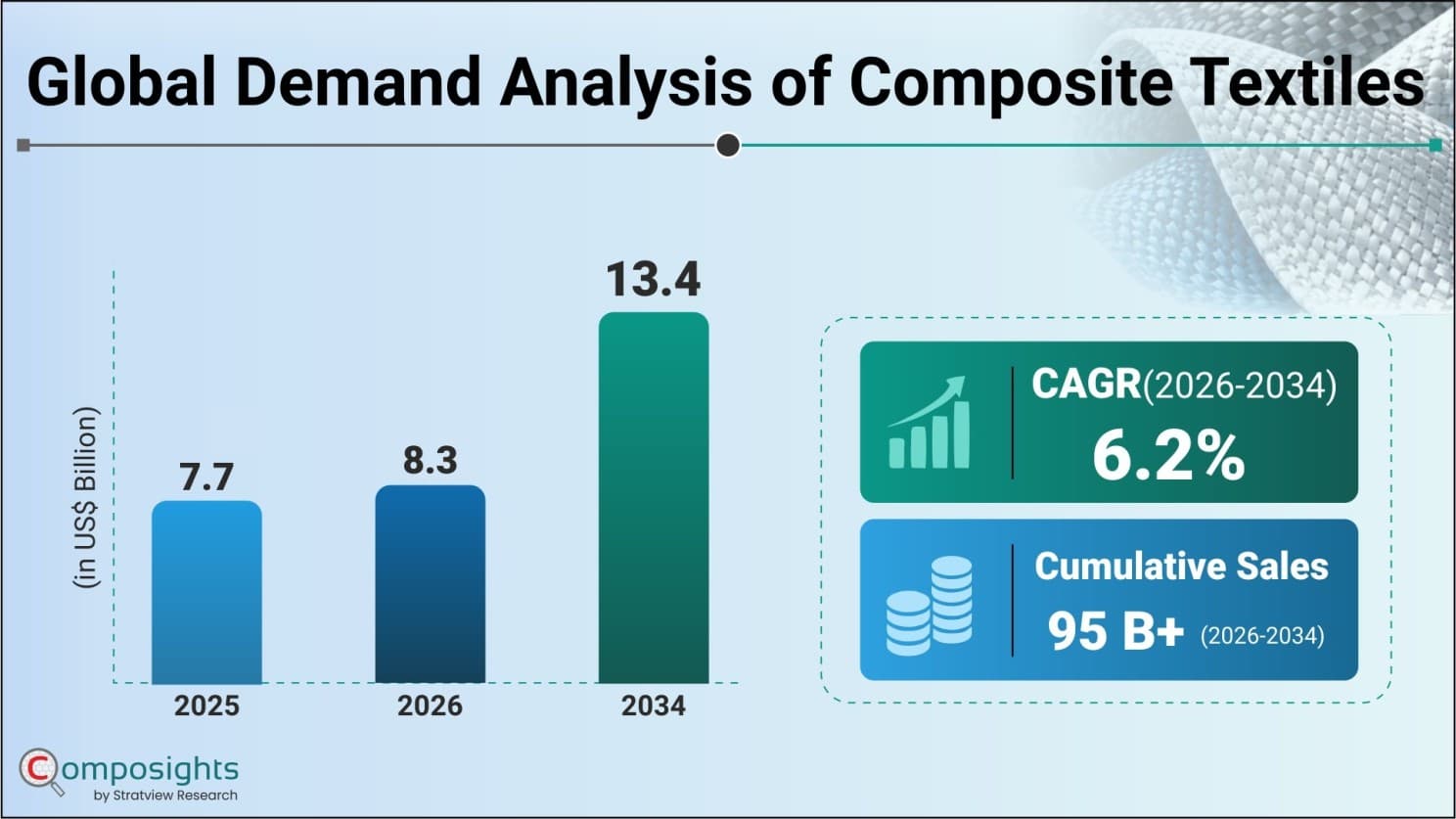
The market extends well beyond these examples. From 2025 to 2034, the global composite textiles market is expected to expand by nearly 75%, reaching USD 13.4 billion by 2034, supported by demand across wind energy, electrical & electronics, aerospace, transportation, marine, construction, and industrial applications.
Which Two Industries Generate Nearly Half the Demand?
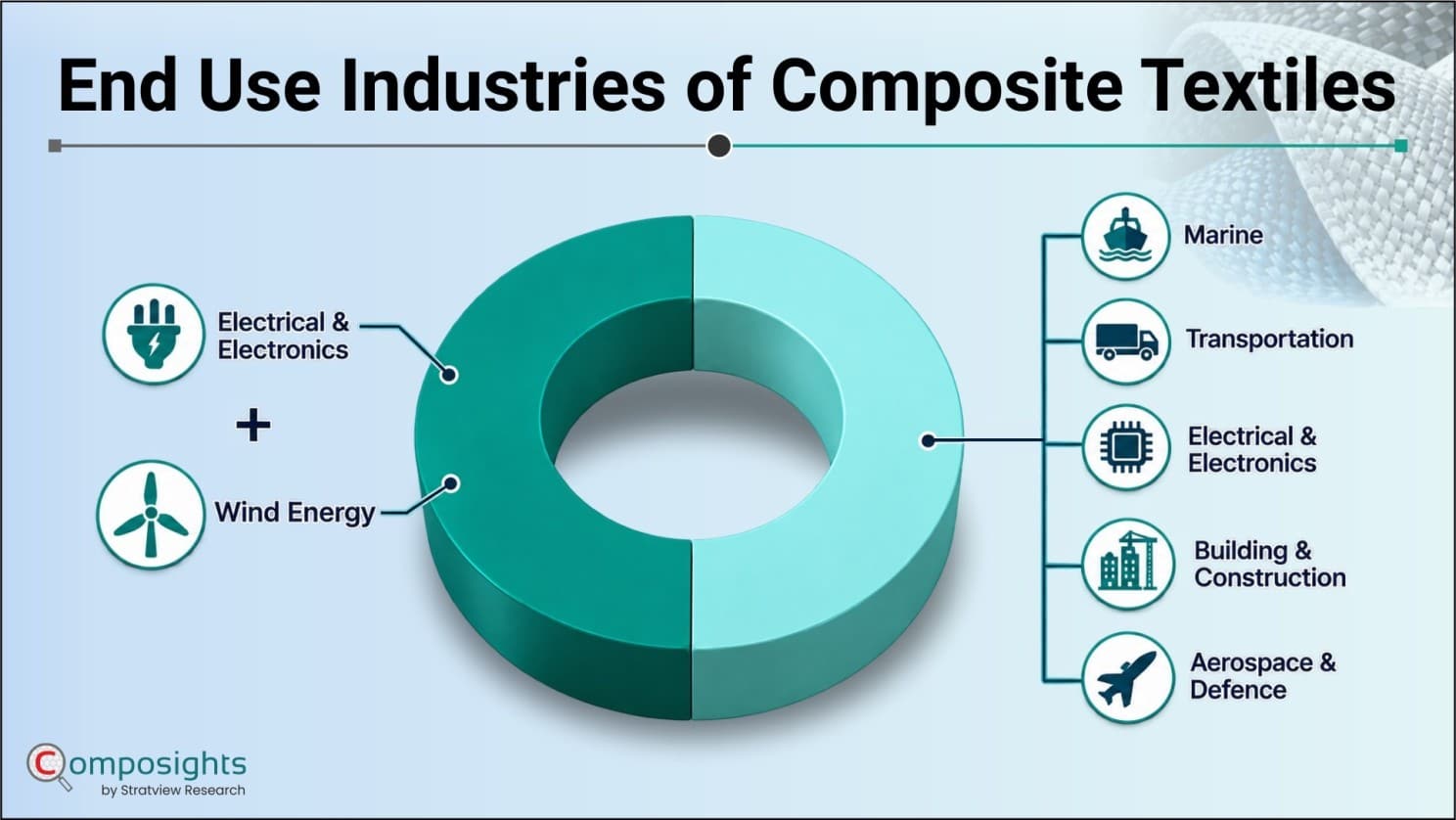
Wind energy and electrical & electronics together generate close to half of global composite textile demand, but the reasons behind that demand are quite different.
Graphic Courtesy of Composights
Wind energy is increasing the need for reinforcement in larger composite structures. As turbine blades grow in length, they require reinforcement that can deliver the necessary stiffness and strength while keeping structural weight under control.
Electrical & electronics creates demand through high-volume products such as printed circuit board (PCB) laminates. Fiberglass textiles are used in these laminates to provide mechanical reinforcement, dimensional stability, and electrical insulation.
One market is pushing reinforcement toward the demands of larger structures, while the other depends on the consistent performance of fiberglass textiles across high-volume electronic products.
Carbon Fiber Gains Ground Where Weight Matters
Carbon fiber becomes particularly valuable where high stiffness and strength need to be achieved without adding much structural weight.
This makes it well suited to aerospace structures, where reducing structural mass can contribute to aircraft efficiency and payload performance. The same advantage is relevant in large wind turbine blades, particularly in highly loaded sections where stiffness needs to be maintained as blade dimensions increase.
These applications help explain the growing use of carbon fiber textiles in the composite textiles market. Unlike glass fiber, carbon fiber can deliver higher specific mechanical performance, but that advantage comes at a higher material cost.
As a result, carbon fiber is most relevant where its weight and performance advantages can justify the additional cost.
Why Does Glass Fiber Still Lead?
Glass fiber remains widely used because it offers a practical balance of performance, durability, and cost.
It provides the strength and stiffness needed for many composite applications, along with good corrosion resistance and electrical insulation. That combination makes it suitable across wind energy, electrical & electronics, transportation, marine, construction, and industrial applications.
Its versatility is a major advantage. Many components do not require the higher specific mechanical performance of carbon fiber, making glass fiber a practical choice when reliable performance and material cost both matter.
Textile Architecture Changes the Reinforcement Equation
Choosing the fiber is only the first decision. The way that fiber is arranged determines where its properties can be used in the finished composite.
Woven fabrics interlace fibers in a defined pattern, making them useful when reinforcement is needed in specific directions. Multiaxial fabrics place relatively straight fibers in multiple directions, while mats distribute fibers more randomly. Engineered preforms take this a step further by arranging reinforcement closer to the shape and requirements of the final component.
The choice is therefore closely tied to the part itself. A component that carries loads mainly in one direction may need a different textile architecture from one that experiences loads across several directions. The textile also needs to fit the manufacturing process, with factors such as drapability, resin flow, handling, and conformability affecting how easily it can be converted into the finished part.
Woven yarn is widely used across composite textile applications, including PCB laminates. Other textile forms become more relevant where specific load paths, complex geometries, or manufacturing requirements call for a different reinforcement arrangement.
APAC Brings Demand and Manufacturing Together
Asia-Pacific has a broad demand base for composite textiles, supported by electronics, wind energy, transportation, and industrial applications.
China accounted for more than one-third of global composite textiles sales in 2025, highlighting the scale of demand in the region. Beyond market demand, Asia-Pacific also has strong manufacturing activity across several major end-use industries, including electronics, wind energy, and transportation.
This combination supports demand for both fiberglass textiles used in high-volume products and engineered reinforcement for more demanding composite structures.
The Next Layer of Opportunity Is in Precision
As composite components become more complex, manufacturers have more scope to design the reinforcement around the component itself.
Fiber type, orientation, textile construction, and manufacturing method all influence how effectively reinforcement performs within the finished structure. The closer these choices are matched to the component, the more effectively the properties of the fiber can be used.
The opportunity, then, is not simply to use more reinforcement, but to use it more precisely.
That is where the layers of opportunity become interesting: in getting the fiber, textile architecture, and manufacturing process to work together around the specific demands of the finished composite.