.jpg "Top 5 Companies Leading The Composite Pressure Vessel Market")
Growth in hydrogen mobility, CNG fleets, and industrial gas transport is pushing storage requirements toward higher pressures and lower system weight. Composite pressure vessels combine fiber-reinforced composites with metal or polymer liners, offering weight advantages while maintaining pressure performance. Type IV vessels are projected to be the largest and fastest-growing vessel type, while Gas Carrier & Storage is expected to remain the leading and fastest-growing application segment.
The composite pressure vessel market was valued at USD 2.32 billion in 2025 and is projected to more than double to USD 6.13 billion by 2031, growing at a 17.7% CAGR (2026-2031).
Stratview Research estimates that the top 10 players account for approximately 50–70% of the global composite pressure vessel market, indicating a moderately concentrated competitive landscape. Established manufacturing capabilities, certifications, customer relationships, and application expertise remain important competitive differentiators as the market expands.
Among the leading companies identified by Composights, Hexagon Composites, Luxfer Holdings, Worthington Enterprises, ILJIN Composites, and FORVIA represent different competitive positions across CNG, hydrogen, LPG, and gas transportation applications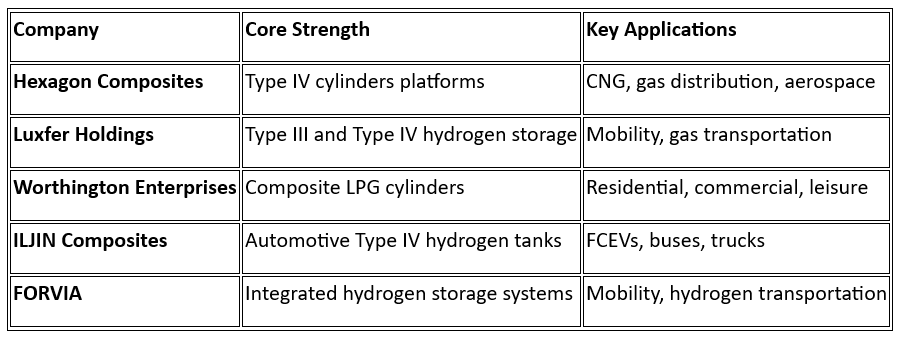
1. Hexagon Composites ASA
As one of the top five composite pressure vessel players, Hexagon Composites has built its position around high-pressure Type IV cylinders for CNG and gas distribution. Its Hexagon Agility business supplies alternative-fuel systems and gas distribution solutions for commercial vehicles and industrial gases.
In 2026, Hexagon expanded its Type IV applications. A USD 7 million order for high-pressure Type IV carbon-fiber cylinders marked its entry into a commercial aerospace application. In July, Hexagon Agility signed a three-year exclusive agreement with IVECO BUS covering Type IV carbon-fiber cylinders across its CNG bus range, with estimated 2026 revenue of EUR 20 million. That same month, Hexagon Agility secured its largest single order to date, an estimated USD 100 million deal with Certarus for Mobile Pipeline® modules to supply CNG solutions for data center power needs.
These developments demonstrate the company's ability to apply composite pressure vessel technology across multiple high-pressure storage applications.
2. Luxfer Holdings PLC
Luxfer Holdings rounds out the top five with a hydrogen-focused composite cylinder portfolio spanning Type III and Type IV technology. Its products address applications including transit buses, heavy-duty vehicles, bulk gas transport, marine, and rail.
In 2026, Luxfer and ULEMCo formalized a strategic collaboration to accelerate the commercial deployment of hydrogen-powered mobility solutions. The collaboration covers integrated onboard hydrogen storage for heavy-duty vehicles, off-road equipment, marine, and rail applications.
The company's hydrogen storage solutions have also demonstrated weight and emissions advantages in commercial applications, supporting its position across both vehicle-mounted storage and broader hydrogen transportation.
3. Worthington Enterprises, Inc.
Worthington Enterprises earns its place among the top five through Ragasco, its composite LPG cylinder business serving household, industrial, leisure, and forklift applications. The company reports 25 million cylinders sold worldwide and certifications in nearly 100 countries, with cylinders weighing approximately half as much as comparable steel alternatives.
The company acquired Ragasco from Hexagon in June 2024 for approximately USD 98 million. At the time of the transaction, Ragasco reported approximately USD 64 million in 2023 sales, operated an automated manufacturing facility in Norway, and sold products in more than 100 countries.
In 2025, Worthington also unified the North American Viking Cylinders brand under the Ragasco name.
4. ILJIN Composites Co., Ltd.
ILJIN specializes in composite fuel tanks for CNG vehicles and hydrogen fuel-cell vehicles. Its Type IV technology uses a high-strength plastic liner reinforced with carbon fiber.
The company supplied hydrogen fuel tanks for Hyundai's Tucson fuel-cell vehicle in 2014 and subsequently supplied tanks for the NEXO from 2018. ILJIN's hydrogen tanks operate at 700 bar, while its portfolio also includes lightweight composite CNG tanks.
This production experience gives ILJIN a specialized position in composite hydrogen and CNG storage for automotive applications, and its portfolio also extends to hydrogen solutions for forklifts, drones, and heavy-duty trucks.
5. FORVIA SE
FORVIA completes the top five with a hydrogen storage portfolio spanning Type III and Type IV composite tanks, alongside containerized solutions for hydrogen transportation and distribution. The company reports 70,000+ hydrogen tanks delivered since 2016, 34 million+ kilometers driven, and four production plants across Europe and Asia.
Its portfolio extends beyond vehicle storage into MEGC-based hydrogen transportation. FORVIA also reports Type III composite tanks for MEGC applications through its H2 Energy partnership, reflecting its focus on storage and distribution infrastructure alongside mobility.
How Market Leaders Are Positioning Themselves
Hydrogen mobility and transportation. Hexagon, Luxfer, ILJIN, and FORVIA are competing across hydrogen storage for fuel-cell vehicles, heavy-duty mobility, and hydrogen transportation, with Type III and Type IV technologies serving different pressure, weight, and application requirements.
CNG and alternative-fuel vehicles. Hexagon and ILJIN maintain strong positions in CNG storage, while composite LPG cylinders give Worthington a distinct position in an established alternative-fuel application.
Gas storage and distribution. The competitive landscape extends beyond vehicle-mounted cylinders. Hexagon addresses gas distribution, Luxfer serves bulk gas transportation, and FORVIA is developing MEGC-based hydrogen storage and transportation solutions.
Application diversification. The leading companies are also expanding into less conventional pressure vessel applications. Hexagon's 2026 aerospace order demonstrates this direction, while Worthington's Ragasco business highlights the continued role of composites in LPG storage.
These overlapping application areas indicate that competition is not concentrated in a single end market. Companies are differentiating through pressure vessel technology, application specialization, manufacturing capabilities, certifications, and established customer relationships.