
The word textile typically brings to mind fabrics designed for clothing and everyday use. In composites, however, textile takes on a more engineered role. Carbon fiber textiles organize thousands of fine carbon filaments into precise reinforcement architectures that influence how a composite carries load and takes shape.
The fibers can be woven, aligned in a single direction, or arranged across multiple orientations, with each architecture serving different structural and manufacturing requirements.
This Carbon Fiber Textiles 101 guide explores what carbon fiber textiles are, how they are made, the main textile forms and their applications, the size of the market, and the supply and recycling challenges associated with these materials.
What Is Carbon Fiber Textile?
A carbon fiber textile is an engineered reinforcement in which carbon fibers are organized into a controlled textile structure.
The starting material is generally continuous carbon fiber supplied as a tow, a bundle of individual filaments. Tow sizes are commonly identified by the approximate number of filaments they contain. For example, Hexcel lists 1K, 3K, 6K, 12K, and 24K tows, where “K” represents approximately one thousand filaments.
These tows are processed into textile structures designed for specific composite applications. The resulting architecture determines how the reinforcement can be handled, positioned, and incorporated into a part.
An important distinction is that carbon fiber textile is a broader term than carbon fiber fabric. Woven fabric is one form, while unidirectional (UD), multiaxial, and other engineered reinforcement structures are also considered carbon fiber textiles.
How Does Carbon Fiber Become a Textile?
The process begins with carbon fiber tows, which are bundles of continuous carbon filaments. Textile manufacturing organizes these tows into reinforcement structures suited to the required fiber orientation, geometry, and manufacturing process.
Depending on the desired reinforcement architecture, the fibers can be interlaced, aligned, or layered and stitched. Other forms, such as mats and veils, use discontinuous fibers without conventional woven interlacing.
A simple way to visualize the material pathway is:
Carbon filaments → tow → textile architecture → reinforcement/preform → composite part
The textile stage gives the fibers a controlled structure that can be handled, positioned, and incorporated into a composite part.
The Main Types of Carbon Fiber Textiles
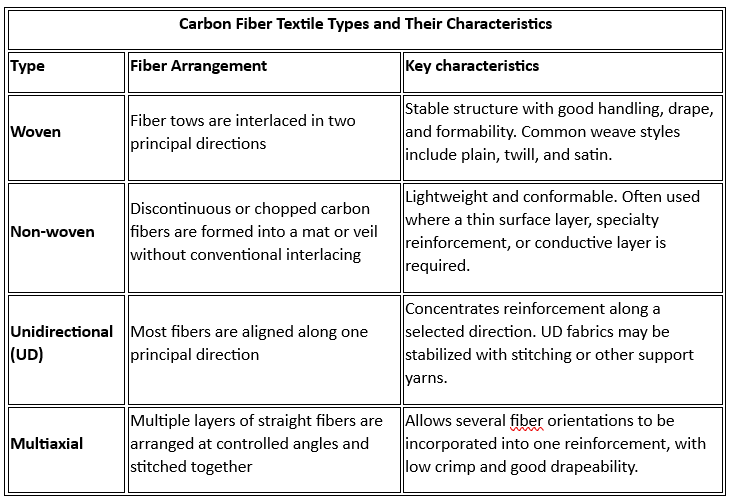
For a beginner-friendly view, carbon fiber textiles can be grouped into four broad forms: woven, non-woven, unidirectional, and multiaxial.
These categories can overlap in technical classifications. UD and multiaxial reinforcements, for example, are often included within non-crimp fabric (NCF) because the fibers are arranged with little or no conventional woven crimp. Here, non-woven refers specifically to random or discontinuous-fiber mats and veils, making the four forms easier to distinguish.
Courtesy of Composights
Where Are Carbon Fiber Textiles Used?
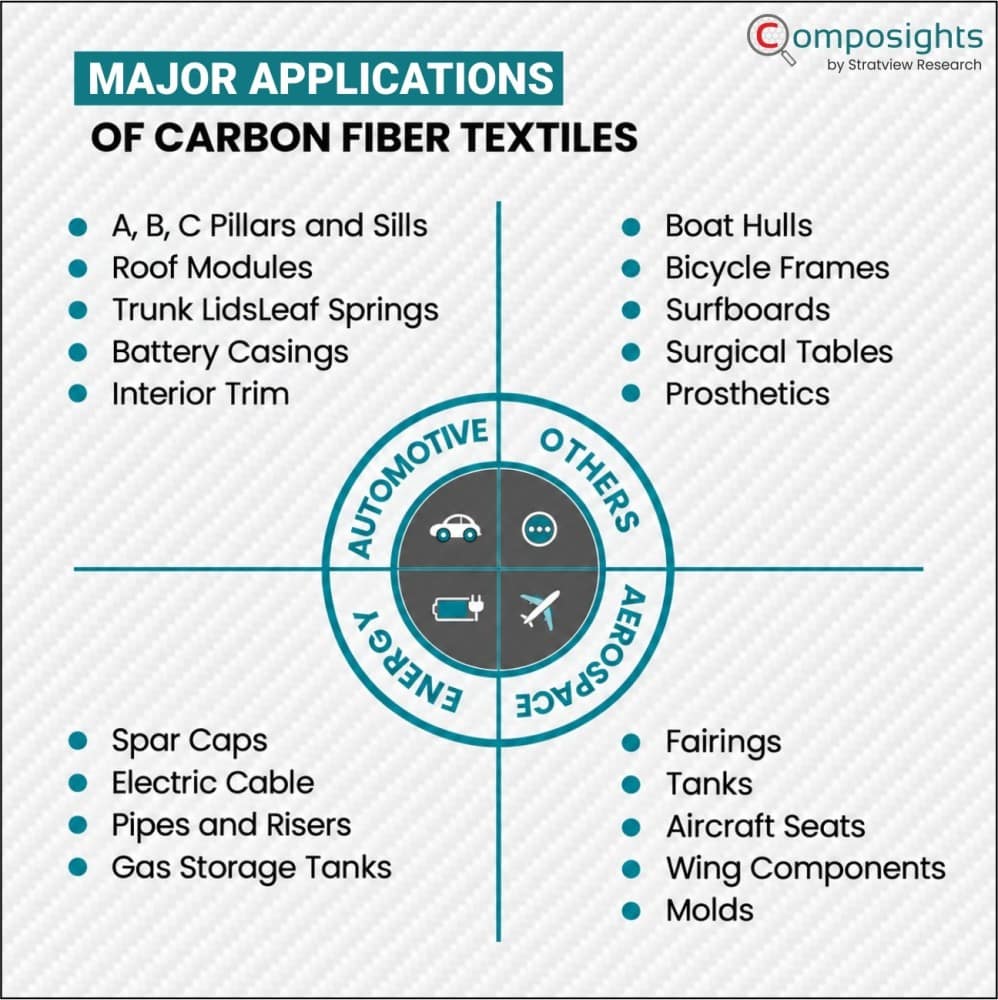
Carbon fiber textiles are used across industries where lightweight reinforcement, controlled fiber orientation, and structural performance are important.
Graphic Courtesy of Composights
What Challenges Does the Market Face?
Two issues deserve particular attention as carbon fiber consumption expands:
1. Potential Carbon Fiber Supply Constraints
Carbon fiber demand is increasing across several major industries, including aerospace, wind energy, automotive, and other composite applications. At the same time, production capacity is expanding to keep pace with this demand.
The Composites United Market Report 2025, published in 2026, estimates global carbon fiber demand at approximately 148,500 tonnes in 2025, up 17.39% from 2024. The report also records significant additions to production capacity during the year.
Even with this capacity growth, supply remains an area to watch. The U.S. Department of Energy has previously identified carbon fiber availability as a potential constraint for faster wind deployment, particularly because the material is also required by aerospace and other industries.
For carbon fiber textiles, sustained pressure on the availability or cost of virgin carbon fiber can eventually affect the supply and pricing of downstream reinforcement materials.
2. Material Waste and Recycling
Carbon fiber waste is generated during composite manufacturing, particularly through cutting, layup, fabrication, and the disposal of end-of-life components.
A 2026 review published in Waste Management estimates that the global carbon-fiber waste stream associated with 2024 activity was around 50 kilotons per year, with manufacturing scrap accounting for a significant share. A separate 2025 review cites a 30–40% manufacturing waste fraction, highlighting the scale of material lost during production.
Recycling the recovered material presents another challenge. Carbon fiber reclaimed from cured composites can have changes in fiber length, surface condition, and mechanical properties, which can limit its use in high-performance structural applications.
The same 2025 review cites an estimate of around 20% recycling for the referenced carbon-fiber waste stream. This is a literature-derived estimate, rather than a measured global recycling rate, but it highlights the gap between carbon-fiber waste generation and material recovery.
Reducing manufacturing scrap and developing higher-value uses for recovered carbon fiber remain important for improving the overall material efficiency of composite production.
How Big Is the Carbon Fiber Textiles Market?
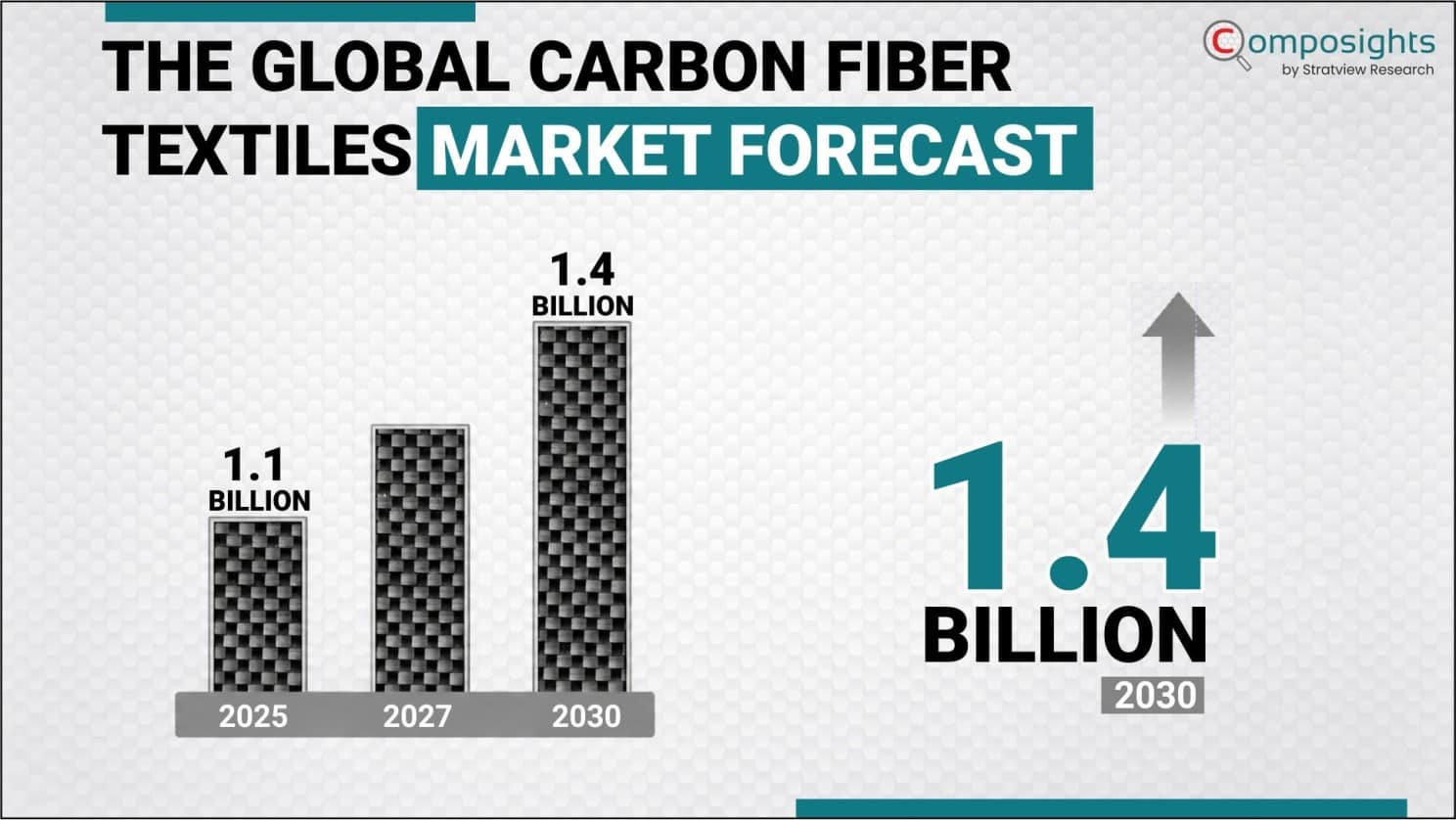
The carbon fiber textiles market is already a USD 1.1 billion industry, with its value expected to reach USD 1.4 billion by 2030, growing at a 4.2% CAGR.
Graphic Courtesy of Composights
The market's growth is spread across different regions, textile forms, and end-use industries. Geographically, North America holds the largest share, while Asia-Pacific is seeing stronger growth as carbon-fiber applications expand across key manufacturing industries through 2030.
Within textile forms, non-crimp fabrics (NCF) are gaining ground because their low-crimp construction allows fibers to be oriented in multiple directions with greater efficiency. This type of reinforcement is particularly relevant to aerospace & defense, which remains the largest application area for carbon fiber textiles.
Despite challenges around carbon fiber supply, material waste, and recycling, demand for carbon fiber textiles continues to grow as industries seek lightweight, high-performance reinforcement for increasingly demanding composite applications. As composite adoption expands across aerospace, automotive, wind energy, and other sectors, engineered textile architectures are expected to see continued demand.