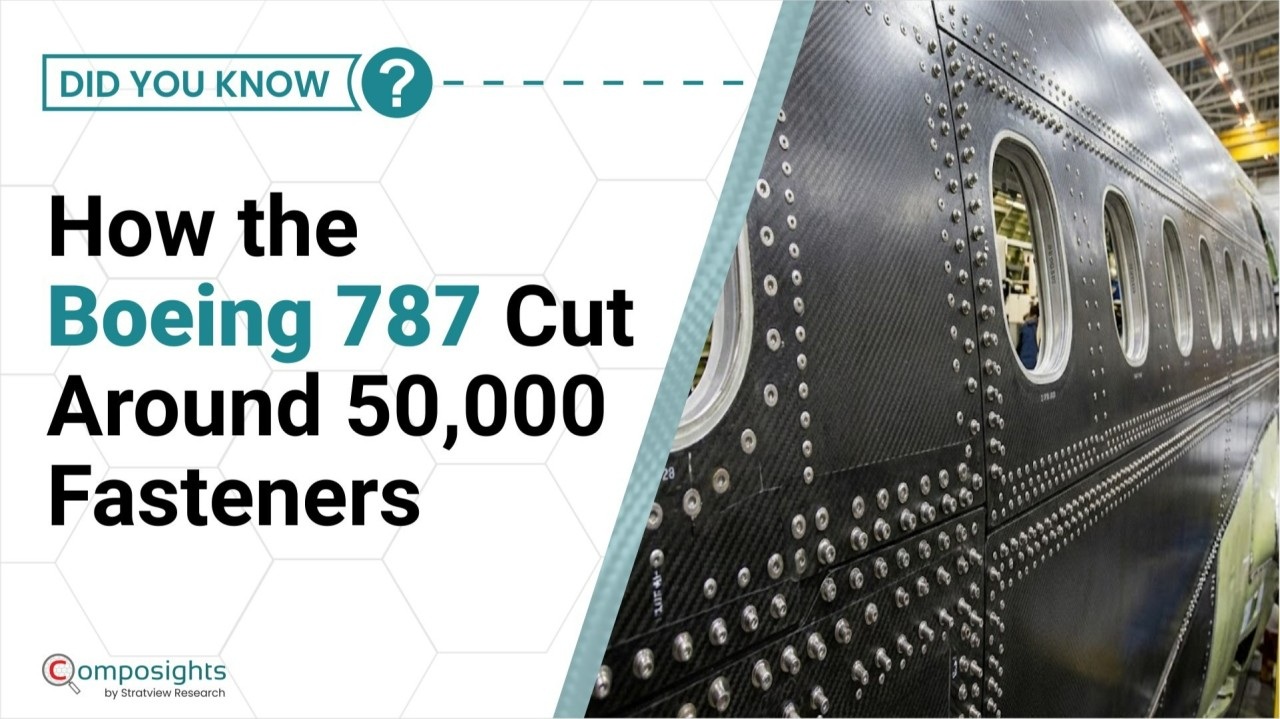
A conventional metal aircraft fuselage is assembled by joining skin panels to an internal framework of frames and longitudinal stiffeners using thousands of fasteners. The Boeing 787 Dreamliner takes a different approach. Its fuselage incorporates large, one-piece composite barrel sections with longitudinal stiffeners integrated into the structure. This construction reduces the number of fasteners required to produce the aircraft by roughly 50,000, according to the U.S. National Research Council.
The difference lies in how these structural components are joined. Frames help maintain the fuselage's cross-sectional shape, while longitudinal stiffeners run along its length to reinforce the skin and resist structural loads. In conventional metal construction, the skin and stiffeners are separate components that must be joined during assembly. The 787's integrated barrel design incorporates the longitudinal stiffeners into the composite structure itself, reducing the need for numerous separate fastening connections. The National Research Council attributes the reported reduction to the use of one-piece barrel sections with integral stiffeners.
Building these large composite sections requires a specialised manufacturing process. Automated fiber placement (AFP) machines lay composite tape onto a rotating cylindrical tool, gradually building the fuselage barrel. The material is then cured in an autoclave under controlled heat and pressure to form a rigid structure. Boeing described this process when it completed its first 7E7 composite fuselage section in January 2005. The finished section is inspected before the manufacturing tool is removed.
The benefits extend beyond fewer assembly connections. Carbon-fiber composites offer a high strength-to-weight ratio, helping reduce the weight of the aircraft's structure. Boeing has reported that the 787 delivers approximately 20% better fuel efficiency than similarly sized aircraft. This improvement reflects several technologies working together, including its composite structure, more efficient engines, aerodynamic design, and onboard systems. The fastener reduction is one outcome of the 787's integrated structural design, while its fuel-efficiency gains come from the combined contribution of these aircraft technologies.