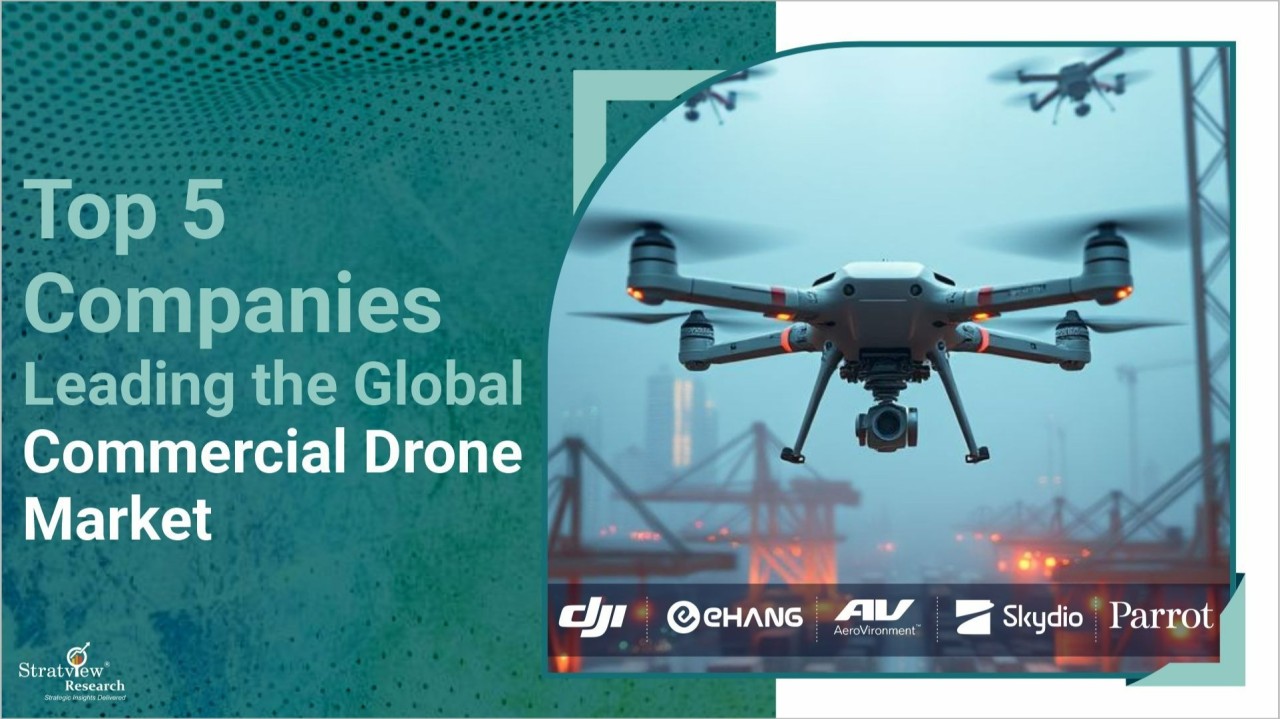
The commercial drone market has moved well beyond early experimental deployments, with drones now increasingly integrated into industrial operations as mobile data platforms supporting infrastructure monitoring, mapping, logistics, and public safety.
Across sectors such as energy and utilities, defense, construction, agriculture, and urban mobility, commercial drones are helping organizations automate data collection, improve operational efficiency, and enhance decision-making through real-time aerial intelligence.
According to Stratview Research, the global commercial drone market is expected to experience strong growth in the coming years generating annual demand of more than USD 17 billion in 2032, supported by expanding enterprise adoption, improving regulatory frameworks, and continuous advancements in drone autonomy and sensor technologies.
Several companies are playing important roles in advancing commercial drone technologies
Based on recent technological developments, strategic initiatives, and market influence, the following companies represent some of the most prominent players in the global commercial drone market.
1. DJI Technology Co., Ltd.
Setting the Benchmark for Integrated Drone Ecosystems
DJI remains one of the most influential companies in the commercial drone industry, largely due to its ability to integrate advanced hardware, imaging technologies, and flight control systems into a cohesive ecosystem.
The company has continuously expanded its drone portfolio with platforms designed for enterprise applications such as infrastructure inspection, surveying, mapping, and cinematography. DJI’s strength lies in its full-stack approach, combining drone hardware, camera systems, data transmission technologies, and intelligent flight software into unified operational platforms.
This level of integration enables organizations to deploy drone solutions that are reliable, scalable, and suited for complex commercial workflows.
Despite increasing competition and regulatory scrutiny in certain regions, DJI continues to play a significant role in advancing drone performance standards, imaging capabilities, and operational reliability within the global commercial drone market.
2. EHang Holdings Limited
Advancing the Vision of the Low-Altitude Economy
EHang has emerged as a prominent innovator in the global drone ecosystem, particularly in autonomous aerial mobility and coordinated drone operations.
The company is widely recognized for its EH216-S pilotless passenger drone, designed for applications such as urban air mobility, aerial tourism, and smart city transportation systems.
In February 2026, EHang gained global attention during the China Media Group Spring Festival Gala, where 22,580 drones were flown simultaneously in a coordinated aerial performance, setting a Guinness World Record for the largest number of multirotor drones airborne at once from a single computer.
In addition to the drone swarm display, 16 EH216-S passenger drones flew in formation during the event, demonstrating the scalability and precision of autonomous flight systems.
Beyond the visual spectacle, the achievement highlighted EHang’s capabilities in swarm control technologies and centralized command platforms, reinforcing its growing presence within the emerging low-altitude economy.
3. Skydio Inc.
Leading the AI-Driven Autonomy Revolution
Skydio has positioned itself at the forefront of autonomous drone technology, particularly in sectors that require advanced navigation, inspection, and situational awareness capabilities.
The company’s drones rely heavily on artificial intelligence, computer vision, and onboard processing to navigate complex environments with minimal human intervention. This capability has proven particularly valuable for industries such as infrastructure inspection, utilities, telecommunications, and defense.
Platforms such as the Skydio X10, along with automated docking and remote operation systems, allow organizations to deploy drones for routine inspection missions with greater operational consistency and efficiency.
Skydio’s emphasis on AI-driven autonomy and secure software architecture has strengthened its position in government and enterprise markets where cybersecurity, supply-chain transparency, and regulatory compliance are critical considerations.
4. AeroVironment, Inc.
Bridging Defense Innovation and Commercial Applications
AeroVironment has long been recognized as a pioneer in unmanned aerial systems, particularly in defense and security operations. In recent years, the company has increasingly extended its technologies into commercial and critical infrastructure environments.
Its expertise in long-endurance drones, mission-critical surveillance platforms, and advanced sensor integration enables organizations to monitor large and complex environments such as energy facilities, border regions, and industrial assets.
The company’s continued investments in counter-drone technologies, autonomous systems, and integrated airspace management solutions highlight the growing convergence between security technologies and commercial drone applications.
As industries increasingly demand persistent aerial monitoring and enhanced situational awareness, AeroVironment’s technologies are helping support safer and more secure airspace operations.
5. Parrot Drone SAS
Delivering Secure and Open Drone Platforms for Enterprise Users
Among European drone manufacturers, Parrot has positioned itself as a trusted provider of secure and open drone platforms for enterprise and government users.
The company’s ANAFI Ai drone platform represents a notable advancement in connected drone operations. Equipped with 4G connectivity, advanced imaging capabilities, and cybersecurity-focused architecture, the platform enables professionals to conduct mapping, inspection, and surveying missions with improved operational flexibility.
Parrot’s open software ecosystem and developer-friendly architecture have also attracted geospatial companies and enterprise solution providers seeking to integrate drones into broader digital workflows.
As concerns around data sovereignty, cybersecurity, and supply-chain transparency continue to grow, Parrot’s emphasis on secure drone infrastructure is becoming increasingly relevant for organizations operating in regulated environments.
Which Companies Are Leading the Commercial Drone Market?
Several companies are contributing to the advancement of the commercial drone industry, each focusing on different technological strengths.
- DJI – Integrated drone ecosystems and advanced imaging technologies
- EHang – Autonomous aerial mobility and large-scale drone orchestration
- Skydio – AI-driven drone autonomy and automated inspection capabilities
- AeroVironment – Defense-grade UAV systems and surveillance platforms
- Parrot – Secure and open enterprise drone architectures
Together, these companies illustrate the diverse innovation shaping the global commercial drone ecosystem.
Outlook: From Standalone Drones to Autonomous Aerial Infrastructure
The commercial drone industry is entering a phase of broader industrial integration, where drones are evolving from standalone aerial tools into connected platforms that support automation, real-time data collection, and intelligent infrastructure monitoring.
Increasingly, drones are being deployed across industrial and public-sector applications such as infrastructure inspection, precision agriculture, energy asset monitoring, drone logistics, and large-scale aerial events.
As technologies such as artificial intelligence, autonomous flight systems, and connected airspace management continue to mature, the role of drones within industrial operations and urban infrastructure is expected to expand significantly.
At Stratview Research, we continue to monitor how emerging technologies, regulatory developments, and industry leaders are influencing the future trajectory of the global commercial drone market.
TAGS: avionics