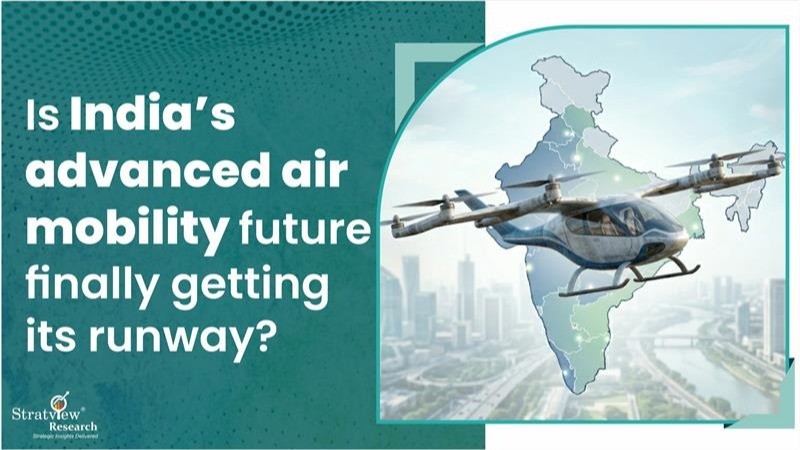
Every day, India’s cities lose millions of productive hours to traffic congestion, impacting not just daily commutes but also logistics efficiency and critical emergency response times. While investments in roads and metro networks continue to expand, it is becoming increasingly evident that ground-based solutions alone may not be enough to meet the scale of future urban mobility demand.
This is where a new dimension of transportation is beginning to emerge.
Electric vertical take-off and landing (eVTOL) aircraft, once considered futuristic, are now moving steadily toward real-world deployment. Globally, the race to commercialize urban air mobility is accelerating, led by advancements in the US and China, while new markets begin to enter the landscape.
This evolution becomes even more significant when viewed against the broader market trajectory. The global eVTOL market, valued at approximately USD 0.06 billion in 2024, is projected to grow at a remarkable CAGR of 28.4%, reaching nearly USD 3.3 billion by 2040.
India is moving beyond observation and is steadily building the capabilities required to participate and secure its place in this growth story.
Key Developments Accelerating India’s eVTOL Ecosystem
India is looking to the skies for its eVTOL future, and recent developments across the ecosystem make this direction quite clear.
In November 2025, Sarla Aviation announced USD ~140 million investment to develop a 200 hectare eVTOL manufacturing campus in Andhra Pradesh. The scale of this initiative reflects a long-term vision, not just to build aircraft, but to establish a full-fledged manufacturing ecosystem capable of supporting commercial air taxi operations. The company is developing the Shunya eVTOL, a hybrid-electric six-seater with a projected range of up to ~800 km in hybrid mode and around 150 km in all-electric configuration. The company is targeting type certification and commercial launch by 2029, with initial plans focused on urban connectivity use cases, including airport-linked mobility in cities like Bengaluru.
Just a few months later, in February 2026, the ePlane Company inaugurated a 60,000 sq. ft. integrated prototyping and testing facility at IIT Madras. Unlike traditional fragmented development approaches, this facility brings together design, manufacturing, system integration, and testing under one roof, significantly accelerating development timelines. It also marks a crucial transition, from experimental prototypes to industrial-scale readiness. The company’s e200X eVTOL aircraft, designed for short urban trips with a range of ~115 km, has already progressed to full-scale flight testing, highlighting the increasing maturity of India’s eVTOL ecosystem.
These developments show India moving past early innovation toward real execution, with the focus shifting from standalone prototypes to building a broader ecosystem. The impact of this shift is likely to extend beyond the domestic market.
Broader Impact
Large-scale manufacturing initiatives, such as those by Sarla Aviation, have the potential to localize production and strengthen regional supply chains, reducing reliance on imports while enabling cost-efficient scaling. At the same time, integrated innovation hubs like that of the ePlane Company are critical for accelerating testing, certification readiness, and time-to-market, historically key bottlenecks in aerospace commercialization.
Beyond manufacturing and testing, India’s strong engineering talent base and cost advantages position it as a future export hub for eVTOL platforms, subsystems, and advanced air mobility solutions.
Not just industry initiatives, but some policies and ecosystem support by the Indian government are supporting the evtol adoption. In February 2025, Ministry of Civil Aviation India, in collaboration with World Economic Forum’s C4IR India, conducted field studies in Gujarat and Andhra Pradesh to evaluate eVTOL deployment, which is part of a broader government agenda to develop world-class sandbox sites for OEMs to conduct field trials.
At the same time, private sector partnerships are accelerating real-world deployment pathways. In February 2026, JetSetGo signed an MoU with Vertical Aerospace for 50 aircraft and AAM services, while Urban-Air Port partnered with Nalwa Aero in July 2025 to develop vertiport infrastructure, highlighting parallel progress across both aircraft and infrastructure segments.
More importantly, these developments are laying the foundation for real-world applications, from air taxis and airport connectivity to emergency medical services and cargo mobility, all of which are highly relevant for densely populated urban centers across the region.
The Flight Ahead
While challenges remain, particularly around regulatory clarity, battery technology, and infrastructure such as vertiports, and the absence of a dedicated eVTOL Maintenance, Repair, and Overhaul (MRO) ecosystem, the long-term trajectory remains promising.
India is gradually moving from the exploratory phase of eVTOL development toward building the capabilities, infrastructure, and ecosystem required to compete.
In a market poised for exponential growth, the question is no longer whether India will participate in the eVTOL revolution, but how quickly it can scale, compete, and potentially lead.