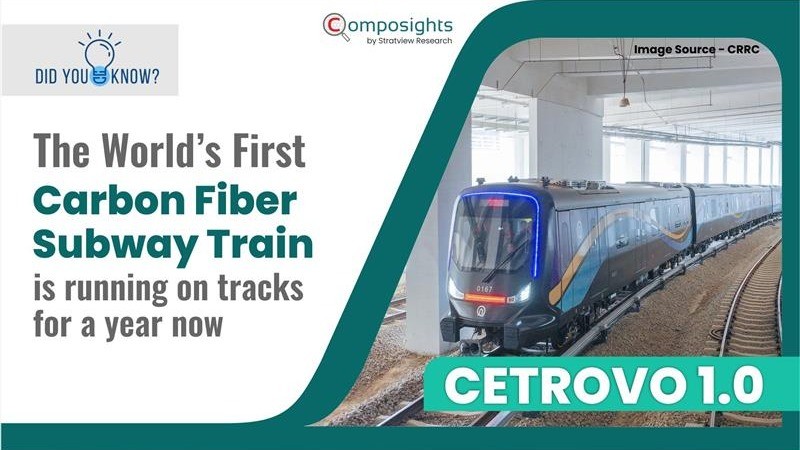
A Future That’s No Longer Waiting.
When we talk about the future of urban transportation, the conversation often drifts toward concepts, prototypes, and “coming soon” innovations. But what if that future was already moving through city tunnels today?
Few people realize that the world’s first subway train, built using carbon fiber composites as its primary structural material, is no longer an idea; it is already in commercial service.
The CETROVO 1.0 carbon fiber subway train has officially entered operation on Qingdao Metro Line 1 in China, marking a global milestone in rail engineering and materials innovation.
Jointly developed by CRRC and Qingdao Metro Group, CETROVO 1.0 represents a decisive leap from experimental technology to real-world application. Unlike previous trials or limited demonstrators, this train is carrying daily passengers in a live metro network.
What makes this achievement truly historic is that carbon fiber composites are not used for secondary panels or cosmetic elements. For the first time in the world, they are deployed in the primary load-bearing structures of a subway train operating in commercial service.
Rewriting Subway Structures with Carbon Fiber
Traditional subway vehicles rely heavily on steel and aluminium to deliver strength and durability. CETROVO 1.0 challenges that convention. Its car body, bogies, and other critical load-bearing components are made from carbon fiber composites, unlocking structural efficiency that metal-based designs struggle to achieve.
This material shift enables a fundamental redesign of the vehicle structure, one that balances strength, stiffness, and weight more effectively than conventional approaches.
The benefits of carbon fiber are not theoretical, they are measurable. Compared to traditional metal subway trains, CETROVO 1.0 offers:
- 25% lighter car body
- 50% weight reduction in bogie structures
- ~11% reduction in total vehicle weight
These reductions translate directly into operational gains. The lighter train consumes ~7% less operating energy and can reduce CO₂ emissions by ~130 tons per train per year. In high-frequency metro systems, such efficiencies compound quickly, delivering long-term economic and environmental value.
Can Materials Improve Ride Comfort in Subway Trains?
Lightweighting is often associated with efficiency, but it also transforms the passenger experience. Carbon fiber composites provide superior vibration damping and isolation compared to metal structures.
As a result, CETROVO 1.0 delivers smoother operation, reduced vibration, and enhanced ride comfort for passengers navigating busy urban corridors. This highlights how material choices influence everyday commuter experience, not just engineering metrics.
Strength, Safety, and Longevity - Redefined
Beyond comfort, the real test of any rail structure lies in strength, safety, and durability. Despite its lighter weight, CETROVO 1.0 does not compromise on any of these. Its carbon fiber structure delivers a higher safety factor than traditional metal designs, while the composite bogie frame improves impact resistance and fatigue performance, extending service life and reducing maintenance demands for operators.
A Signal for the Future of Mobility
In rail transit engineering, lightweighting is about more than shedding kilograms. It is a strategic tool for reducing energy consumption, lowering emissions, and building greener, low-carbon transportation systems. CETROVO 1.0 demonstrates how advanced composites can deliver this balance at a full commercial, city-wide scale.
The significance of CETROVO 1.0 extends beyond rail. As the automotive, electric mobility, and public transportation sectors increasingly prioritize efficiency and sustainability, carbon fiber composites are transitioning from niche solutions to core structural materials.
This train sends a clear signal to the mobility industry: the future will not be defined by smarter systems alone, but by smarter materials embedded at the structural level, quietly reshaping how vehicles are designed, built, and operated.
TAGS: Carbon Fiber Reinforced Polymer carbon composites Carbon Fiber Mobility
.jfif)