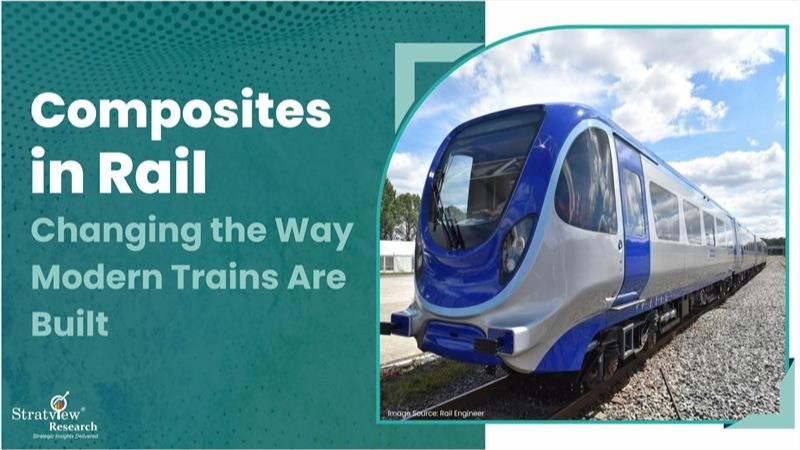
Travelling by train produces significantly lower CO₂ emissions, around three to ten times less than road or air travel, making it one of the most sustainable options for modern transportation and a key part of global decarbonisation efforts. As governments and infrastructure developers accelerate investments in sustainable mobility, rail systems are increasingly expected to deliver not only capacity and reliability, but also measurable environmental performance.
In this evolving landscape, material innovation is becoming just as important as system-level upgrades. Among these, advanced composite materials are emerging as a key enabler of next-generation rail platforms. Their lightweight properties, structural durability, and long-term economic benefits are driving growing adoption across global rail systems. For rolling stock manufacturers and operators, composites have become strategic tools for improving operational efficiency and lifecycle value.
Role of Composites in Modern Rail Platforms
Across global rail systems, composites are increasingly used in structural components due to their lightweight, strength, durability, and flexibility. They help streamline designs, reduce maintenance needs, and enable faster, more efficient manufacturing, making them well-suited for modern, high-volume train production and long-term performance goals.
Weight Reduction and System-Level Efficiency Gains
One of the most compelling advantages of composites in rail lies in their ability to significantly reduce overall vehicle weight while enhancing system performance. According to the International Union of Railways, the use of composite materials in train car bodies can lower total weight by 20% to 30%, translating into at least a 5% reduction in CO₂ emissions through improved energy efficiency.
A substantial portion of these gains can be attributed to advancements in bogie design. As one of the heaviest components, accounting for nearly 30% to 40% of total train weight, bogies present a critical opportunity for optimisation. Fibre-reinforced polymer (FRP) bogie frames have already demonstrated around 25% weight reduction compared to conventional steel designs. This reduction in mass not only lowers traction energy requirements and improves acceleration but also decreases wheel–rail wear by over 30%, reducing infrastructure stress and extending component life. These improvements enhance ride stability, minimise vibration, and contribute to more reliable, cost-efficient rail operations over the long term.
Aerodynamic and Exterior Applications
In high-speed and intercity rail applications, composites are widely used in aerodynamic structures such as nose cones, roof panels, fairings, and underbody covers. Their mouldability enables the production of complex geometries that optimise airflow, reduce drag, and improve acoustic performance. Structural elements, including doors, sandwich panels, and modular exterior assemblies, further benefit from composite integration by enabling lightweight construction without compromising structural integrity and mechanical strength. These attributes are critical for improving energy efficiency at higher operating speeds.
Interior Applications and Passenger Comfort
Composites also play a dominant role in interior components, including wall panels, ceilings, seating shells, luggage racks, toilet modules, and partitions. Recent industry assessments indicate that interior applications account for approximately 60% of composite usage in rail systems, making interiors the largest end-use segment globally. Their corrosion resistance, design flexibility, and parts-consolidation capability support improved aesthetics, faster installation, and easier maintenance. In addition, composites enable greater customisation of cabin layouts, supporting enhanced passenger comfort and brand differentiation for operators.
Safety Standards and Lifecycle Performance
Modern composite materials are designed to meet strict fire, smoke, and toxicity standards such as EN 45545 and NFPA 130, ensuring high levels of passenger safety. Beyond compliance, composites offer strong resistance to fatigue, moisture ingress, and environmental degradation. Additionally, adopting composite solutions for high-speed train bogies can significantly lower maintenance requirements, contributing to lifecycle cost savings of over 15%. Together, these benefits translate into longer service life, fewer disruptions, and more cost-efficient rail operations.
Real-World Application
The shift toward composites is no longer theoretical, it is already visible across different segments of the rail industry.
Some examples clearly highlight how composite adoption is gaining momentum across rail applications. High-speed platforms such as the Talgo Avril demonstrate how composites are being integrated within hybrid lightweight designs alongside traditional materials. At the same time, the development of carbon fibre composite freight wagons in China signals that this shift is extending beyond passenger trains into heavy-haul applications. The CETROVO 1.0 metro train further reinforces this trend, representing one of the first carbon fibre-intensive platforms in commercial service and showcasing the structural potential of composites in modern rail systems. Taken together, these examples show how the industry is gradually moving beyond limited applications of composites toward a more widespread and integrated use of these materials across the rail ecosystem.
Market Outlook and Strategic Opportunities
Driven by sustainability goals, rapid urbanisation, and the expansion of high-speed rail networks, the global rail composites market is set for steady growth, projected to reach approximately US$ 1.6 billion by 2028 at a CAGR of >4.5%. Increasing investments in lightweight rolling stock, digital manufacturing technologies, and next-generation mobility platforms are expected to further strengthen market momentum.
From car bodies and bogie systems to aerodynamic structures and passenger interiors, composites are redefining modern rail engineering and strengthening the sector’s long-term sustainability profile.
Detailed insights into market trends, application dynamics, and competitive developments are available in Stratview Research’s comprehensive analysis of the Rail Composites Market, supporting informed strategic planning and investment decision-making.
TAGS: Automotive