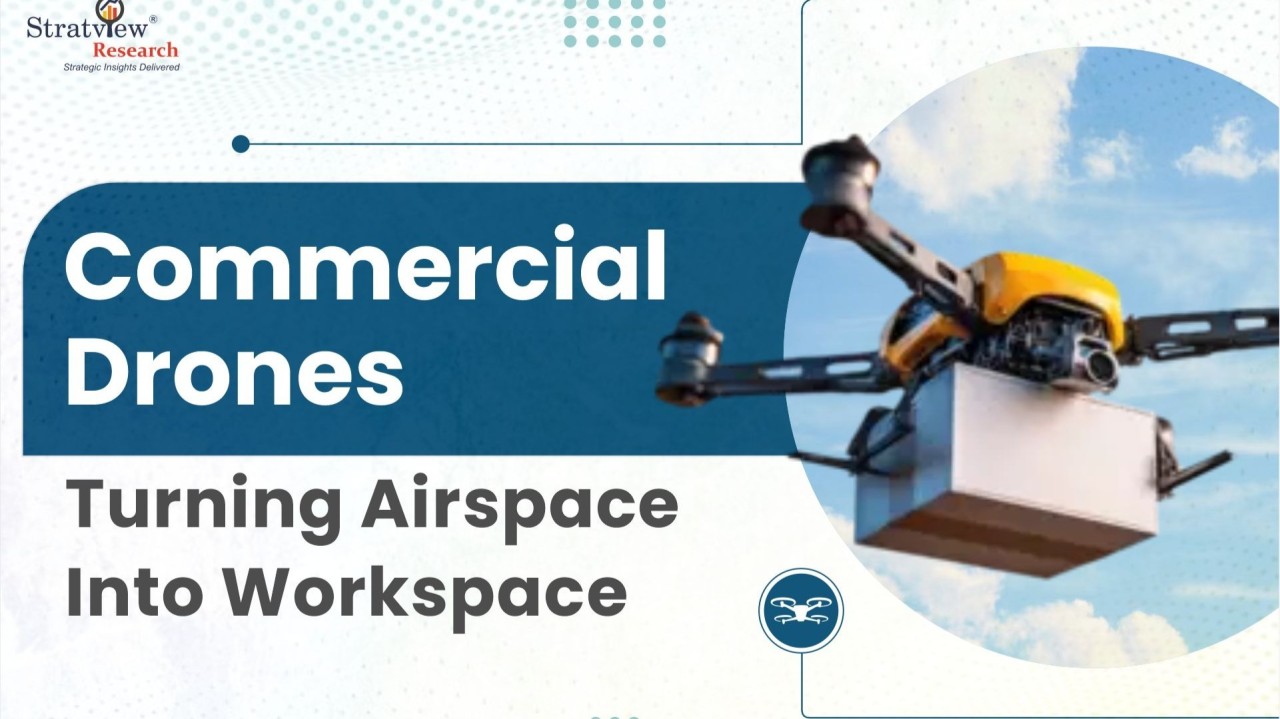
In 2006, the FAA issued its first commercial drone permits. At the time, it seemed like a routine regulatory milestone. Nearly two decades later, it reads like the opening line of an industrial revolution. Commercial drones are no longer aerial curiosities. They spray crops across thousands of hectares, inspect transmission towers no human can safely reach, map construction sites in real time, and deliver parcels to doorsteps. The sky, quite literally, has become a workspace.
The Numbers Behind the Altitude
The global commercial drone market stands at over USD 8 billion in 2025. By 2032, that figure is projected to approach USD 18 billion, with a CAGR exceeding 11% (2025-2032). Over the same period, the industry is projected to create a cumulative revenue opportunity of approximately USD 110 billion. Behind this growth is a simple reality: organizations across industries are discovering that drones can perform critical tasks faster, more safely, and more cost-effectively than traditional methods.
Industries Fueling the Drone Demand
Ask someone about drones a decade ago, and they would probably think of aerial photography. Ask the same question today, and the answer is far more complex. Today, they are no longer confined to a single industry or use case. Their footprint now spans agriculture, logistics, construction, utilities, insurance, media, public safety, and others.
Agriculture uses drones to monitor crop health, optimize spraying, and improve yields. Delivery and logistics companies are exploring faster last-mile delivery solutions. Construction firms rely on drones for site surveys and progress tracking, while energy and utility operators use them to inspect power lines, pipelines, and remote assets.
The technology is also gaining traction in real estate marketing, media production, environmental monitoring, insurance assessments, and public safety operations. As drone capabilities continue to improve, the range of commercial applications keeps expanding.

Why Agriculture Is Leading Adoption
If there is one sector that perfectly illustrates the strongest business case for drones, it is agriculture. Farmers are increasingly turning to drone-powered precision agriculture to improve productivity while reducing resource consumption.
Drone-based spraying can reduce chemical usage by 30–40%, while crop-monitoring operations can improve field-management efficiency by up to 70%. Studies also indicate potential yield improvements of around 20% while lowering operating costs by approximately 15%. The productivity gains are equally impressive. Tasks that traditionally require nearly an hour per hectare can often be completed in about eight minutes using drones—an efficiency improvement exceeding 85%.
Looking ahead, industry forecasts suggest that by the end of 2026, more than 65% of large farms could be using drones combined with AI-driven analytics to support crop-management decisions.
The preferred drone type
Rotary-blade drones have become the preferred choice for many commercial applications.
Their ability to take off and land vertically, hover in place, and maneuver in confined environments makes them particularly effective for inspections, surveillance missions, photography, and infrastructure monitoring. Fixed-wing and hybrid drones continue to play important roles, especially in long-range mapping and surveying applications, but rotary systems remain the go-to option for a broad range of commercial operations.
Asia-Pacific Is Setting the Pace
More than 40% of global commercial drone demand originates from Asia-Pacific. The region benefits from regulatory frameworks built to encourage UAV adoption, a manufacturing base that keeps hardware costs competitive, and an e-commerce sector that has made last-mile drone delivery commercially viable in select corridors. China's domestic drone industry, anchored by DJI, Ehang, Yuneec, and JOUAV, gives the region both supply-side depth and product innovation that the rest of the world is still catching up to.
As businesses increasingly prioritize automation, real-time data collection, and operational efficiency, commercial drones are becoming indispensable tools. The technology may have taken flight two decades ago, but its biggest opportunities are still ahead.
TAGS: Aerospace