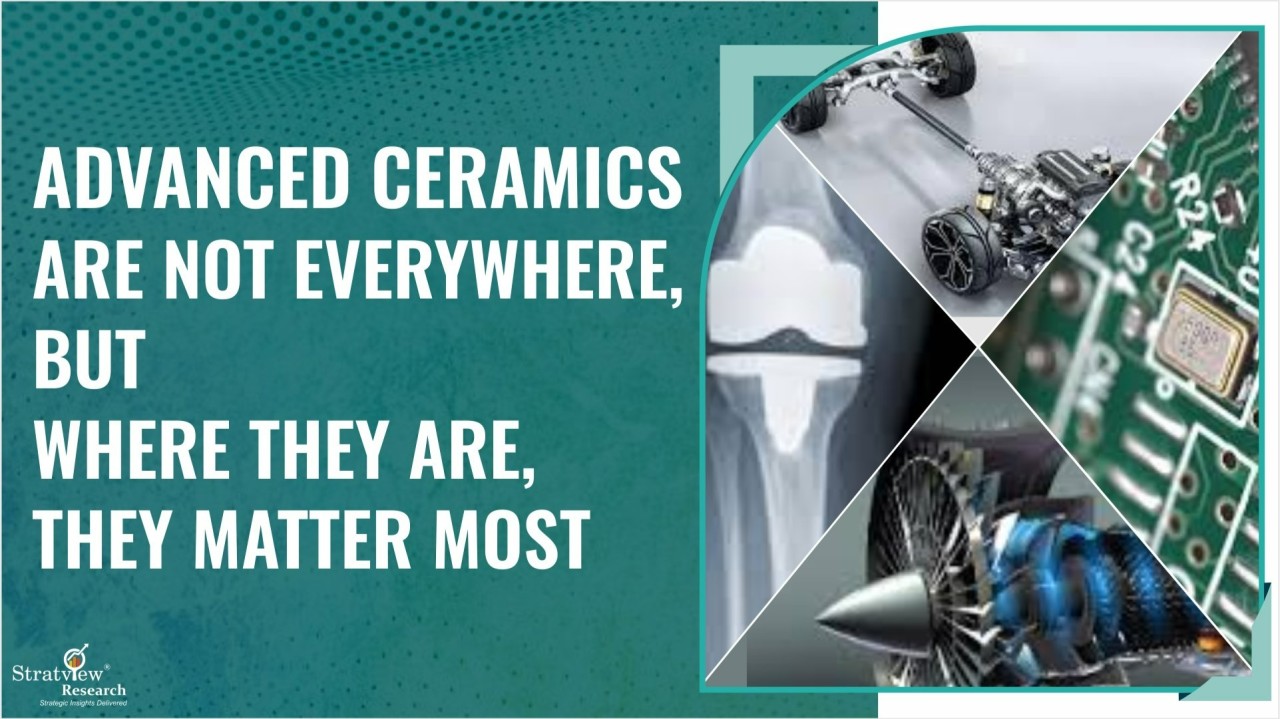
Most people associate ceramics with tiles or insulation. That view changes quickly once you look at how advanced ceramics are actually used.
They operate inside turbochargers under sustained thermal stress, within semiconductor equipment where even minor instability is not tolerated, and inside the human body where materials are expected to function reliably for decades. These are not environments of immediate failure, but of tightening performance margins. That is typically where advanced ceramics start to appear.
They are not used everywhere. But in the applications they do serve, they are often difficult to replace.
This pattern is not random, it is driven by how these materials are selected in engineering systems.
Not a Mass Material, But a Constraint-Driven One
Advanced ceramics are defined less by their properties and more by the conditions in which they are used.
They retain mechanical performance at temperatures often exceeding 1,000°C, where conventional materials begin to lose structural stability. As a result, their adoption is typically triggered when conventional materials begin to struggle under thermal, mechanical, or electrical stress.
In such cases, ceramics are not introduced as an upgrade, but as a requirement to maintain system integrity.
This is why their use remains limited to specific operating environments.
Electronics: The Most Structured Demand Base
This pattern is most clearly established in electronics, where advanced ceramics have evolved into a highly structured and indispensable material category.
They play a central role in substrates, capacitors, insulating components, and semiconductor manufacturing processes such as deposition and etching. In high-frequency and high-power-density systems, even small variations in material behavior can affect yield and device consistency.
Ceramics address these requirements through thermal control, dielectric strength, and dimensional precision, making them integral to both device functionality and manufacturing consistency.
Automotive: Powertrain Still Leads, While Electrification Expands the Scope
A similar logic applies in automotive systems, although the application landscape is broader and more component-driven.
Advanced ceramics have long been integrated into powertrain components such as silicon nitride-based fuel injector links, high-pressure pumping elements, zirconia-based injector metering parts, and ceramic exhaust filters. These components operate under high temperature, pressure, and wear conditions where durability directly affects efficiency.
There is also measurable system-level impact. In certain engine configurations, heat-insulating ceramic components have contributed to improved thermal efficiency, increasing from approximately 40–42% in conventional systems.
As vehicles transition toward electrification, their role continues to expand. In power electronics, particularly in inverters and converters, materials must handle high voltages, thermal cycling, and switching frequencies. Ceramics provide the required insulation and heat dissipation, while their role in sensors is also increasing with system complexity.
Powertrain remains the foundation of current demand, but electrification is gradually redefining where ceramics add value.
Aerospace & Defense: Performance Under Extremes
The same material logic extends into far more demanding environments in aerospace and defense, where operating conditions push materials to their limits.
In propulsion systems, advanced ceramics enable operation under sustained heat, oxidation, and mechanical stress. Ceramic matrix composites (CMCs), for instance, allow turbine components to function at higher temperatures while reducing reliance on complex cooling systems, supporting both efficiency and weight reduction.
Beyond propulsion, ceramics are integrated into radomes, antenna systems, and electronic housings, where electromagnetic transparency and environmental resistance are critical.
In defense applications, their high hardness-to-weight ratio supports use in armor systems, balancing protection with weight efficiency.
Volumes remain limited, but the requirements in this segment are significantly higher, making material consistency the defining factor.
Medical: Precision-Led Adoption
In healthcare, the focus shifts from operating extremes to long-term consistency, where materials are expected to perform reliably over decades.
Dental remains the dominant segment, followed by orthopedic applications. Zirconia is widely used in dental restorations due to its durability and compatibility with digital dentistry workflows, enabling faster and more consistent fabrication compared to conventional metal-based systems.
Beyond these established uses, ceramics are increasingly being explored in implantable devices designed for functions such as cardiac regulation and hearing support. In such applications, biocompatibility and chemical stability are essential.
At the same time, inherent limitations such as lower fracture toughness compared to natural bone (approximately ~2 MPa·m¹ᐟ² vs. ~6 MPa·m¹ᐟ²) continue to influence design approaches, leading to the development of reinforced ceramic systems.
Industrial: Built for Wear, Not Visibility
Industrial applications represent a more continuous, wear-driven use case, where performance is measured over long operating cycles rather than peak conditions.
Applications such as bearings, bushings, seals, valve components, and cutting tools rely on advanced ceramics to operate under sustained wear, high loads, and chemically aggressive environments.
In such conditions, metals often face corrosion, surface degradation, or frequent maintenance requirements. Ceramics offer longer service intervals through high hardness, low friction behavior, and chemical inertness, particularly in pumps, chemical processing systems, and high-speed rotating equipment.
They are also used in tooling and forming operations where dimensional consistency and resistance to thermal fatigue are critical over extended production cycles.
This segment may not be highly visible, but it remains structurally important due to its reliance on consistent performance.
Application Boundaries - Why Not Everywhere?
Despite their advantages, advanced ceramics are not applied across all systems because their benefits come with clear trade-offs.
Brittleness, limited repairability, processing complexity, and higher system-level costs make them less suitable for applications requiring impact resistance, design flexibility, or cost efficiency. In many such cases, metals and composites continue to provide a more balanced solution.
As a result, advanced ceramics are not replacing traditional materials, they are used selectively where their advantages justify the trade-offs.
Where the Market Is Heading
What is changing is not the material itself, but the number of systems approaching material and design limits.
Electrification, higher operating temperatures, increasing power density in electronics, and rising durability expectations across industries are gradually expanding the range of conditions where ceramics become relevant.
This shift is reflected in steady, application-driven market growth, not through widespread substitution, but through deeper integration in performance-critical systems.
For a detailed breakdown of material types, applications, and future outlook, explore our complete analysis on the Advanced Ceramics Market.
Closing Thought
Advanced ceramics are not defined by how widely they are used, but by the conditions that require them.
As more systems begin to operate closer to their limits, their role is likely to expand, not across entire systems, but precisely where conventional materials begin to fall short.
.jfif)