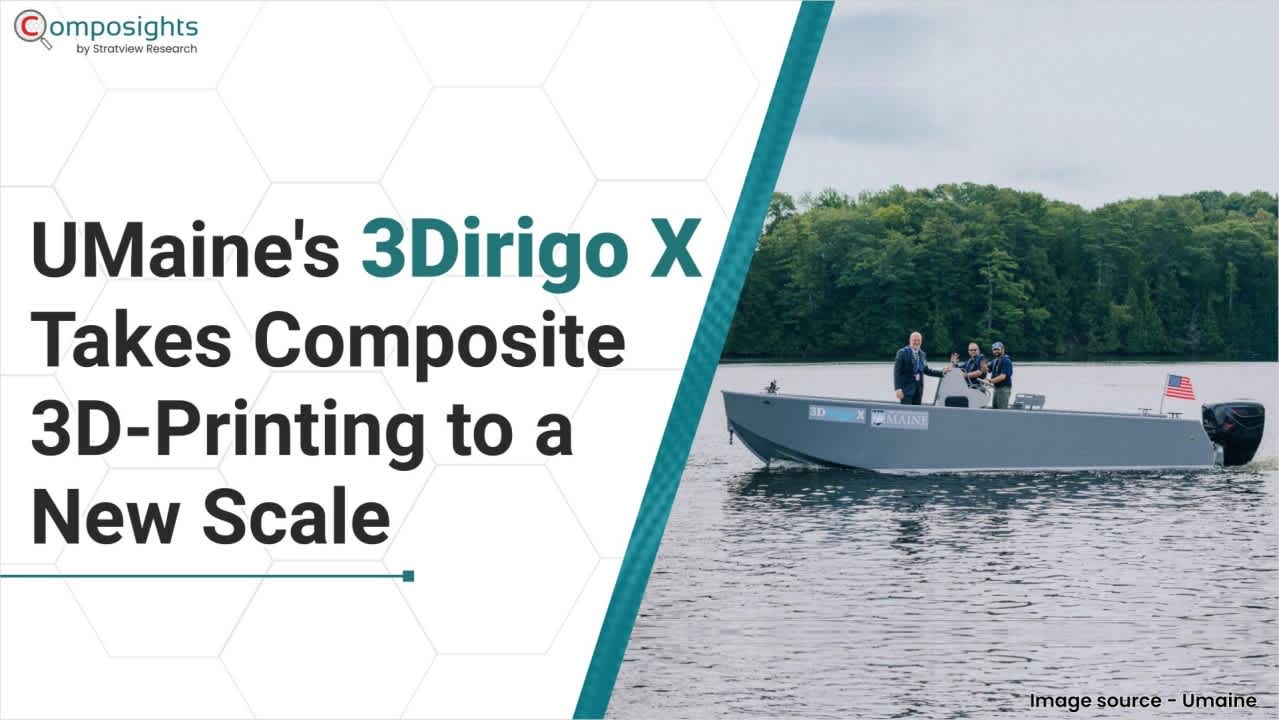
A boat that made history in 2019 as the world’s largest 3D-printed vessel is back seven years later – bigger, faster and built for a much tougher test.
For this edition of Fresh from the Autoclave, the interesting part is not simply that UMaine has printed another, larger boat. It is what has changed in the composites and manufacturing behind it.
The University of Maine has launched 3Dirigo X, a new 30-foot, 3-ton vessel built from high-performance fiber-reinforced thermoplastic composites. With a design geared toward high-speed offshore operation, the vessel can reach speeds of up to 40 knots, showcasing how additive manufacturing is being pushed into increasingly demanding marine applications.
The 30-foot 3Dirigo X builds on a 2019 prototype, the original 3Dirigo, which became the world’s largest 3D-printed boat and earned Guinness World Records. But the evolution from 3Dirigo to 3Dirigo X is about more than adding five feet to the hull. It represents years of progress in large-scale 3D printing, composite materials, material deposition, and digital manufacturing at UMaine.
3Dirigo First Proved It Could Be Printed
The original 3Dirigo was a 25-foot-long, 5,000-pound vessel produced using UMaine’s industrial-scale polymer 3D-printing technology. It was printed in just 72 hours, demonstrating that additive manufacturing could move beyond small prototypes and into structures measured in metres and tonnes. The vessel subsequently earned Guinness World Records for the world’s largest 3D-printed boat and the world’s largest 3D-printed object.
Its material story was equally significant. Umaine’s large-scale additive manufacturing research explored bio-based thermoplastics and wood-derived reinforcement, including materials incorporating cellulose from Maine-sourced wood. The work was part of a broader effort to develop more sustainable materials for large-format 3D printing.
The first 3Dirigo essentially demonstrated the scale that additive manufacturing could achieve. The new vessel builds on that foundation with a stronger emphasis on performance, material capability, and marine use.
The Materials Got Better. So Did the Printing.
The most notable change is the focus on structural performance. UMaine describes 3Dirigo X as being built from high-performance fiber-reinforced thermoplastic composites, a material platform intended to provide the performance needed for demanding marine conditions.
The manufacturing technology has advanced considerably as well. When UMaine’s large-scale additive manufacturing work began, its material deposition rate was approximately 20 pounds per hour. Today, the university reports a rate of around 500 pounds per hour, approximately 25 times higher. UMaine is targeting a future deposition rate of 1,000 pounds per hour through its planned Factory of the Future.
For large-format 3D printing, that matters. Higher deposition rates can make the production of large structures faster, while digital manufacturing allows engineers to modify designs without relying on a new conventional mold for every iteration.
That combination of production speed, design flexibility, and fiber reinforcement creates opportunities for marine manufacturers looking to produce customized or complex structures more efficiently.
The Bigger Opportunity Beyond the Boat
3Dirigo X is an opportunity to test how large-scale additive manufacturing and advanced composite materials perform together under real offshore conditions. UMaine plans to evaluate the vessel’s performance and durability in Atlantic waters, taking the technology from a controlled manufacturing environment into the conditions it was designed to face.
For the composites industry, this could be an important direction to watch. Large-format 3D printing has the potential to reduce dependence on conventional tooling, accelerate design iterations, and enable complex structures to be manufactured directly from digital models.
The story of 3Dirigo has therefore moved well beyond a Guinness World Record.
In 2019, the original vessel demonstrated that a boat could be 3D printed at unprecedented scale. Seven years later, 3Dirigo X shows how that same approach is evolving through advanced composites, faster deposition, and offshore testing, bringing 3D-printed composites closer to real-world marine applications.