.jpg "the open die method")
The aerospace open-die forging market reached ~USD 6.2 billion in 2025, up from ~USD 5 billion, and is projected to exceed USD 7.2 billion by 2032. Driven by engine forgings, nickel-alloy demand, and continued aircraft production, open-die forging remains critical for large, high-stress aerospace components requiring superior internal integrity and controlled grain flow.
Since the earliest days of metalworking, forging has stood for strength, toughness, reliability, and uncompromising quality. Those attributes are even more critical for aerospace systems that operate under high temperatures, loads, and stress regimes. As aircraft structures grow lighter and engines run hotter, the margin for metallurgical uncertainty narrows. Forged components remain central to meeting that challenge.
For large cross-sections and high-energy rotating components, internal soundness is non-negotiable. Grain flow must align with stress paths. Segregation must be minimized. Voids cannot exist. Open-die forging remains one of the few manufacturing routes capable of delivering these attributes at industrial scale.
Unlike near-net processes that prioritize geometric precision, open-die forging prioritizes internal structural integrity. Open-die forging includes progressively shaping a component between flat or contoured dies without being fully enclosed. This allows deformation to be carefully directed through multiple passes, enabling precise control over grain flow and internal consolidation. Open-die forging continues to hold ground in aerospace because it delivers structural scale with metallurgical control.
Application Matrix of Open-Die Forging
In open die forging, the workpiece is not completely confined as it is being shaped by the dies. This process, also known as ‘free forging,’ requires a skilled operator to constantly move, rotate, and reposition the workpiece between successive hammer blows or press strokes to achieve the desired shape.
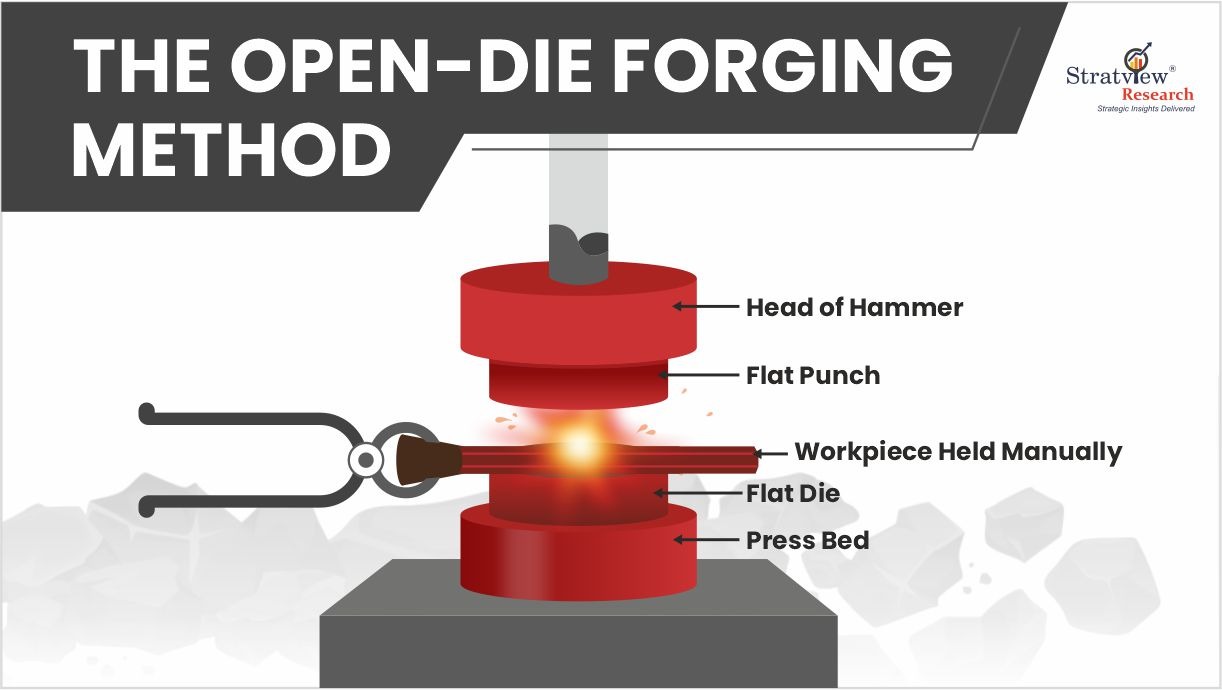
Fig 1. Open-die Forging Method Working
The process delivers high strength and durability through a relatively simple setup with low-cost dies, making it suitable for small production runs; however, it offers low production rates. The process is best suited for large-axisymmetric components such as discs, rings, sleeves, cylinders and shafts, step shafts, bars, beams, spindles, hubs, mandrels, metal shells, simple pancake forgings, and pierced blanks, etc., many of which are used in both airframe and engine structures.
Forging demand in aerospace is heavily skewed toward propulsion systems. The reason is material intensity and replacement frequency. A modern high-bypass turbofan engine contains multiple large forged rotating components operating in thermally aggressive zones. Shafts, compressor discs, turbine rings, etc., operate under extremely high temperatures, cyclic stress, and aggressive overhaul schedules and must maintain dimensional stability and fatigue resistance over tens of thousands of cycles.
Airframes experience structural loading, but typically at lower thermal extremes and longer service intervals compared to engines.
Engine shafts, disks, and rings demand:
- Directional grain flow for fatigue resistance
- Clean microstructure with minimal segregation
- Structural integrity across thick sections
Open-die forging serves these requirements by enabling controlled deformation, improved internal soundness, and optimized grain flow in large cross-sections.
As a result, engine component forgings represent the dominant share of value creation in the aerospace forging landscape. Stratview Research’s market estimates indicate that engine forgings were valued at ~USD 4.60 billion in 2025, more than three times the value attributed to airframe forgings.
The Preferred Metal for Extreme Engine Conditions
Open-die forging process uses a range of metals for aerospace sector – titanium for its high strength-to-weight ratio, stainless steel for corrosion resistance, alloy and carbon steels for strength and cost efficiency, aluminum for formability, and nickel alloys for high-temperature performance.
In practice, material selection is driven less by variety and more by operating conditions. Components exposed to extreme heat and sustained mechanical stress, particularly within engines, demand materials that can retain strength, resist creep, and maintain structural stability over long cycles. This is where nickel alloys stand apart. Their high flow stress makes them difficult to shape, but open-die forging accommodates this through repeated, controlled deformation, reducing the risk of cracking while preserving internal integrity. Nickel and nickel-based alloys dominate open-die forging in aerospace, accounting for more than half of total material usage.
In high-bypass turbofan engines developed by Rolls-Royce and Safran, these forgings operate in zones where thermal and mechanical loads leave no room for compromise. Safran recently has also signed a long-term contract with Hindustan Aeronautics Limited (HAL) for the supply of nickel-based forged parts for the LEAP engine, which powers the Airbus A320neo and Boeing 737 MAX.
Titanium follows as the next preferred material, valued for its high strength-to-weight ratio, particularly in sections, where reducing mass without sacrificing performance is essential.
Home to OEMs Accounting for the Bulk of Forging Demand
North America, a region where the scale and continuity of programs led by industry giants such as Boeing and Lockheed Martin, accounts for well over half of the global consumption of open-die forged parts.
The region also has the scale, continuity, and funding stability in its aerospace programs that keeps it ahead. Commercial backlogs and defense modernization cycles run in parallel, creating a demand environment where open-die forgings are not just preferred but indispensable.
Europe, while operating at a smaller scale, is advancing with clear industrial intent. With production anchored in France, Germany, Spain, and the United Kingdom, the region has built a disciplined and resilient supply chain that supports both civil and military aviation. Its growth is being driven less by volume expansion and more by strategic alignment, particularly around sustainability, material efficiency, and next-generation aircraft platforms. With close to USD 2 billion in consumption in 2025, Europe firmly holds its position as the second-largest market, and more importantly, signals a shift toward a more calibrated, long-term growth trajectory.
Are the Skies Truly Clear for Aircraft Open-Die Forging?
While forging remains indispensable to aerospace manufacturing, both closed-die and open-die methods account for the majority of aircraft forging applications; however, despite representing roughly one-fourth of the total aircraft forging market, open-die forging is unlikely to lose relevance, as its capabilities and benefits cannot be replicated by alternative processes.
Open Die Forging remains a tried-and-true method for producing high-strength metal parts in custom dimensions. This process offers a range of benefits that are essential for different applications in the aerospace sector. Versatility, high strength, and fast lead times are all among the key advantages of open die forging.
This forging method does not require the production of a complex die, reducing overall processing times. This helps reduce long-term costs for part replacement. Open die forging also produces less material waste than other forging methods.
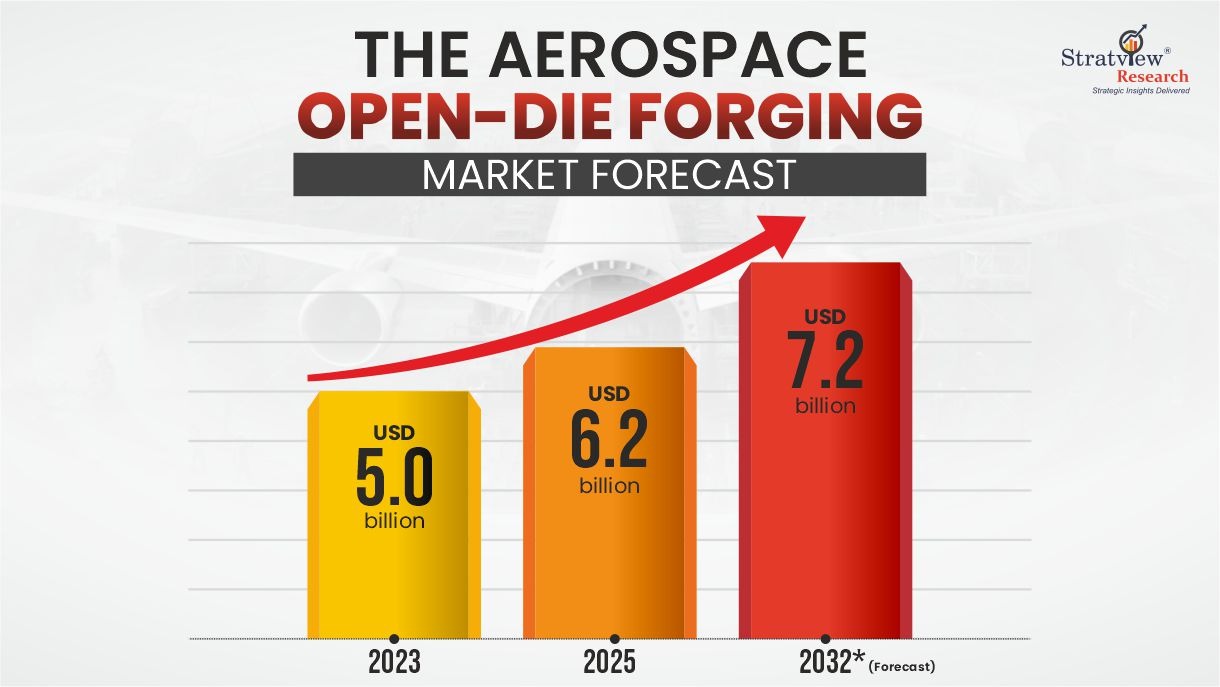
Fig 2. The Global Aerospace Open-Die Forging Market Forecast
The aerospace open-die forging market expanded from ~USD 5 billion to USD 6.2 billion within three years, reaching that level in 2025, and is projected to add close to USD 1 billion over the 2025 baseline by 2032 (to cross USD 7.2 billion), reinforcing its sustained strategic value within the aerospace supply chain.
As the aerospace sector evolves toward more fuel-efficient and compact designs, the demand for high-quality forgings continues to grow.
Trends point toward increased use of additive manufacturing combined with traditional forging to optimize part design and reduce lead times. However, challenges such as supply chain disruptions, rising raw material costs, etc., will persist. Companies that invest in advanced forging techniques, quality assurance, and sustainable practices will be best positioned to thrive in 2026 and beyond.
Subscribe to our newsletter
Related Articles:
Open-Die Forging at Center of Aerospace’s Production Push
Didn’t find what you were looking for?
Tell us about your requirements
(Our team usually responds within a few hours)