Extrusion has long been a foundational manufacturing process in aerospace. The process delivers continuous, high-strength profiles with tight tolerances, predictable mechanical behavior, and efficient material utilization – a few qualities that are indispensable in aircraft design. And for decades, aluminium has defined this space.
From seat tracks, floor support members to structural reinforcements and interface profiles, aluminium extrusion has anchored aircraft structural efficiency. While structural integrity remains non-negotiable, aircraft interiors also demand weight optimization, wear resistance, impact tolerance, flame-smoke-toxicity compliance, and increasingly, recyclability. This is where thermoplastic extrusion is gradually finding its footing.
Today, though aluminium continues to dominate aircraft extrusion overall, thermoplastics are steadily establishing their role within interior applications, particularly where equal functional strength, lower weight, and end-of-life recyclability align with OEM priorities.
Thermoplastics as a Weight-Efficiency Lever
Thermoplastics enter the extrusion conversation as a response to weight economics. They are inherently lighter than aluminium, and in aviation, weight is currency. Every kilogram removed from an aircraft translates into measurable operational gains. Industry analyses indicate that saving just one kilogram on an A320 operating roughly 2,800 flight hours annually, can result in nearly 100 kilograms of kerosene saved and ~350 kilograms of CO₂ emissions reduced per passenger per year. Multiplied across fleet operations, these margins become commercially huge.
Airlines have long understood this equation. Today, in an average aircraft, an estimated 700 to 900 kilograms of thermoplastic and elastomer extrusions are already deployed in seats, galleys & inserts, lavatories, stowages, floor panels, etc., reducing structural weight by 20% to 50%, supporting improved performance and operational efficiency.
Among these applications, floor panels stand out as a plastic material-intensive area. A significant portion, more than one-fifth of total aircraft interior extrusion plastics demand is concentrated in floor panel systems alone.
This is hardly surprising. Floor structures must withstand continuous passenger movement, service cart traffic, and dynamic load cycles, making them one of the most structurally demanding interior zones.
Choosing the Right Material for Structural Interior Components
Material selection in aircraft interior extrusion is all about performance alignment. Each material is evaluated against a strict checklist, flame, smoke and toxicity (FST) compliance, dimensional stability, impact resistance, fatigue behaviour, processing compatibility, and long-term durability under fluctuating cabin conditions.
A few common thermoplastic materials used in aerospace interior components include – Polyvinyl Chloride (PVC), Thermoplastic Polyurethane (TPU), Polycarbonate (PC), Polyetherimide (PEI), Polyethylene (HDPE & LDPE), Thermoplastic Vulcanisate (TPV), Polyamide (PA) / Nylon, etc. Each serves a defined purpose.
Extruded Thermoplastic Materials in different aircraft – (Source – Trellborg)
|
Thermoplastic polyurethane (TPU) |
Boeing BMS8-424, CDM005 |
Seat track covers, cable covers, panel edge trim |
|
Polycarbonate (PC) |
Boeing BMS8-251, CDM005 |
Lighting lenses, trim covers |
|
Polyamide (nylon) (PA) |
Boeing BMS8-270, Airbus AIMS04-01-004 |
Raceways, carpet thresholds, seat track covers |
|
Polyvinyl Chloride (PVC) |
Boeing BMS8-137, CDM005 |
Flooring transitions, trim buffers, interior seals |
However, when the discussion narrows specifically to aircraft interior extrusion profiles, two materials dominate: polyamide (PA) and polycarbonate (PC).
Polycarbonate offers excellent impact resistance and dimensional stability, making it suitable for protective trims and structural interfaces exposed to repeated mechanical stress.
Yet, in terms of overall volume consumption, polyamides – PA – has become the preferred choice for structurally engaged interior profiles, accounting for >60% of the aircraft interior extrusion plastics segment.
Polyamides are known for delivering a strong balance of stiffness, fatigue resistance, abrasion performance, and process reliability during extrusion. These materials also maintain mechanical integrity under cyclic loading, a critical factor in floor panels, support profiles, and reinforcement inserts subjected to constant passenger movement and service operations.
In short, while multiple polymers participate in aircraft interiors, polyamide has emerged as the structural workhorse of thermoplastic extrusion within this space.
Thermoplastics Vs Aluminum for Aircraft Interior Extrusion
Aircraft interiors may look aesthetic and seamless, but behind every panel, seat track, raceway, and sidewall profile lies a critical material decision. When it comes to extrusion-based components, the debate often narrows down to thermoplastics or aluminum. Both materials have carved a solid footprint in aerospace interiors and we know that aluminum still is the chosen material by aircraft manufacturers, but their performance economics, compliance profile, and processing behavior tell very different stories.
Let’s break it down.
1. Weight Performance:
In interior applications where structural loads are minimal, thermoplastics can deliver up to 50% weight reduction (depending on applications) compared to aluminum profiles of similar geometry. However, when load-bearing capacity is required, aluminum remains unmatched in stiffness and long-term dimensional stability.
|
Parameter |
Aluminum |
Thermoplastics |
|
Density |
~2.7 g/cm³ |
1.2–1.6 g/cm³ |
|
Weight Saving Potential |
Baseline |
30-50% lighter |
|
Structural Load Capacity |
High |
Moderate – Low |
Trade-off in simple terms: If stiffness dominates the requirement, aluminum wins. And if weight and design flexibility dominate, thermoplastics take the lead.
2. Processing & Manufacturing Economics
Aluminum extrusions require high-temperature billet heating (≈400–500°C), often need secondary machining and surface treatments, and typically involve longer die-adjustment lead times.
Whereas, billets for thermoplastic extrusions are generally not heated in the same manner as metal billets; instead, plastic raw material is heated via frictional shear and heater bands within the barrel, usually ranging from 150°C to 250°C depending on the specific plastic type. This enables near-net-shape designs with integrated features like snap-locks and cable channels, reducing part count, fasteners, assembly time, and overall lifecycle cost.
Apart from all the above, the interior materials must comply with strict aviation standards (FAR 25.853). Aluminum is inherently non-combustible. Thermoplastics must be engineered and certified for FST compliance, which increases raw material costs but enables wider interior applications.
Furthermore, aluminum requires coatings to prevent corrosion, especially in humid cabin environments. Whereas thermoplastics are inherently corrosion-resistant and immune to oxidation. Hence, in galleys and lavatory areas, etc., where moisture exposure is frequent, thermoplastics often outperform aluminum in durability.
In aircraft interiors, every gram, every fastening point, and every certification cycle counts. The winning strategy is not choosing one over the other, but it’s engineering both where they deliver maximum value.
The Flight Ahead with Lighter Cabins, Stronger Systems
With fuel costs representing the highest of all operating costs for aircraft, it's not surprising that the demand for lighter aircraft has risen with it. It is interesting to note that a few years ago researchers estimated that for each passenger to carry a cell phone, it cost Southwest Airlines and additional $1.2m annually in fuel costs. If the passengers each carried a laptop, then the cost jumped to $21.6m.
Thermoplastics, meets the challenge by being up to 50% lighter than equivalent aluminum part. This sharply lowers lifetime fuel costs, reduces emissions, and extends flight range. For all the above reasons combinedly, the market for aircraft interiors extrusion plastics is growing slowly but steadily.
As per market experts, the current industry direction suggests that aluminum will continue to dominate structural interior extrusion applications, but thermoplastics are gaining ground in aesthetic, functional, and semi-structural interior components.
The global market for aircraft interiors extrusion plastics that was valued at USD 109mn in 2024, is estimated to grow to reach USD 200mn in 10 years.
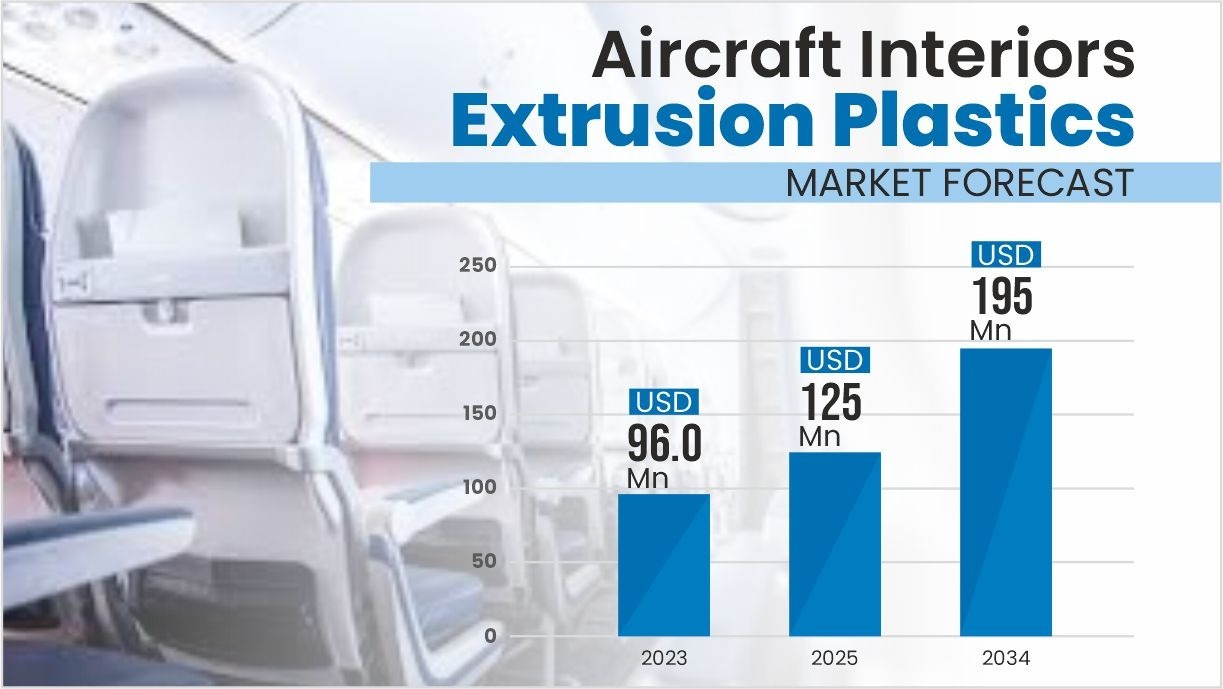
Aircraft Interiors Extrusion Plastics Market Forecast
By and large, the aircraft OEMs are not replacing one material with another for interiors entirely. Instead, they are optimizing material placement along functional load paths, engineering weight more precisely within the cabin.
Authored by Stratview Research. Also published on – Aluminium International Today