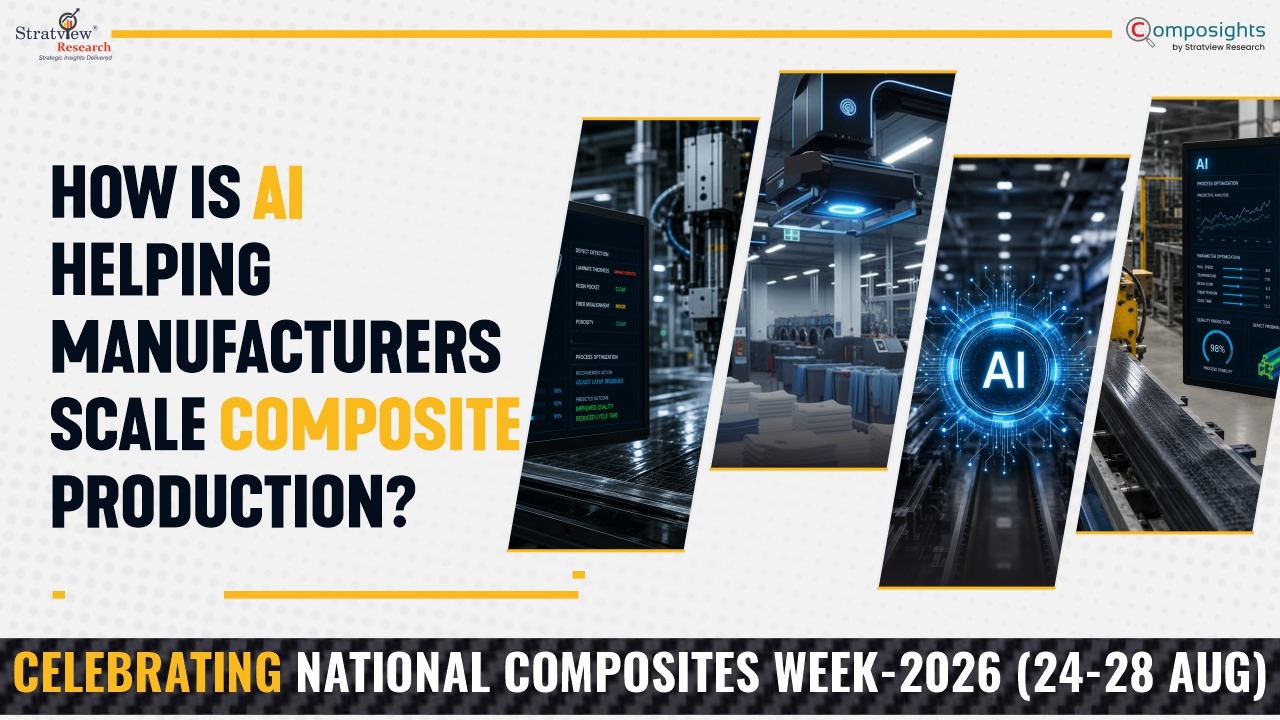
As composites move toward higher-volume production, AI and emerging technologies are beginning to help manufacturers plan smarter, detect issues earlier, optimize processes, and scale production more efficiently. Explore the real-world applications and numbers showing where AI is already making an impact.
Scaling composite manufacturing is not simply about making more parts, faster. It also means finding better ways to plan production, monitor processes, catch defects, use manufacturing data, and respond before small issues become costly delays.
That's where the story moves next. After exploring process innovations and the materials enabling faster processing, today our focus is on how AI and emerging technologies are helping manufacturers make composite production more efficient and scalable.
From AI-powered inspection and predictive maintenance to digital twins, process optimization, and intelligent manufacturing planning, these technologies are beginning to address some of the practical challenges that come with scaling composite production.
The adoption curve is still taking shape, but the early numbers are already interesting. Our latest thought leadership report identified AI use cases delivering more than 40% improvement in speed, highlighting the potential for measurable gains even in the early stages of adoption.
So, where is AI making the biggest impact today, and what could that mean for the future of composite manufacturing?
Where AI Is Gaining Traction in Composites
AI is being explored across multiple stages of the composite manufacturing workflow, from design and process planning to inspection, maintenance, and material tracking.
Our survey of more than 50 industry professionals provides a snapshot of where AI is expected to have the greatest utility during this early phase.
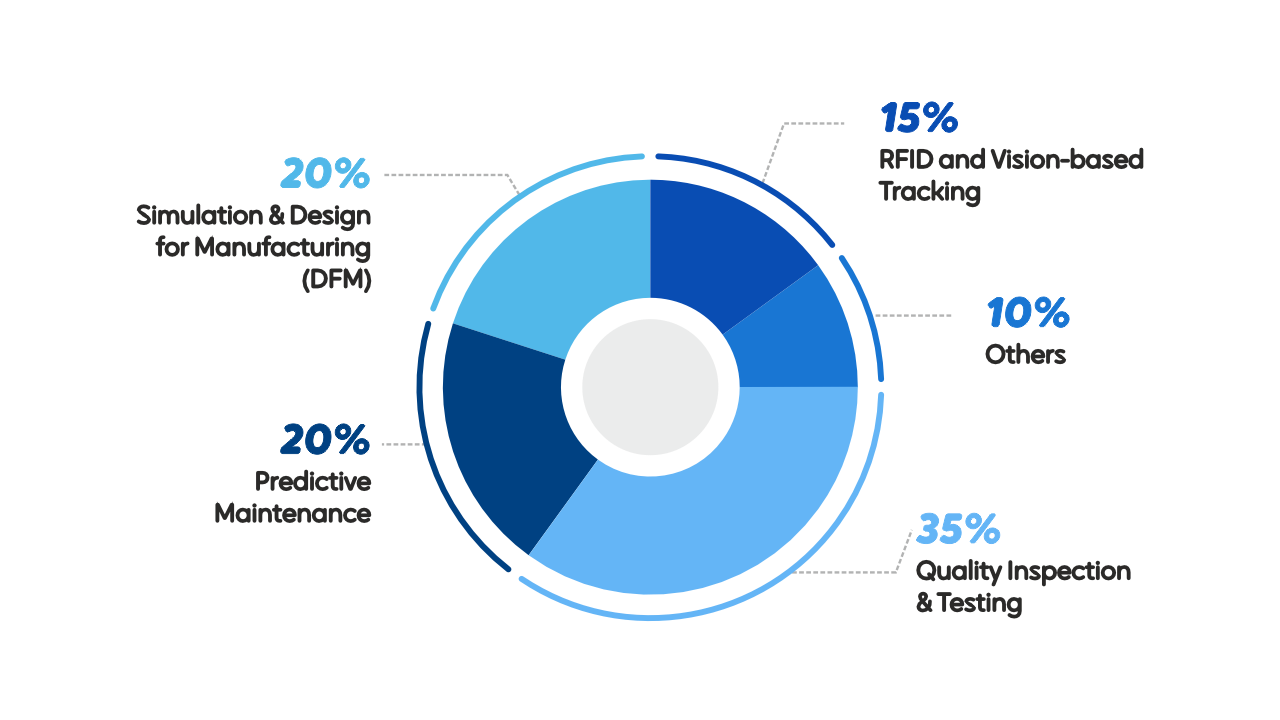
Applications where AI adoption will be Highest. Source: Composights Thought Leadership White Paper, “AI in Composites Manufacturing”
The findings point to a clear opportunity: AI is beginning to address some of the most data-intensive and time-sensitive activities in composite manufacturing. But the real story goes beyond industry expectations.
Manufacturers are already putting these technologies to work, and the results are beginning to show.
The Real-World Applications Where AI is Making a Difference
Some of the clearest examples come from manufacturers already using AI to tackle real production challenges.
8–9 Days Saved Per Part with AI: Magestic Technologies × Lockheed Martin
In aerospace composite manufacturing, even a single additional manufacturing step can add significant time to production. Magestic Technologies' AI-driven TruPly Comp software uses historical manufacturing data to identify laminate-thickness issues and optimize composite processing. The technology was tested across multiple F-35 part numbers, helping identify potential issues early enough to avoid an additional cure cycle.
The reported impact is significant, with 8–9 days potentially saved per part. Beyond the time savings, the application demonstrates how AI can support composite manufacturing without replacing the existing production process. Instead, it uses historical manufacturing data to help engineers identify potential problems earlier and make better process decisions.
75% Lower Setup Time with AI and Digital Twins: Fibclick
Pultrusion is already known for continuous, high-throughput composite production, but setting up a pultrusion process can still involve significant planning and trial-and-error. Fibclick combines AI and digital twin technology to simulate pultrusion setups and automate production planning, allowing manufacturers to evaluate configurations digitally before moving to physical production.
The approach has reportedly delivered a 75% reduction in setup time and up to 50% lower planning costs, while improving process stability and supporting more complex shapes. It shows how AI and digital twins can work together to reduce reliance on physical trials and accelerate tooling development and production planning.
AI-Powered Composite Inspection in Less Than 3 Seconds: Virtek Vision
Inspection is one of the most important, and potentially time-consuming, stages of composite manufacturing. Virtek Vision's IRIS™ combines AI-powered imaging with laser projection to support inspection during composite manufacturing. The system can identify issues such as foreign-object debris (FOD) and backing paper while providing feedback during the inspection process.
The system can generate inspection results in less than 3 seconds and supports the inspection of large and complex composite parts. It also provides real-time feedback and digital inspection traceability, helping move quality control closer to the production process rather than treating inspection as a completely separate downstream activity.
24% Faster Composite Inspection: Spirit AeroSystems and Research Partners
AI is also being explored to address one of the challenges of ultrasonic inspection: evaluating large volumes of inspection data efficiently. A team involving Spirit AeroSystems, Argonne National Laboratory, Northern Illinois University, and TRI Austin developed an AI-assisted anomaly-detection system for composite inspection. Instead of relying primarily on defective samples, which can be difficult to collect because defects are relatively rare, the system uses non-defective ultrasonic scans to identify anomalies that may require closer attention.
The approach delivered up to 24% faster ultrasonic inspection evaluation, along with an 8.8% reduction in inspection-related manufacturing flow time and approximately 3% energy savings per aircraft. The system was also tested across additional composite material systems and configurations, demonstrating how AI-assisted inspection can improve both inspection efficiency and overall composite manufacturing flow.
44% Faster Tool Manufacturing with Plyable and Syensqo
AI and digital technologies are not limited to the production of final composite components. They are also influencing the tooling and development stages. Plyable supported Syensqo's composite material development through rapid, high-precision hot-press tooling, bringing mold design and manufacturing together through its in-house capabilities and supplier network.
The approach reportedly delivered a 44% faster tool-manufacturing lead time, enabling faster material testing and iteration while maintaining the precision required for composite development. For composite developers, faster tooling can shorten the cycle between developing a material, producing a tool, testing the material, and moving toward the next iteration.
AI is Moving Toward the Mainstream, But How Far Can It Take Composites?
The composites industry is still in the early stages of its AI journey, but its potential is becoming increasingly clear. AI is already moving into practical manufacturing applications helping reduce inspection time, setup time, production delays, and process inefficiencies.
The bigger opportunity lies in connecting these applications. Imagine AI-assisted design feeding into process planning, digital twins reducing the need for physical trials, intelligent systems monitoring equipment, and computer vision identifying defects during production.
When these technologies work together, AI could become more than an individual manufacturing tool. It could become a layer connecting people, machines, materials, and manufacturing data across the production workflow.
For an industry looking to scale composite manufacturing while maintaining quality and consistency, that connection could be significant.
Now, the question is no longer simply whether AI has a place in composites. The question is how far the industry can take it.
Do follow our pages @Stratview Research and @Composights for regular interesting content on composites.
Wait for tomorrow to read our next piece in this National Composites Week series.
#NationalCompositesWeek #CompositesBuildToScale #Composites #CompositeManufacturing #AdvancedManufacturing
Subscribe to our newsletter
Related Articles:
.jpg)
How Material Innovations are Speeding Up Composites Manufacturing
Didn’t find what you were looking for?
Tell us about your requirements
(Our team usually responds within a few hours)