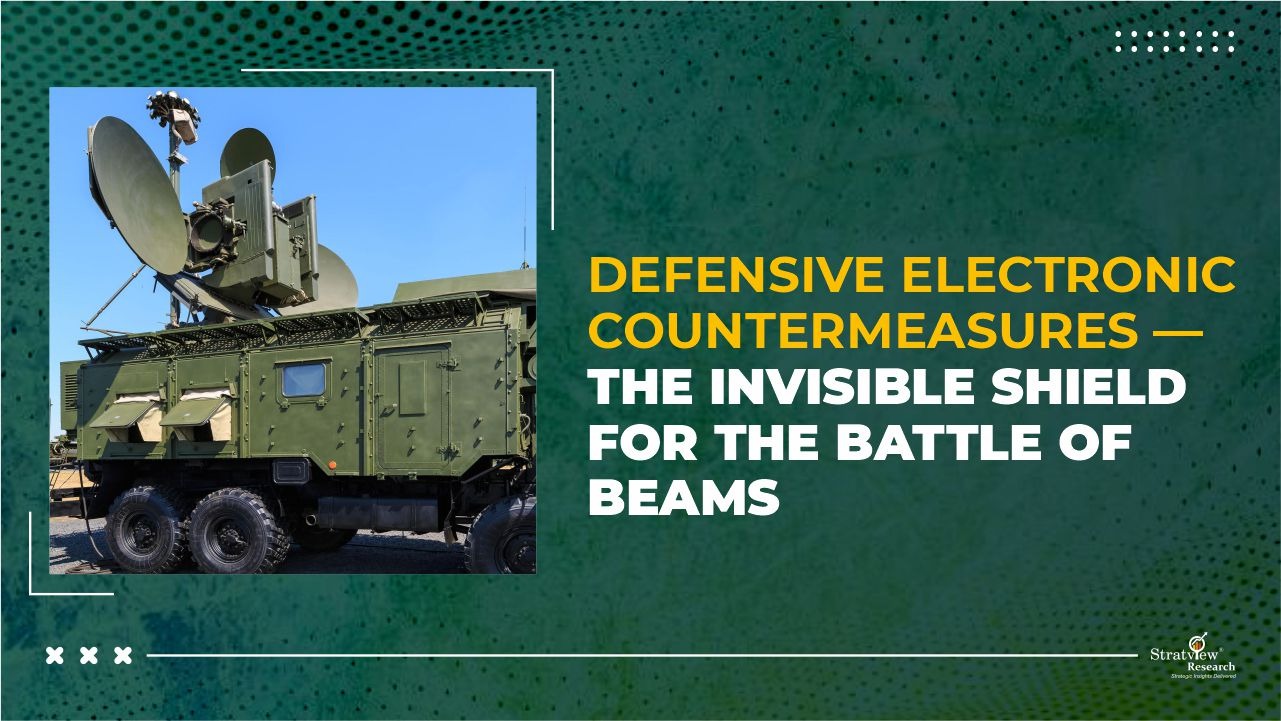
Defensive Electronic Countermeasures (DECMs) protect military assets across air, land, and sea from radar tracking, jamming, and missile threats. By disrupting and deceiving hostile systems while safeguarding vital communications and sensors, DECMs ensure mission continuity and strengthen electromagnetic spectrum dominance in modern warfare.
Warfare today, be it on the ground, in the air, or at sea has a lot more than what meets the eye. Today’s hidden battle of beams involves radars, transmitters, sensors, and communication devices, etc. Electronic Warfare (EW) is all about the undercover struggle that shapes the outcome of battles before they even begin.
Modern warfare relies heavily on Electronic Countermeasures (ECMs) for protection, deception, survivability, and more. ECMs aid in preventing or reducing the enemy’s use of the electromagnetic spectrum. ECMs can be used offensively or defensively to disrupt or deceive the enemy electronic systems.
The invisible shields that protect friendly equipment from being jammed/deceived/disrupted, without causing any direct destruction to the enemy are – the Defensive Electronic Countermeasures (DECMs). These systems safeguard communication, navigation, and combat effectiveness in the silent war of the electromagnetic spectrum.
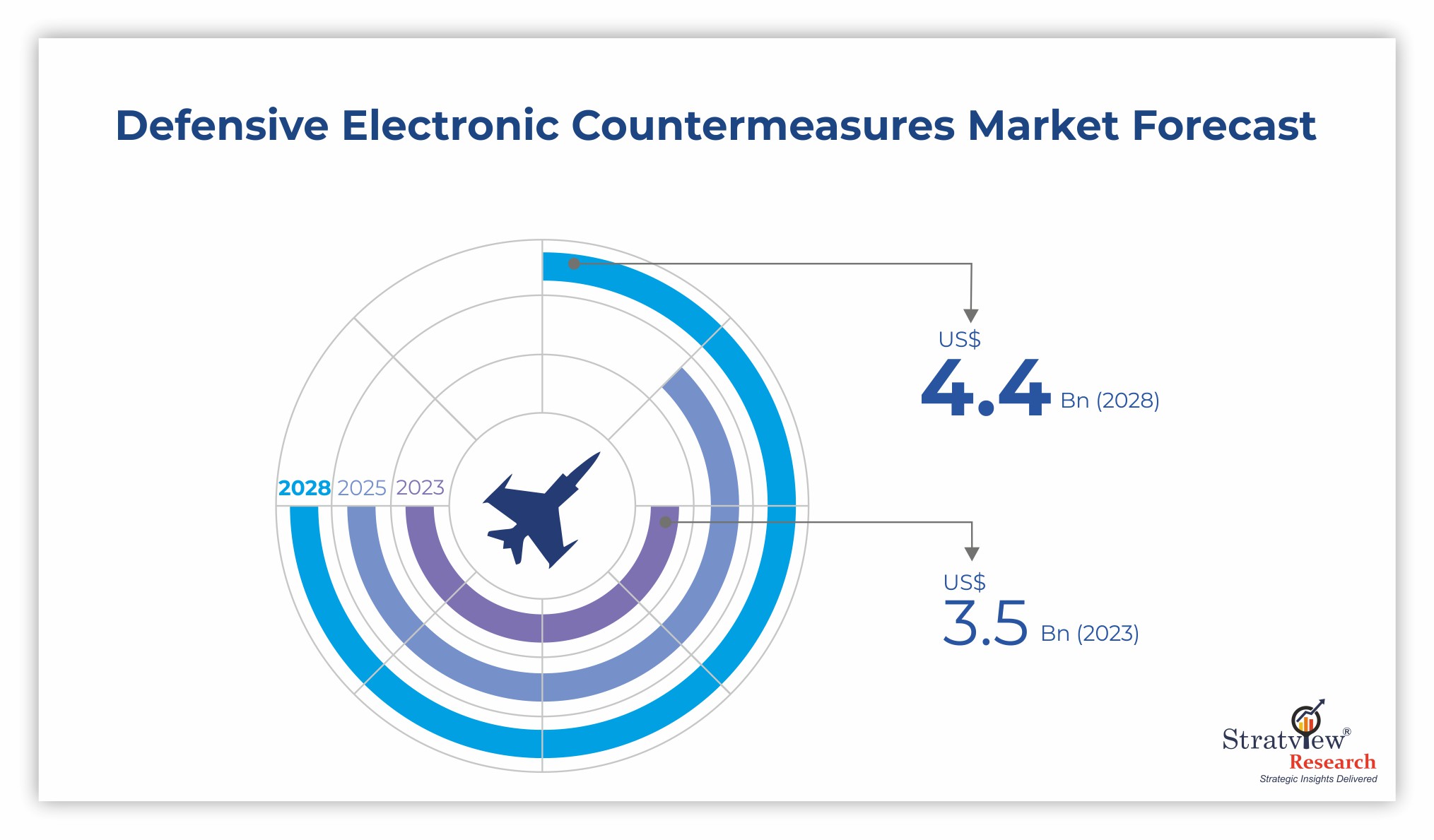
Fig 1. Defensive Electronic Countermeasures Market Forecast
DECMs – Crucial Part of Any Military Strategy
To simply classify, the field of EW is discussed in terms of –
Active roles involve impairing the enemy’s use of electronic system/equipment, misleading the enemy in the interpretation of data received from their electronic systems/devices.
and,
Passive roles include searching for electromagnetic radiation to determine the existence, source, and other characteristics of the enemy’s use of the electromagnetic spectrum.
DECMs typically encompass both passive and active techniques. They include physical barriers, jamming enemy signals, deploying laser-based countermeasures, or using decoys to mislead enemy sensors. DECMs guarantee uninterrupted communication for friendly forces.
Preventing mission-critical failures due to interception/hacking, diverting away enemy’s focus from the main target, and providing enhanced situational awareness, are a few advantages of DECMs that assure the operational integrity and effectiveness of any military force in modern warfare.
DECMs have been a crucial part of military strategy. The recent Russo-Ukraine war serves as a powerful example of their continued importance. On one side, where Ukraine was relying on drones for a number of distinct operations on the battlefield, the Russian military made good on its reputation as one of the world’s best at electronic warfare as the army used powerful jammers, and decoy missiles to overwhelm Ukrainian air defences. The Russian army used powerful EW systems including the R-330Zh Zhitel, the Shipovnik-Aero tactical jammer, etc. to jam Ukrainian radar signals and disrupt communications and control links between enemy drones.
Here is another example that highlights the importance of DECMs in military or defense strategies. BAE Systems, which secured a >USD 35.5 million contract (in 2019) from the U.S. Navy, stated that the project involved manufacturing a next-generation dual-band Fiber-Optic Towed Decoy (FOTD). These FOTDs were radio-frequency countermeasure systems and would interface with the onboard electronic warfare (EW) equipment, enhancing its effectiveness against current and upcoming threats.
Warships don’t waste time on maneuvers, and drone technologies today are hi-tech enough to disrupt the opposition army. To empower their war fighters to defend against modern threats, in December 2023, the US Navy awarded Raytheon Technologies (RTX) a contract worth $80m for developing a replacement to current integrated defensive electronic countermeasures and radar warning receivers. The proposed Advanced Electronic Warfare system (ADVEW) is designed to improvise the existing EW components by reducing the present parts and adding an open architecture as defined by the government to improve safety and enhance Navy carrier wing electronic warfare capabilities.
Air Domain Takes the Lead in Global DECMs Market
In order to maintain supremacy in warfare, certain nations and military powers are actively investing in enhancing their ECM capabilities for all platforms (Air, Land, and Naval domain). The air domain is heavily contested, and with the growing number of aircraft vying for airspace, the likelihood of air-to-air combat has increased significantly.
The air domain plays a crucial role in modern warfare, where fighter jets, and unmanned aerial vehicles (UAVs), etc., rely heavily on uninterrupted communication, navigation, and sensor data. DECM applications in the air domain encompass jamming enemy radars and communication systems, deploying decoys to mislead missiles, and spoofing signals for tactical advantage, and more. Air platforms, hence, dominate the DECMs market with a share exceeding 65%, according to Stratview Research’s report on the global Defensive Electronic Countermeasures.
For today’s battlefields, militaries are investing in pairing their combat aircraft with electronic warfare (both offensive as well as defensive countermeasures) to gain air superiority.
Lockheed Martin awarded a $493 million contract to BAE Systems (in December 2021) to upgrade and modernize the Electronic Warfare (EW) system for the F-35 Lightning II. This upgrade enables the fighter to quickly detect and address evolving electromagnetic threats in contested battlespaces. The upgraded system will improve superior situational awareness and electromagnetic attack and countermeasure capabilities with new sensors and powerful signal processing.
As the skies become a more contested battlefield, the demand for these defensive electronic countermeasures continues to soar. Military giants based in North America, like - L3Harris Technologies, Inc., Raytheon Technologies Corporation, Northrop Grumman Corporation, Lockheed Martin Corporation, and more, have significantly contributed to the manufacturing of various DECMs, not just for military applications, but also for civilian use too, thus solidifying the region's leadership in the DECMs’ domain.
North America holds more than 35% of the global DECMs market and is expected to dominate in the coming years too, owing to the strong military base, and substantial research and development initiates.
Spectrum-Wide Supremacy Drives Bright Prospects for DECMs
The global unrest between countries has already driven major economies and developing countries to increase their defense spending to the point where last year; 2023 marked the highest-ever global military spending of ~ $2.2 trillion.
Not just this, but big economies are also investing in military modernising programs and allotting a good amount in research and development of military capabilities. The US, being the world's largest defense spender, is itself a leading exemplar of this trend.
In the recently proposed government budget ($7.3 trillion) for the 2025 fiscal year, the US has once again broken its records by allotting nearly $900 billion for defense spending, out of which, a portion of this hefty budget undoubtedly goes towards legitimate defense needs to support the US military interventions, and development of new weapons, emerging military technologies, modernizing and upgrading military capabilities, and more.
Defensive electronic countermeasures (DECM) are no longer optional extras, but essential tools for safeguarding nations. Looking into the crystal ball for a moment, on the defense side, the transition from traditional to digital warfare is a complex and ongoing challenge.
Wars will be fought and won on the ability to collect, analyze, and leverage vast amounts of data, as well as control and exploit the electromagnetic spectrum. On the defense front, advanced DECM systems will be able to read, identify, and alert friendly systems thus presenting counter-suggestions accordingly. Emerging needs for modern electronic warfare solutions are burgeoning in order to achieve spectrum-wide supremacy, and with this, the need for DECMs also escalates in tandem.
The world is currently witnessing a rapidly evolving scenario marked by the emergence of new arms races and technological advancements, that are transforming the global security landscape. Technological advancements towards more advanced products, improved dispensing mechanisms, increasing integration of expendable countermeasures across various platforms, including unmanned aerial, ground, and naval systems, etc. are all likely to impact the future of defence strategies across the globe.
Subscribe to our newsletter
Related Articles:
Space Electronics and Their Evolving Trends
Didn’t find what you were looking for?
Tell us about your requirements
(Our team usually responds within a few hours)