




404
+1-313-307-4176

Engineering Plastics Market Analysis | 2025-2032

Engineering Plastics Market Size, Share, Trends, Dynamics, Forecast, & Growth Analysis: 2025-2032
Engineering Plastics Market is segmented by Product Type (Acrylonitrile Butadiene Styrene, Polyamide, Polycarbonate, Thermoplastic Polyesters, Polyacetals, Fluoropolymers, PEEK, Polyphenylene Sulfide, Polyphenylene Oxide, PMMA, and Others), by End-Use Industry Type (Automotive & Transportation, Electrical & Electronics, Industrial & Machinery, Packaging, Consumer Appliances, Medical, and Others), and by Region (North America [The USA, Canada, and Mexico], Europe [Germany, France, The UK, Russia, and Rest of Europe], Asia-Pacific [China, Japan, India, and Rest of Asia-Pacific], and Rest of the World [Brazil, Saudi Arabia, and Others]).
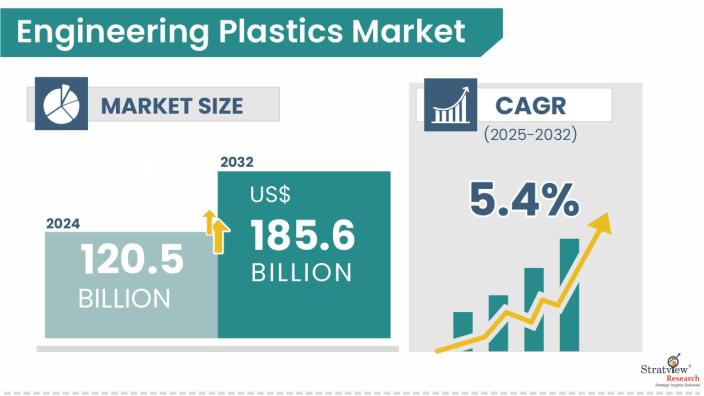
The engineering plastics market was estimated at USD 120.5 billion in 2024 and is likely to grow at a CAGR of 5.4% during 2025-2032 to reach USD 185.6 billion in 2032.
Want to get a free sample? Register Here
Engineering plastics are specifically designed to possess superior mechanical and thermal performances as compared to conventional plastics. These materials are used where components need better strength, wear, heat resistance, and chemical and corrosion resistance. Some of the kinds of engineering plastic are listed as follows, namely, polycarbonate, nylon, acrylonitrile butadiene styrene (ABS), and polyoxymethylene (POM).
Automotive, aerospace, and electronics industries are widely used for manufacturing parts such as gears, bearings, housing connectors, and so on. Engineering plastics on the other hand, can perform better under conditions of higher stress and temperatures, unlike conventional plastics. Due to their flexibility and resistant characteristics, they play various crucial roles in the contemporary production and construction industries.
The engineering plastics market is witnessing steady growth, driven by increasing electric vehicle production, expanding electronics manufacturing, and rising demand for lightweight, high-performance materials across industries. Engineering plastics are replacing traditional materials such as metals due to their superior strength-to-weight ratio, durability, chemical resistance, and design flexibility. A key trend shaping the market is the growing focus on sustainable polymer solutions, including advanced recycling technologies and bio-based engineering plastics, to support circular economy objectives.
Rising EV Production and Vehicle Lightweighting is Driving Market Growth
Rising electric vehicle production and vehicle lightweighting are driving the growth of the engineering plastics market. Automakers are increasingly replacing metal components with engineering plastics in battery housings, connectors, interiors, and structural applications due to their lightweight properties, durability, and thermal performance.
Growth in Electronics and Electrical Manufacturing is Expanding Market Share
The growth in electronics and electrical manufacturing is expanding the market share of the engineering plastics market. Materials such as ABS, polycarbonate, and PBT are widely used in connectors, electrical enclosures, smartphones, and consumer electronics due to their electrical insulation, durability, and heat resistance.
Industrial Automation and Infrastructure Expansion is Driving Market Demand
Industrial automation and infrastructure expansion are driving demand in the engineering plastics market. Engineering plastics are increasingly replacing metals in industrial machinery, construction components, piping systems, and electrical infrastructure due to their durability, corrosion resistance, and lightweight characteristics.
Limited Recycling and Circularity Challenges Market Growth
Limited recycling and circularity are challenging the growth of the engineering plastics market. Complex polymer structures, reinforced grades, and additives make recycling technically difficult and increase processing costs compared with conventional plastics.
High Raw Material and Processing Costs Restrain Market Demand
High raw material and processing costs are restraining demand in the engineering plastics market. Specialized resins, additives, and advanced manufacturing processes increase production expenses compared with commodity plastics, limiting adoption in cost-sensitive applications.
Regulatory Pressure on Plastic Waste and Emissions Challenges Market Growth
Increasing regulatory pressure on plastic waste management and emissions is challenging the growth of the engineering plastics market. Governments are introducing stricter recycling targets, sustainability requirements, and carbon reduction measures, increasing compliance costs for manufacturers.
Advanced Recycling Technologies Strengthen Market Forecast
The development of advanced and chemical recycling technologies is strengthening the market forecast for the engineering plastics market. New recycling methods are enabling the recovery of complex engineering plastics that are unsuitable for conventional mechanical recycling, supporting circular economy initiatives.
Expansion of EV Battery and Charging Infrastructure Creates New Market Opportunities
The expansion of EV battery and charging infrastructure is creating new opportunities in the engineering plastics market. Increasing adoption of engineering plastics in battery modules, charging systems, power electronics, and thermal management components is creating demand for high-performance polymers.
Sustainable and Bio-Based Engineering Plastics Emerge as a Key Market Trend
The development of sustainable and bio-based engineering plastics is emerging as a key trend in the engineering plastics market. Manufacturers are investing in bio-based polyamides, recycled-content polymers, and low-carbon materials to meet sustainability targets across automotive, electronics, and consumer goods industries.
|
Segmentations |
List of Sub-Segments |
Segments with High Growth Opportunity |
|
Product Analysis |
Acrylonitrile Butadiene Styrene, Polyamide, Polycarbonate, Thermoplastic Polyesters, Polyacetals, Fluoropolymers, PEEK, Polyphenylene Sulfide, Polyphenylene Oxide, PMMA, and Others |
The thermoplastic polyesters segment dominates the market during the forecast period. |
|
End-Use Industry Type Analysis |
Automotive & Transportation, Electrical & Electronics, Industrial & Machinery, Packaging, Consumer Appliances, Medical, and Others |
The automotive & transportation segment dominates the market during the forecast period. |
|
Regional Analysis |
North America, Europe, Asia-Pacific, and Rest of the World |
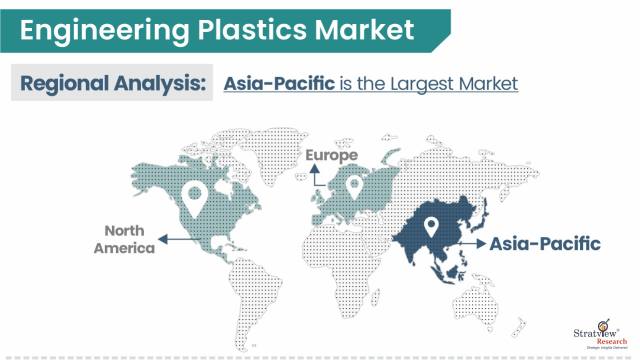
Asia-Pacific is estimated to be the largest market during the forecast period. |
“The thermoplastic polyesters segment dominates the market.”
The engineering plastics market is segmented as acrylonitrile butadiene styrene, polyamide, polycarbonate, thermoplastic polyesters, polyacetals, fluoropolymers, peek, polyphenylene sulfide, polyphenylene oxide, PMMA, and others. The thermoplastic polyesters segment held the largest share of the market.
On the other hand, the polyacetal segment is expected to register the fastest growth during the forecast period. Thermoplastic polyesters are the most widely used engineering plastics across the world and their popularity is mainly due to their high strength-to-weight ratio, lightweight, excellent chemical resistance, and easy recyclability properties.
“The automotive & transportation segment dominates the market.”
The market is segmented into automotive & transportation, electrical & electronics, industrial & machinery, packaging, consumer appliances, medical, and others. The automotive & transportation segment dominates the market, owing to the increasing usage of lightweight materials to address the industry challenges of increasing carbon emissions and increasing fuel efficiency. Automotive interior, exterior, hood, and powertrain are some of the major applications of the automotive & transportation segment.
“Asia-Pacific is the largest market during the forecast period.”
China, Japan, and India are the major countries with lucrative growth opportunities. The growth of the region’s market is mainly driven by increasing urbanization, and the substitution of many metals for suitable engineering plastics in various industries, such as packaging and automotive. Increasing automotive production in the region is one of the major factors driving the growth of the region’s market. The abundant availability of raw materials in the region is a core factor that is propelling the growth of the market.
Want to get a free sample? Register Here
The market is highly populated with the presence of several local, regional, and global players. Most of the major players compete in some of the governing factors including price, product offerings, regional presence, etc.
The following are the key players in the engineering plastics market (arranged alphabetically).
Note: The above list does not necessarily include all the top players in the market.
Are you the leading player in this market? We would love to include your name. Write to us at [email protected]
Mergers & Acquisitions
In May 2026, DOMO Chemicals announced an agreement for an affiliate of Lone Star Fund XII to acquire its Engineered Materials business. The transaction includes manufacturing facilities in Premnitz (Germany), Arco (Italy), and Gorzów (Poland), strengthening private equity investment in the engineering plastics sector. Financial terms were not disclosed.
In December 2025, XRG, the international investment arm of ADNOC, completed its acquisition of Covestro. The transaction, originally valued at approximately €14.7 billion, resulted in XRG directly and indirectly controlling approximately 95.1% of Covestro, including its global engineering plastics business.
In July 2025, BASF completed the acquisition of DOMO Chemicals' 49% stake in the Alsachimie joint venture, becoming the sole owner of the production facility in Chalampé, France. The acquisition strengthens BASF's integration across the European polyamide 6.6 value chain. Financial terms were not disclosed.
Recent Developments
In June 2026, SABIC launched LNP™ ELCRIN™ DC0051RC1, a polycarbonate engineering plastic compound containing 75% post-consumer recycled (PCR) material. The material is designed to deliver high mechanical performance while supporting sustainability goals in electronics and durable goods.
In November 2025, Syensqo reported mixed demand across its Specialty Polymers portfolio. While overall volumes declined 2% year over year, volumes excluding electronics increased 4%, driven by double-digit growth in the automotive and healthcare sectors.
In July 2025, SABIC introduced LNP™ THERMOTUF™ WF0087N, its first flame-retardant PBT-based nano-molding compound, enabling strong metal bonding, high impact resistance, and improved durability for compact consumer electronic devices.
This report provides market intelligence in the most comprehensive way. The report structure has been kept such that it offers maximum business value. It provides critical insights into market dynamics and will enable strategic decision-making for existing market players as well as those willing to enter the market. The following are the key features of the report:
This report studies the market, covering a period of 12 years of trends and forecasts. The report provides detailed insights into the market dynamics to enable informed business decision-making and growth strategy formulation based on the opportunities present in the market.
The engineering plastics market is segmented into the following categories:
By Product Type
By End-Use Industry Type
By Region
This strategic assessment report, from Stratview Research, provides a comprehensive analysis that reflects today’s engineering plastics market realities and future market possibilities for the forecast period of 2025 to 2032. After a continuous interest in our engineering plastics market report from the industry stakeholders, we have tried to further accentuate our research scope to the engineering plastics market to provide the most crystal-clear picture of the market. The report segments and analyses the market in the most detailed manner to provide a panoramic view of the market. The vital data/information provided in the report can play a crucial role for the market participants as well as investors in the identification of the low-hanging fruits available in the market as well as in the formulation of the growth strategies to expedite their growth process.
This report offers high-quality insights and is the outcome of a detailed research methodology comprising extensive secondary research, rigorous primary interviews with industry stakeholders, and validation and triangulation with Stratview Research’s internal database and statistical tools. More than 1000 authenticated secondary sources, such as company annual reports, fact books, press releases, journals, investor presentations, white papers, patents, and articles, have been leveraged to gather the data. We conducted more than 15 detailed primary interviews with the market players across the value chain in all four regions and industry experts to obtain both qualitative and quantitative insights.
With this detailed report, Stratview Research offers one of the following free customization options to our respectable clients:
Company Profiling
Competitive Benchmarking
Custom Research: Stratview Research offers custom research services across sectors. In case of any custom research requirement related to market assessment, competitive benchmarking, sourcing and procurement, target screening, and others, please send your inquiry to [email protected].
The report is delivered digitally through our online portal. Buyers receive login credentials from our team to access the report and may update their credentials at any time after the initial login.
Delivery timelines depend on the status of the report:
For the most accurate delivery timeline, please contact us to confirm the current status of the report.
Yes. You may request a complimentary preview of the report through a video conference with our team.
Yes. The scope of the report can be fully customized to align with your specific research objectives and information requirements.
Please contact us at [email protected], and our team will be happy to discuss your requirements and propose a tailored solution.
Yes. Selected sections of the report can be purchased separately based on your requirements. Please contact us at [email protected] to discuss your needs.
Yes, AI can help gather publicly available information, but its outputs are only as reliable as the data it accesses. Stratview Research reports are built using validated data, extensive primary interviews with industry stakeholders, and the expertise of our experienced research team.
Additionally, many critical insights, including market dynamics, competitive intelligence, and industry-specific trends, are not publicly available and therefore cannot be captured through AI alone.
Engineering plastics are specifically designed to possess superior mechanical and thermal performances as compared to conventional plastics. These materials are used where components need better strength, wear, and heat resistance, chemical and corrosion resistance. Some of the kinds of engineering plastic are listed as follows namely, polycarbonate, nylon, acrylonitrile butadiene styrene (ABS), and polyoxymethylene (POM). Automotive, aerospace, and electronics industries are widely used for manufacturing parts such as gears, bearings, housing connectors, and so on. Engineering plastics on the other hand can perform better under conditions of higher stress and temperatures, unlike conventional plastics.
The engineering plastics market was estimated at USD 120.5 billion in 2024.
The forecasted value of the engineering plastics market is expected to be USD 185.6 billion in 2032.
The engineering plastics market is likely to grow at a CAGR of 5.4% during 2025-2032.
BASF SE, Covestro AG, Solvay SA, Celanese Corporation, DuPont de Nemours, Inc., LG Chem Ltd., SABIC, Evonik Industries AG, Lanxess AG, and Mitsubishi Engineering Plastics Corporation are among the key players in the market.
Asia-Pacific is expected to remain the largest market during the next five years.
The automotive & transportation segment dominates the market.
The thermoplastic polyesters segment held the largest share of the market.


WE ACCEPT