




404
+1-313-307-4176

Oil & Gas Sensors Market Analysis & Forecast | 2023-2028
Oil & Gas Sensors Market Size, Share, Forecast, Industry, and Growth Analysis (2023-2028)
Oil and Gas Sensors Market is segmented by Product Type (Pressure Sensor, Temperature Sensor, Level Sensor, Flow Sensor, and Others), by Connectivity Type (Wired, Wireless), by Application Type (Remote Monitoring, Condition Monitoring & Maintenance, and Analysis and simulation), by Sector Type (Upstream, Midstream, and Downstream), and by Region (North America, Europe, Asia-Pacific, and Rest of the World).
The Global Oil & Gas Sensors Market is expected to grow from USD 7.08 Billion in 2022 to USD 9.45 Billion by 2028 at a healthy CAGR of 4.93% during the forecast period of 2023-2028.
_47787.jpg)
Wish to Get a Free Sample? Register Here.
What are Oil & Gas Sensors?
Sensors have wide applications in oil & gas processing and production. These sensors can withstand the world’s most challenging environmental conditions, both offshore and land, while providing precise and reliable performance. This report includes the market for all the sensors used in oil and gas production and processing.
|
Global Oil & Gas Sensors Market Report Highlights |
|
|
Market Size in 2022 |
US$ 7.08 Billion |
|
Market Size in 2028 |
US$ 9.45 Billion |
|
Market Growth by 2023-2028 |
CAGR of 4.93% |
|
Base Year of Study |
2022 |
|
Trend Period |
2017-2021 |
|
Forecast Period |
2023-2028 |
|
Dominant Region |
Asia-Pacific is estimated to be the largest oil & gas sensors market during the forecast period. |
The utilization of advanced sensor technologies can provide several benefits to the Oil and Gas industries. Several reasons drive the global market for oil and gas sensors. A few of them are –

Want to have a closer look at this report. Register Here.
Some of the major players in the global market are-
The oil & gas sensors market is segmented into pressure sensors, temperature sensors, level sensors, flow sensors, and others.
Pressure sensor is expected to be the largest segment, during the forecast period, owing to the increased focus on augmenting production from oil & gas wells and improved economic conditions and operational benefits provided by technology.
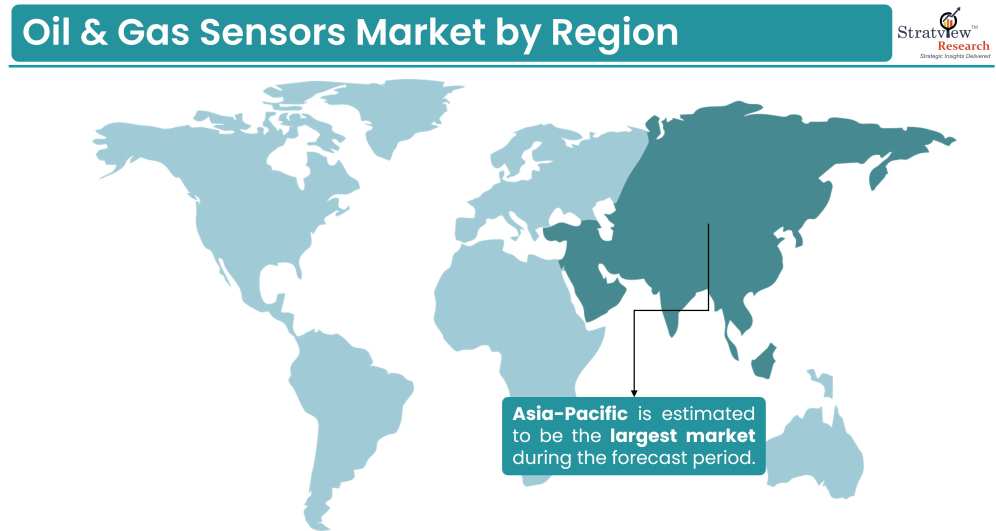
Asia-Pacific is estimated to be the largest oil & gas sensors market during the forecast period. Increasing adoption of industrial automation in emerging economies such as India and China is likely to drive the oil & gas sensors market in the region. China and India are the growth engines of the region.
To know which region offers the best growth opportunities, Click Here.
Critical Questions Answered in the Report
This report studies the market covering 12 years of trend and forecast. The report provides detailed insights into the market dynamics to enable informed business decision-making and growth strategy formulation based on the opportunities present in the market.
The market is segmented into the following categories:
By Product Type
By Application Type
By Connectivity Type
By Sector Type
By Region
This report offers high-quality insights and is the outcome of a detailed research methodology comprising extensive secondary research, rigorous primary interviews with industry stakeholders, and validation and triangulation with Stratview Research’s internal database and statistical tools.
More than 1,000 authenticated secondary sources, such as company annual reports, fact books, press releases, journals, investor presentations, white papers, patents, and articles, have been leveraged to gather the data.
We conducted more than 15 detailed primary interviews with the market players across the value chain in all four regions and industry experts to obtain both qualitative and quantitative insights.
This report provides market intelligence most comprehensively. The report structure has been kept such that it offers maximum business value. It provides critical insights into the market dynamics and will enable strategic decision-making for the existing market players as well as those willing to enter the market.
What Deliverables Will You Get in this Report?
|
Key questions this report answers |
Relevant contents in the report |
|
How big is the sales opportunity? |
In-depth analysis of the oil & gas sensors market. |
|
How lucrative is the future? |
The market forecast and trend data and emerging trends. |
|
Which regions offer the best sales opportunities? |
Global, regional, and country-level historical data and forecasts. |
|
Which are the most attractive market segments? |
Market Segment Analysis and Forecast. |
|
What are the top players and their market positioning? |
Competitive landscape analysis, Market share analysis. |
|
How complex is the business environment? |
Porter’s five forces analysis, PEST analysis, and Life cycle analysis. |
|
What are the factors affecting the market? |
Drivers & challenges. |
|
Will I get the information on my specific requirements? |
10% free customization. |
The following is a list of the customers that the market aims to convert the most:
Stratview Research offers one of the following free customization options to our respectable clients:
Company Profiling
Competitive Benchmarking
Custom Research:
Stratview Research offers custom research services across sectors. In case of any custom research requirement related to market assessment, competitive benchmarking, sourcing and procurement, target screening, and others, please send your inquiry to [email protected].
The report is delivered digitally through our online portal. Buyers receive login credentials from our team to access the report and may update their credentials at any time after the initial login.
Delivery timelines depend on the status of the report:
For the most accurate delivery timeline, please contact us to confirm the current status of the report.
Yes. You may request a complimentary preview of the report through a video conference with our team.
Yes. The scope of the report can be fully customized to align with your specific research objectives and information requirements.
Please contact us at [email protected], and our team will be happy to discuss your requirements and propose a tailored solution.
Yes. Selected sections of the report can be purchased separately based on your requirements. Please contact us at [email protected] to discuss your needs.
Yes, AI can help gather publicly available information, but its outputs are only as reliable as the data it accesses. Stratview Research reports are built using validated data, extensive primary interviews with industry stakeholders, and the expertise of our experienced research team.
Additionally, many critical insights, including market dynamics, competitive intelligence, and industry-specific trends, are not publicly available and therefore cannot be captured through AI alone.
Sensors have wide applications in oil & gas processing and production. These sensors can withstand the world’s most challenging environmental conditions, both offshore and land, while providing precise and reliable performance. This report includes the market for all the sensors used in oil and gas production and processing.
The oil & gas sensors market is expected to grow from USD 7.08 Bn in 2022 to USD 9.45 Bn by 2028.
The oil and gas sensors market is expected to grow at a CAGR of 4.93 % during the forecast period.
Some of the major players in the market are- Honeywell International Inc., Siemens AG, ABB Ltd, Rockwell Automation Inc, GE Sensing & Inspection Technologies GmbH, Indutrade, MTS Sensor Technology GmbH & Co. Kg, BD Technologies, Bosch, and TE Connectivity.
Asia-Pacific is estimated to be the largest oil & gas sensors market during the forecast period.
The utilization of advanced sensor technologies can provide several benefits to the Oil and Gas industries. Several reasons drive the global market for oil and gas sensors. A few of them are – 1. Reliable operational efficiency: Oil and gas companies are looking to optimize their operational efficiency by reducing costs, maximizing outputs, and in many other ways. Control and monitoring boost efficiency, decrease operational costs and increase profitability. Oil and gas sensors play a vital role in these operations saving a lot, due to which, industries opt for these sensors. 2. Early detection of potential hazards: The oil and gas industry involves hazardous environments and complex processes. Oil and gas sensors allow early detection of any possible leaks, pressure fluctuation, structural integrity, etc. allowing companies to take prior and proper actions to mitigate risks. 3. Growing Regulatory Compliance: Stringent environment regulations and safety standards in the oil and gas industry demand real-time monitoring and reporting of any leaks, emissions, etc. Oil and gas sensors are used to collect data-driven insights and help companies avoid any damage. 4. Growing adoption of automation in the industries: The oil and gas industry is growing rapidly with the increasing demand. The global oil demand will rise by 6% between 2022 and 2028 to reach 105.7 million barrels per day (mb/d) – according to the International Energy Agency (IEA). Industries are increasingly adopting automation that will help meet these needs with high precision and speed. Hence, the use of sensors to monitor and control the operations of automated systems, such as pipelines and drilling rigs is also growing.


WE ACCEPT